Many English learners mix up correlative conjunction and coordinating conjunction because both connect words or ideas. But they do not work the same way.
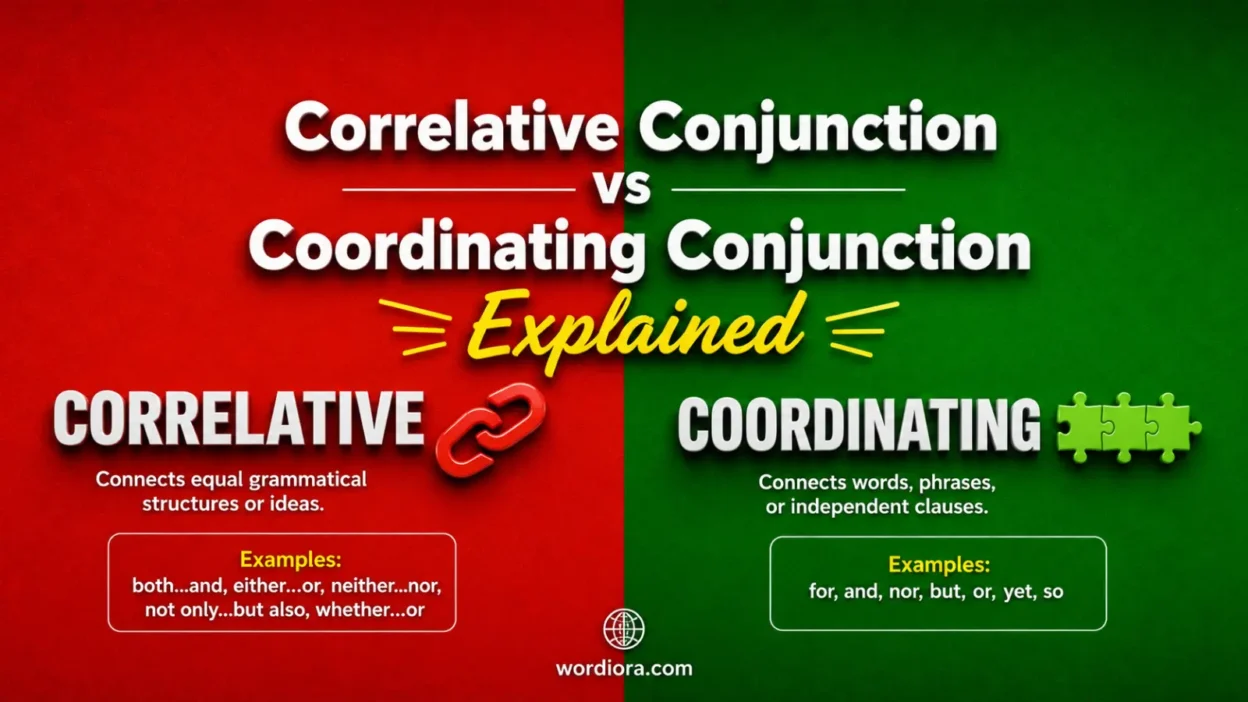
A coordinating conjunction joins equal sentence parts with a single word like “and” or “but.” A correlative conjunction works in pairs, such as “either…or” or “not only…but also.”
Understanding the difference helps your writing sound clearer and more natural in everyday American English.
Quick Answer
A coordinating conjunction uses one joining word:
- “I wanted coffee, but the shop was closed.”
A correlative conjunction uses two matching words:
- “Either we leave now or we miss the movie.”
The main difference is structure:
- Coordinating conjunction = one connector
- Correlative conjunction = paired connector
Why People Confuse Them
People confuse these terms because both are conjunctions. They both connect ideas, phrases, or clauses.
Some sentences can even look similar:
- “She likes pizza and tacos.”
- “She likes both pizza and tacos.”
The first uses a coordinating conjunction.
The second uses a correlative conjunction.
Another reason for confusion is that grammar classes often teach all conjunctions together without clearly separating how they function.
Key Differences At A Glance
| Context | Best Choice | Why |
|---|---|---|
| Joining equal words simply | Coordinating conjunction | Uses one connector like “and” or “but” |
| Showing two linked choices | Correlative conjunction | Uses paired words like “either…or” |
| Adding contrast | Coordinating conjunction | “But” creates direct contrast naturally |
| Creating emphasis | Correlative conjunction | Pairs like “not only…but also” add emphasis |
| Writing short casual sentences | Coordinating conjunction | Faster and more conversational |
| Building balanced sentence structure | Correlative conjunction | Creates symmetry between ideas |
Meaning and Usage Difference
A coordinating conjunction connects words, phrases, or clauses of equal importance.
Common coordinating conjunctions include:
- and
- but
- or
- so
- yet
- for
- nor
These are often remembered with the acronym FANBOYS.
Examples:
- “Marcus cooked dinner, and Ava set the table.”
- “I called him, but he never answered.”
- “Do you want tea or coffee?”
A correlative conjunction always comes in a pair. The two parts work together.
Common correlative conjunctions include:
- either…or
- neither…nor
- both…and
- not only…but also
- whether…or
Examples:
- “Either Maya or Chris will drive.”
- “Both the manager and the assistant attended.”
- “Not only was the game exciting, but it was also close.”
One important grammar point is balance. Correlative conjunctions usually need matching sentence structure.
Correct:
- “She likes both hiking and swimming.”
Awkward:
- “She likes both hiking and to swim.”
Tone, Context, and Formality
Coordinating conjunctions are more common in everyday speech and casual writing.
Examples:
- “I was tired, so I went home.”
- “He called, but I missed it.”
They sound direct and natural.
Correlative conjunctions often sound slightly more structured or emphatic.
Examples:
- “Not only did she apologize, but she also fixed the problem.”
- “Either you study tonight or you wake up early tomorrow.”
They are common in speeches, presentations, formal writing, and polished conversation.
Quick Comparison
| Feature | Correlative Conjunction | Coordinating Conjunction |
|---|---|---|
| Structure | Paired words | Single word |
| Main purpose | Balanced connection | Simple connection |
| Tone | More emphatic or structured | More casual and direct |
| Examples | either…or | and, but, or |
| Sentence balance needed | Usually yes | Usually no |
Which One Should You Use?
Use a coordinating conjunction when you want a simple, natural connection.
Examples:
- “We ordered burgers and fries.”
- “I wanted to go, but I was busy.”
Use a correlative conjunction when you want emphasis, comparison, or paired structure.
Examples:
- “Both the teacher and the students agreed.”
- “Neither the app nor the website was working.”
If your sentence feels too heavy or formal, a coordinating conjunction may sound smoother.
If your sentence needs balance or stronger emphasis, a correlative conjunction usually works better.
When One Choice Sounds Wrong
Sometimes using the wrong type makes a sentence sound awkward or incomplete.
Incorrect:
- “Either Jake and Mia are coming.”
Correct:
- “Either Jake or Mia is coming.”
Incorrect:
- “Both Sarah but Emma joined.”
Correct:
- “Both Sarah and Emma joined.”
Another common issue happens when writers mix structures.
Incorrect:
- “Not only he missed the bus but also forgot his wallet.”
Correct:
- “Not only did he miss the bus, but he also forgot his wallet.”
The paired structure matters with correlative conjunctions.
Common Mistakes (and Quick Fixes)
Mistake 1: Mixing conjunction types
Incorrect:
- “Either rain and snow are expected.”
Correct:
- “Either rain or snow is expected.”
Mistake 2: Forgetting parallel structure
Incorrect:
- “She enjoys both reading and to paint.”
Correct:
- “She enjoys both reading and painting.”
Mistake 3: Using too many conjunctions
Incorrect:
- “I wanted pizza and but tacos.”
Correct:
- “I wanted pizza, but I chose tacos.”
Mistake 4: Confusing “nor” usage
Incorrect:
- “Neither the coach or the players agreed.”
Correct:
- “Neither the coach nor the players agreed.”
Everyday Examples
Coordinating Conjunction Examples
- “I cleaned the kitchen, and my brother vacuumed.”
- “The movie was long, but it was entertaining.”
- “We can stay home or go downtown.”
- “She studied hard, so she passed the exam.”
Correlative Conjunction Examples
- “Both my parents and my sister came.”
- “Either call me tonight or text me tomorrow.”
- “Neither the printer nor the Wi-Fi was working.”
- “Not only was the concert loud, but it was also crowded.”
Dictionary-Style Word Details
Verb
- Correlative conjunction: Not used as a verb in standard US English.
- Coordinating conjunction: Not used as a verb in standard US English.
Noun
- Correlative conjunction: A pair of conjunctions that work together to connect balanced sentence elements.
- Coordinating conjunction: A conjunction that joins equal grammatical elements using a single connecting word.
Synonyms
- Correlative conjunction: Closest plain alternatives include paired conjunctions or paired connectors.
- Coordinating conjunction: Closest plain alternatives include standard conjunctions or sentence connectors.
Clear antonyms do not strongly apply because both belong to the broader conjunction category.
Example Sentences
- “Either the manager or the assistant will respond.”
- “Both the laptop and the tablet need updates.”
- “I called twice, but nobody answered.”
- “We stayed inside because it started raining, and the roads flooded.”
Word History
- Correlative conjunction: The term comes from grammar traditions describing paired relational words.
- Coordinating conjunction: The term developed from traditional grammar descriptions of words that coordinate equal sentence parts.
Exact historical timelines vary across grammar references.
Phrases Containing
- Correlative conjunction:
- either…or
- neither…nor
- both…and
- not only…but also
- Coordinating conjunction:
- and
- but
- or
- yet
- so
FAQs
Is a correlative conjunction the same as a coordinating conjunction?
No. A coordinating conjunction uses one connecting word like “and” or “but.” A correlative conjunction uses paired words such as “either…or” or “both…and.”
What are examples of coordinating conjunctions?
Common coordinating conjunctions include:
- and
- but
- or
- so
- yet
- nor
- for
These words connect equal parts of a sentence.
What are examples of correlative conjunctions?
Common correlative conjunction pairs include:
- either…or
- neither…nor
- both…and
- not only…but also
- whether…or
These pairs work together to connect related ideas.
Why are correlative conjunctions called “paired” conjunctions?
They are called paired conjunctions because they always appear in two parts that work together in the same sentence.
Example:
- “Either Sam or Jordan will help.”
Can coordinating conjunctions join complete sentences?
Yes. Coordinating conjunctions can connect two independent clauses.
Example:
- “I finished my homework, and I watched a movie.”
Do correlative conjunctions need parallel structure?
Usually, yes. The sentence parts connected by correlative conjunctions should match grammatically.
Correct:
- “She enjoys both dancing and singing.”
Incorrect:
- “She enjoys both dancing and to sing.”
Which is more common in everyday English?
Coordinating conjunctions are more common in casual speech and everyday writing because they are shorter and simpler.
Is “both…and” a coordinating conjunction?
No. “Both…and” is a correlative conjunction because it works as a pair.
Can “or” be both coordinating and correlative?
“Or” alone is a coordinating conjunction.
But in the pair “either…or,” it becomes part of a correlative conjunction.
What is the easiest way to remember the difference?
Think of it this way:
- Coordinating conjunction = one connector
- Correlative conjunction = two matching connectors
Conclusion
The difference between correlative conjunction vs coordinating conjunction mainly comes down to structure and purpose.
A coordinating conjunction uses one connecting word to join equal ideas naturally and simply.
A correlative conjunction uses matching pairs to create balance, emphasis, or linked choices.
If you remember “single connector” versus “paired connector,” choosing the right one becomes much easier in everyday writing and conversation.