Many English learners and writers confuse declarative sentences and interrogative sentences because both are common parts of everyday communication. However, they serve very different purposes.
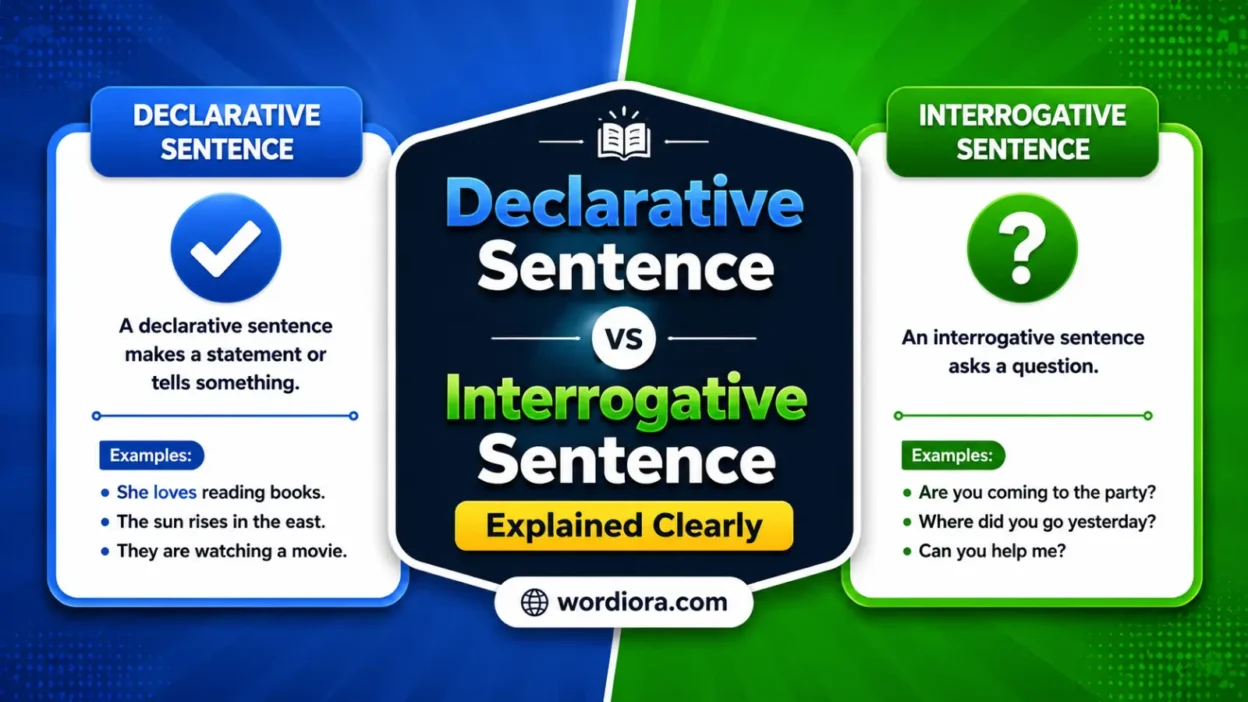
A declarative sentence provides information, expresses a fact, or shares an opinion. An interrogative sentence asks a question and seeks information from someone else.
Understanding the difference helps improve grammar, writing clarity, and communication skills. Whether you are writing an essay, sending an email, or having a conversation, choosing the correct sentence type matters.
This guide explains the distinction between declarative and interrogative sentences in simple American English with practical examples.
Quick Answer
The difference is straightforward:
- Declarative sentence: Makes a statement and ends with a period.
- Interrogative sentence: Asks a question and ends with a question mark.
Examples:
- Declarative: The meeting starts at 9 a.m.
- Interrogative: What time does the meeting start?
If you are giving information, use a declarative sentence.
If you are requesting information, use an interrogative sentence.
Why People Confuse Them
The confusion often happens because both sentence types can contain similar words.
For example:
- You are coming tomorrow.
- Are you coming tomorrow?
The words are almost identical, but the word order changes the sentence’s purpose completely.
Another source of confusion is that some statements sound like questions in conversation because of voice tone. In writing, punctuation and structure determine the sentence type.
Common Reasons for Confusion
- Similar vocabulary
- Similar sentence subjects
- Spoken tone differences
- Informal texting habits
- Missing punctuation
Key Differences At A Glance
| Context | Best Choice | Why |
|---|---|---|
| Giving information | Declarative Sentence | Shares facts or opinions |
| Reporting news | Declarative Sentence | Communicates information clearly |
| Asking for details | Interrogative Sentence | Requests information |
| Seeking confirmation | Interrogative Sentence | Invites a response |
| Academic writing | Mostly Declarative Sentence | Presents evidence and arguments |
| Interviews | Mostly Interrogative Sentence | Collects information |
Quick Comparison
| Feature | Declarative Sentence | Interrogative Sentence |
| Purpose | Makes a statement | Asks a question |
| Ending Punctuation | Period (.) | Question Mark (?) |
| Expected Response | Not always required | Usually expected |
| Word Order | Standard subject-verb order | Often inverted order |
| Tone | Informative | Inquisitive |
Meaning and Usage Difference
A declarative sentence communicates information directly.
Examples:
- The store closes at 8 p.m.
- My sister lives in Chicago.
- We finished the project yesterday.
These sentences tell the reader something.
An interrogative sentence seeks information.
Examples:
- When does the store close?
- Where does your sister live?
- Did you finish the project yesterday?
These sentences invite an answer.
Purpose of Declarative Sentences
Declarative sentences are used to:
- State facts
- Share opinions
- Express observations
- Deliver information
- Explain ideas
Examples:
- The weather is beautiful today.
- I think this movie is excellent.
- The train arrived early.
Purpose of Interrogative Sentences
Interrogative sentences are used to:
- Ask questions
- Gather information
- Clarify details
- Confirm facts
- Start conversations
Examples:
- What is the weather like today?
- Did you enjoy the movie?
- When did the train arrive?
Tone, Context, and Formality
Declarative sentences generally sound more confident because they present information directly.
Example:
- The report is complete.
Interrogative sentences sound more curious because they seek information.
Example:
- Is the report complete?
Workplace Communication
Declarative:
- The presentation begins at noon.
Interrogative:
- What time does the presentation begin?
Academic Writing
Most academic papers rely heavily on declarative sentences because they present evidence and conclusions.
Example:
- Research indicates that exercise improves overall health.
Questions may appear occasionally, but statements dominate formal writing.
Everyday Conversations
Both sentence types appear frequently.
Example:
- Declarative: I ordered pizza for dinner.
- Interrogative: What did you order for dinner?
Which One Should You Use?
Choose a declarative sentence when your goal is to provide information.
Examples:
- The package arrived this morning.
- Our team won the game.
Choose an interrogative sentence when your goal is to obtain information.
Examples:
- When did the package arrive?
- Which team won the game?
Easy Rule
Ask yourself one question:
Am I giving information or requesting information?
- Giving information = Declarative
- Requesting information = Interrogative
When One Choice Sounds Wrong
Sometimes using the wrong sentence type creates confusion.
Incorrect Situation:
You need information:
- The meeting starts at what time.
Correct:
- What time does the meeting start?
Another example:
Someone asks:
- Where do you live?
Wrong response style:
- Where do I live.
Correct response:
- I live in Dallas.
The purpose of the sentence must match the situation.
Common Mistakes (and Quick Fixes)
Mistake 1: Using a Period Instead of a Question Mark
Incorrect:
- Where are you going.
Correct:
- Where are you going?
Mistake 2: Keeping Statement Word Order
Incorrect:
- You are coming tomorrow?
Better:
- Are you coming tomorrow?
Mistake 3: Turning a Statement into a Question Accidentally
Incorrect:
- The deadline is Friday?
Correct:
- The deadline is Friday.
Or:
- Is the deadline Friday?
Mistake 4: Forgetting Auxiliary Verbs
Incorrect:
- What time you leave?
Correct:
- What time do you leave?
Everyday Examples
School
Declarative:
- The test begins at 10 a.m.
Interrogative:
- When does the test begin?
Workplace
Declarative:
- The manager approved the proposal.
Interrogative:
- Did the manager approve the proposal?
Travel
Declarative:
- Our flight leaves tomorrow.
Interrogative:
- When does our flight leave?
Shopping
Declarative:
- This laptop is on sale.
Interrogative:
- Is this laptop on sale?
Family Conversations
Declarative:
- Dinner is ready.
Interrogative:
- Is dinner ready?
Dictionary-Style Word Details
Verb
Declarative Sentence: Not commonly used as a verb in standard American English.
Interrogative Sentence: Not commonly used as a verb in standard American English.
Noun
Declarative Sentence: A sentence that makes a statement or provides information.
Interrogative Sentence: A sentence that asks a question.
Synonyms
Declarative Sentence
Closest plain alternatives:
- Statement sentence
- Informative sentence
- Assertive sentence
Interrogative Sentence
Closest plain alternatives:
- Question sentence
- Inquiry sentence
- Asking sentence
Example Sentences
Declarative Sentence
- The conference starts next Monday.
- My brother works downtown.
- The road is closed today.
Interrogative Sentence
- When does the conference start?
- Where does your brother work?
- Why is the road closed today?
Word History
Declarative Sentence
The term comes from the idea of declaring or stating information.
Interrogative Sentence
The term comes from the concept of questioning or asking for information.
Both terms have long-standing use in traditional English grammar.
Phrases Containing
Declarative Sentence
- Declarative statement
- Declarative clause
- Simple declarative sentence
Interrogative Sentence
- Interrogative form
- Interrogative clause
- Direct interrogative sentence
Frequently Asked Questions (FAQs)
What is the main difference between a declarative sentence and an interrogative sentence?
A declarative sentence makes a statement, while an interrogative sentence asks a question.
Does a declarative sentence always end with a period?
Yes. In standard American English, declarative sentences typically end with a period.
Does an interrogative sentence always end with a question mark?
Yes. Interrogative sentences generally end with a question mark because they ask questions.
Can the same idea be written as both a declarative and interrogative sentence?
Yes.
Declarative:
- The store opens at 8 a.m.
Interrogative:
- What time does the store open?
Which sentence type is more common in formal writing?
Declarative sentences are more common because formal writing usually presents information rather than asking questions.
Are interrogative sentences always seeking new information?
Usually, but some rhetorical questions are asked for effect rather than to receive an answer.
Can declarative sentences express opinions?
Yes.
Examples:
- I believe this policy is effective.
- The movie was fantastic.
Why is word order different in interrogative sentences?
Many interrogative sentences use subject-verb inversion or helping verbs to signal that a question is being asked.
Can an interrogative sentence contain the same words as a declarative sentence?
Yes.
Declarative:
- You are ready.
Interrogative:
- Are you ready?
How can I quickly identify the sentence type?
Look at the purpose and punctuation.
- Statement + period = Declarative sentence
- Question + question mark = Interrogative sentence
Conclusion
The difference between declarative sentence vs interrogative sentence comes down to purpose.
A declarative sentence gives information, expresses a fact, or shares an opinion. An interrogative sentence asks for information and expects some type of response.
Understanding this distinction improves writing, speaking, grammar accuracy, and overall communication. When deciding which form to use, simply ask whether you are providing information or requesting it. That one question will usually lead you to the correct choice every time.