Many English learners and even native speakers confuse imperative sentences and declarative sentences because both appear frequently in everyday communication. While they may sometimes use similar words, they serve very different purposes.
The main difference is simple:
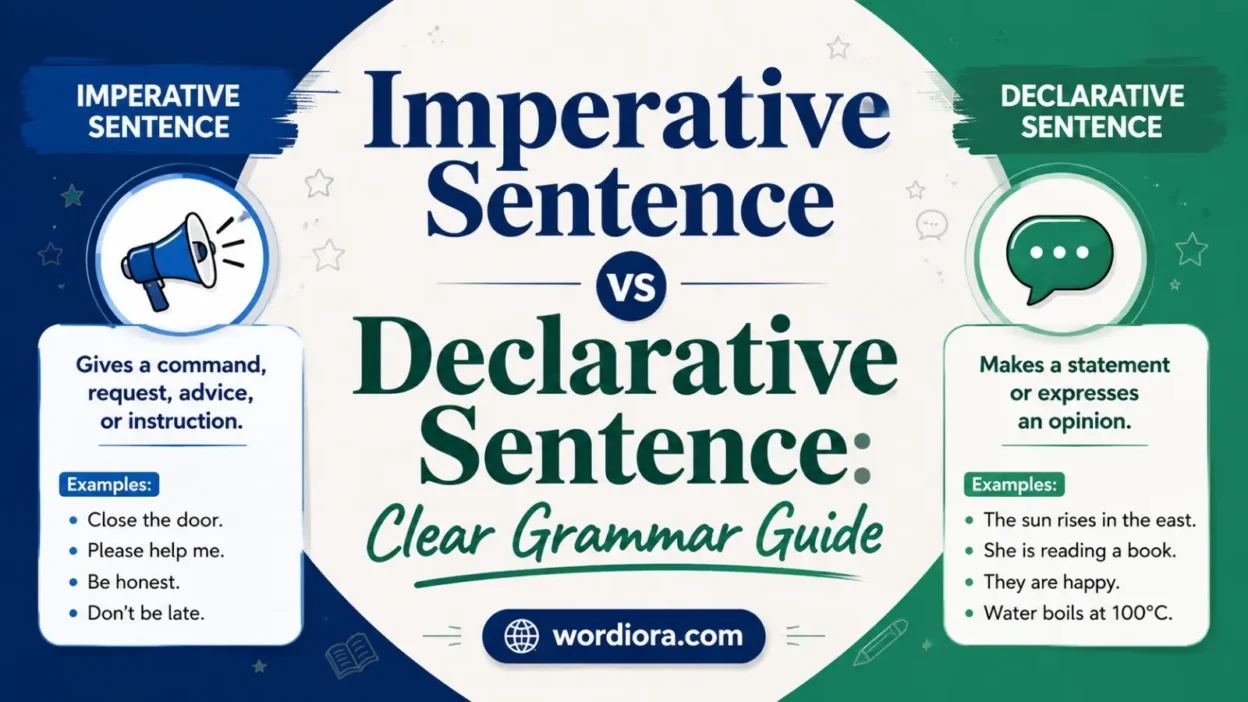
- An imperative sentence gives a command, request, instruction, warning, or advice.
- A declarative sentence states information, facts, opinions, or observations.
Understanding this distinction helps improve writing clarity, grammar accuracy, and communication skills. Whether you’re writing emails, essays, workplace messages, or social media posts, knowing when to use each sentence type makes your message more effective.
In this guide, you’ll learn exactly how imperative sentences differ from declarative sentences, when to use each one, common mistakes to avoid, and practical examples from everyday American English.
Quick Answer
An imperative sentence tells someone to do something.
Examples:
- Close the door.
- Please sit down.
- Follow the instructions carefully.
A declarative sentence tells someone information.
Examples:
- The door is closed.
- Everyone is sitting down.
- The instructions are easy to follow.
If the sentence is giving a direction or command, it’s imperative. If it’s simply providing information, it’s declarative.
Why People Confuse Them
People often confuse these sentence types because they can discuss the same subject.
Consider these examples:
Imperative:
- Turn off the lights.
Declarative:
- The lights are off.
Both sentences involve lights, but they perform different functions.
Another reason for confusion is that imperative sentences often omit the subject.
For example:
- Take your seat.
The subject “you” is understood but not written.
Meanwhile, declarative sentences usually include a visible subject:
- You have taken your seat.
Because both sentence types can look similar, learners sometimes misidentify them.
Key Differences At A Glance
| Context | Best Choice | Why |
|---|---|---|
| Giving instructions | Imperative Sentence | Directs someone to act |
| Giving directions | Imperative Sentence | Tells what to do |
| Providing information | Declarative Sentence | States facts |
| Sharing opinions | Declarative Sentence | Expresses beliefs |
| Offering advice | Imperative Sentence | Suggests an action |
| Reporting events | Declarative Sentence | Describes what happened |
Quick Feature Comparison
| Feature | Imperative Sentence | Declarative Sentence |
| Main Purpose | Command or request | Statement of information |
| Subject | Usually implied | Usually stated |
| Ends With | Period or exclamation mark | Usually period |
| Reader Action | Expected | Not necessarily expected |
| Common Tone | Direct | Informative |
Meaning and Usage Difference
The biggest difference lies in the purpose of the sentence.
Imperative Sentence
An imperative sentence encourages or directs action.
Common uses include:
- Commands
- Requests
- Instructions
- Warnings
- Advice
- Invitations
Examples:
- Call me tomorrow.
- Please open the window.
- Watch out for traffic.
- Follow the recipe carefully.
- Enjoy your vacation.
Notice that each sentence asks someone to do something.
Declarative Sentence
A declarative sentence communicates information.
Common uses include:
- Facts
- Opinions
- Explanations
- Observations
- Reports
Examples:
- Tomorrow is a holiday.
- The window is open.
- Traffic is heavy today.
- The recipe requires fresh ingredients.
- We enjoyed our vacation.
These sentences simply provide information rather than directing action.
Parts of Speech Perspective
Both imperative and declarative sentences are sentence types rather than individual parts of speech.
However:
- Imperative sentences generally begin with a base-form verb.
- Declarative sentences typically contain a subject followed by a verb.
Examples:
Imperative
- Stop talking.
- Read the report.
Declarative
- Students stopped talking.
- She read the report.
Tone, Context, and Formality
Tone often changes depending on the sentence type.
Imperative Tone
Imperative sentences may sound:
- Direct
- Urgent
- Helpful
- Authoritative
- Encouraging
Examples:
- Leave immediately.
- Please have a seat.
- Keep up the good work.
Adding words like “please” can soften the tone.
Declarative Tone
Declarative sentences usually sound:
- Neutral
- Informative
- Professional
- Objective
Examples:
- The meeting starts at noon.
- The project is complete.
- Sales increased this quarter.
Formal Writing
In formal writing, declarative sentences appear more frequently because reports, articles, and academic papers mainly present information.
Imperative sentences appear when instructions are necessary.
Examples:
Declarative
- The survey included 500 participants.
Imperative
- Complete all sections before submitting the form.
Which One Should You Use?
Choose an imperative sentence when you want someone to act.
Examples:
- Submit the application today.
- Check your email regularly.
- Save your work frequently.
Choose a declarative sentence when you want to share information.
Examples:
- The application deadline is today.
- New emails have arrived.
- Your work has been saved.
A simple test:
Ask yourself:
“Am I telling someone something, or am I telling someone to do something?”
If you’re telling them something, use a declarative sentence.
If you’re telling them to do something, use an imperative sentence.
When One Choice Sounds Wrong
Sometimes using the wrong sentence type creates confusion.
Incorrect Situation
A manager wants an employee to finish a report.
Weak:
- The report should be finished today.
Clear:
- Finish the report today.
Another Example
Someone wants directions.
Weak:
- You should turn left at the next intersection.
Clear:
- Turn left at the next intersection.
Likewise, a declarative sentence is better when merely sharing information.
Awkward:
- Know that the meeting starts at 10 a.m.
Better:
- The meeting starts at 10 a.m.
Matching the sentence type to the purpose improves communication.
Common Mistakes (and Quick Fixes)
Mistake 1: Forgetting the Implied Subject
Incorrect understanding:
- Sit down.
Some learners think the sentence has no subject.
Quick Fix:
The subject is understood as “you.”
Mistake 2: Turning Information Into Commands
Awkward:
- Remember that the office closes at 5 p.m.
Better:
- The office closes at 5 p.m.
Mistake 3: Being Too Direct
Harsh:
- Send the document now.
Polite:
- Please send the document now.
Mistake 4: Using Declarative Sentences for Instructions
Weak:
- You need to click the blue button.
Better:
- Click the blue button.
Everyday Examples
Here are side-by-side examples from daily life.
At Home
Imperative:
- Wash the dishes.
Declarative:
- The dishes are dirty.
At Work
Imperative:
- Review the proposal.
Declarative:
- The proposal needs review.
In School
Imperative:
- Complete your assignment.
Declarative:
- The assignment is due tomorrow.
While Driving
Imperative:
- Slow down.
Declarative:
- The speed limit is 35 mph.
Online
Imperative:
- Subscribe to our newsletter.
Declarative:
- Our newsletter is published weekly.
Dictionary-Style Word Details
Verb
Imperative Sentence:
Not commonly used as a verb in standard US English. It is a sentence category used to issue commands or requests.
Declarative Sentence:
Not commonly used as a verb in standard US English. It is a sentence category used to make statements.
Noun
Imperative Sentence:
A sentence that gives commands, directions, requests, warnings, or advice.
Declarative Sentence:
A sentence that states facts, opinions, observations, or information.
Synonyms
Imperative Sentence:
Closest plain alternatives:
- Command sentence
- Directive sentence
- Instructional statement
Declarative Sentence:
Closest plain alternatives:
- Statement sentence
- Informative sentence
- Factual statement
Antonyms:
- Imperative sentence ↔ Declarative sentence only in specific sentence-type comparisons.
- Neither serves as a complete opposite in every context.
Example Sentences
Imperative Sentence Examples
- Turn off your phone.
- Please arrive early.
- Drive carefully.
- Read the instructions.
- Keep the receipt.
Declarative Sentence Examples
- Your phone is turned off.
- Everyone arrived early.
- The roads are busy today.
- The instructions are clear.
- I kept the receipt.
Word History
Imperative Sentence:
The term comes from the grammatical concept of expressing commands or requirements. The word “imperative” has long been associated with directing action.
Declarative Sentence:
The term comes from the grammatical concept of declaring or stating information. The word “declarative” relates to making statements.
Phrases Containing
Imperative Sentence
- Imperative mood
- Imperative command
- Imperative instruction
- Imperative statement
Declarative Sentence
- Declarative statement
- Declarative clause
- Declarative form
- Declarative structure
FAQs
What is the main difference between an imperative sentence and a declarative sentence?
An imperative sentence gives a command, request, instruction, or advice. A declarative sentence states information, facts, or opinions.
Do imperative sentences always start with a verb?
Most imperative sentences begin with a base-form verb because the subject “you” is usually implied rather than written.
Can an imperative sentence be polite?
Yes. Adding words such as “please” makes an imperative sentence more polite.
Example:
- Please take a seat.
Do declarative sentences always have a subject?
Generally, yes. Declarative sentences typically include an expressed subject and a verb.
Example:
- The meeting starts at noon.
Can imperative sentences end with an exclamation mark?
Yes. An exclamation mark can add urgency or emphasis.
Example:
- Stop immediately!
Which sentence type is more common in formal writing?
Declarative sentences are more common because formal writing usually presents information, explanations, and facts.
Is “Please close the door” an imperative sentence?
Yes. It politely asks someone to perform an action.
Is “The door is closed” a declarative sentence?
Yes. It simply provides information about the door.
Are imperative and declarative sentences opposite types?
Not exactly. They are different sentence functions. One directs action, while the other communicates information.
How can I quickly identify an imperative sentence?
Ask whether the sentence is telling someone to do something. If the answer is yes, it is likely an imperative sentence.
Conclusion
The difference between an imperative sentence and a declarative sentence comes down to purpose.
An imperative sentence tells someone what to do. It gives commands, requests, instructions, warnings, or advice.
A declarative sentence tells someone information. It presents facts, opinions, explanations, and observations.
Compare these examples:
- Close the window. (Imperative)
- The window is closed. (Declarative)
The first directs action. The second provides information.
Once you focus on the sentence’s purpose, choosing the correct type becomes much easier.