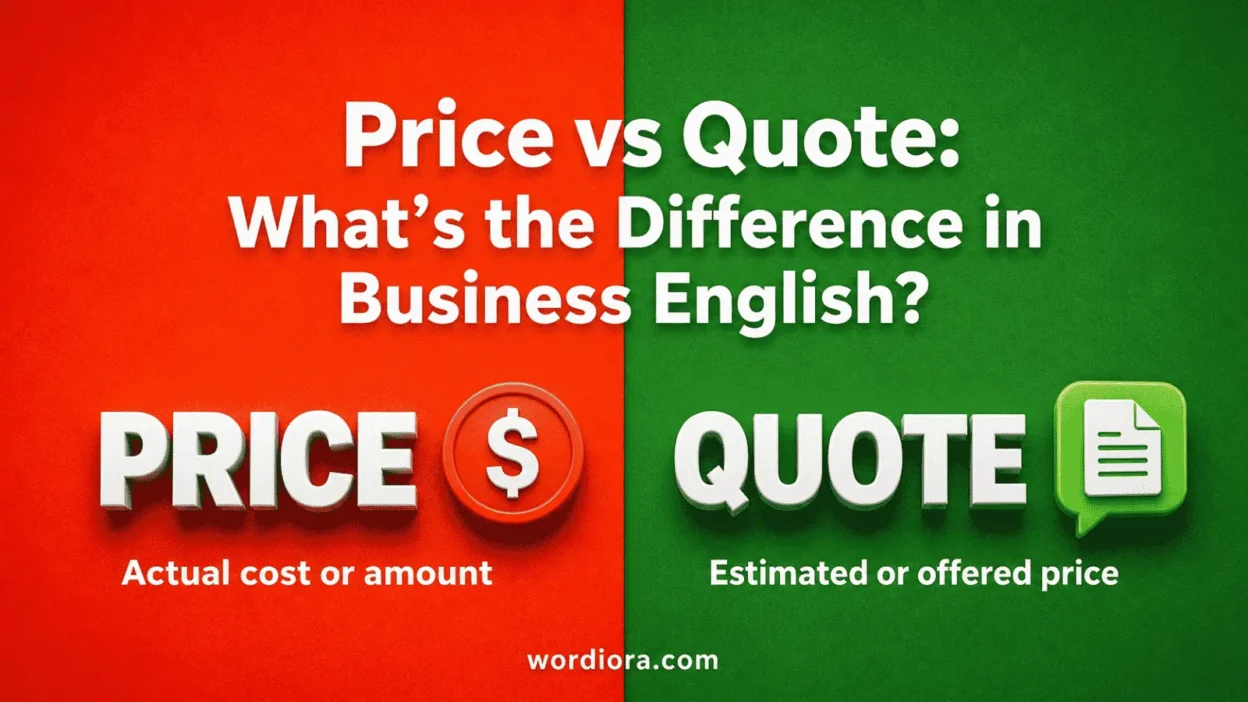
People often treat price and quote as if they mean the same thing, but they are not fully interchangeable. In business English, price usually means the amount charged for something. Quote usually means the offered or stated price for a specific job, service, or order.
That distinction matters because one word names the number itself, while the other often points to the act or document of giving that number to a customer.
If you are writing emails, proposals, service pages, or product descriptions, choosing the right word makes your message sound more accurate and more professional.
Quick Answer
Use price when you mean the amount something costs.
Use quote when you mean a stated price given to a customer for a specific job, service, or request.
So you would usually say:
- “What is the price of this chair?”
- “Can you send me a quote for repainting the office?”
In many business situations, a quote includes a price, but a price is not automatically a quote.
Why People Confuse Them
The confusion happens because both words deal with cost.
A customer may ask for “the price,” while a business replies with “a quote.” That can make the terms seem identical. They overlap, but they are not the same in function.
Another reason is that some industries use quote very broadly. Contractors, designers, printers, mechanics, and software vendors often say “We’ll quote you a price.” In that sentence, quote is the action and price is the amount.
So the words are connected, but they do different jobs.
Key Differences At A Glance
| Context | Best Choice | Why |
| A tag on a shelf or website | Price | It names the cost of the item itself. |
| A custom job request | Quote | It means a stated amount prepared for that specific work. |
| A general discussion of cost | Price | It is the broader everyday word. |
| A document sent before work begins | Quote | It usually refers to the offer or proposal sent to the customer. |
| A sentence about raising or lowering costs | Price | It fits standard discussions of market cost or retail cost. |
| A reply to “How much would you charge for this project?” | Quote | It suggests a tailored response for that request. |
Compact comparison
- Price = the amount charged
- Quote = the offered or stated price for a particular request
- Price is broader
- Quote is more situational and often more formal in business use
Meaning and Usage Difference
Price is the wider term. It can refer to the cost of a product on a shelf, the rate for a service, the amount in a catalog, or the amount discussed in general conversation.
Examples:
- “The price of eggs went up again.”
- “That store has the best price on office chairs.”
- “We need to lower the price to stay competitive.”
Quote is narrower in this comparison. In business use, it usually means the amount a company says it will charge for a particular job, service, or order, often after reviewing the customer’s request.
Examples:
- “The roofer sent a quote this morning.”
- “We asked three firms for a quote.”
- “Her quote included labor, materials, and delivery.”
A simple way to remember it is this: price is the cost, while quote is the communicated offer.
Tone, Context, and Formality
Price sounds plain, direct, and universal. It works in everyday speech, retail writing, product pages, and market discussions.
Quote sounds more business-specific. It often appears in service settings, B2B writing, sales emails, vendor communication, and project-based work.
Compare these:
- “What’s your price for bulk orders?”
- “Could you send a formal quote for 500 units?”
Both are natural, but the second one sounds more structured and more tied to a business process.
In casual conversation, people often choose price because it is simpler. In professional communication, quote is often better when there is a request, scope, or proposed deal involved.
Which One Should You Use?
Use price when:
- you mean the cost itself
- the amount is fixed or publicly listed
- you are speaking generally
- you are writing for ordinary shoppers or general readers
Use quote when:
- you are responding to a request
- the amount is specific to one customer or project
- the figure may depend on scope, quantity, timing, or service details
- you mean the actual offer, not just the number
A product page usually shows a price.
A contractor, lawyer, caterer, or agency often sends a quote.
When One Choice Sounds Wrong
Sometimes either word is technically understandable, but one sounds off.
For example:
- “The quote of milk is $4.29” sounds unnatural in ordinary retail English.
- “Please review our price for the kitchen remodel” is possible, but “quote” often sounds more natural if the remodel is custom work.
Here is the pattern:
Use price for standard items and general costs.
Use quote for tailored work and customer-specific offers.
That is why “car price” sounds normal, but “repair quote” often sounds better than “repair price.”
Common Mistakes (and Quick Fixes)
One common mistake is using quote for every kind of cost.
Incorrect:
“We compare quote across grocery stores.”
Better:
“We compare prices across grocery stores.”
Another common mistake is using price when the situation clearly involves a formal business response.
Less natural:
“Please send your price for redesigning our website.”
Better:
“Please send your quote for redesigning our website.”
A third mistake is forgetting that quote can suggest more than one number on a page. It may include terms, quantities, and scope, not just a single amount.
Weak:
“The quote is $2,500.”
Better:
“The quote is $2,500 and includes installation and follow-up support.”
Everyday Examples
Here are natural examples that show the difference clearly.
- “The price of the laptop is $899.”
- “Can you quote me a price for replacing all the windows?”
- “Their prices are lower than the local store’s.”
- “We received a quote from the marketing agency yesterday.”
- “Before we order, let’s confirm the final price.”
- “The plumber said the quote would arrive by email.”
- “That price does not include shipping.”
- “The quote includes labor, paint, and cleanup.”
Notice the pattern: price works well for the amount itself, while quote works well for a prepared response to a specific need.
Dictionary-Style Word Details
Verb
Price:
To price something is to set or determine what it will cost. Example: “They priced the new menu items too high.”
Quote:
To quote can mean to state a price for goods, services, or work. Example: “The vendor quoted us $4,800 for the project.”
Noun
Price:
A price is the amount of money asked or paid for something. It is the standard noun for cost.
Quote:
In business use, a quote is the price a person or company says they will charge for a particular piece of work or order.
Synonyms
Price:
cost, amount, charge, rate, fee
Quote:
quotation, estimate, offer, proposed price
These are not perfect substitutes in every sentence. Estimate, for example, often suggests more uncertainty than quote.
Example Sentences
Price:
- “The price seems fair for the quality.”
- “Gas prices dropped this week.”
- “We need a better price before we sign.”
Quote:
- “The designer sent a quote by noon.”
- “I asked the shop for a quote on brake repairs.”
- “Please review the quote before approving the work.”
Word History
Price:
The word comes through Old French from Latin pretium, meaning price or value.
Quote:
The word comes from Medieval Latin quotare. In modern business use, one established sense is to state a price.
The histories are different, which helps explain why price centers on value itself, while quote centers on stating or presenting something.
Phrases Containing
Price:
- asking price
- sale price
- list price
- market price
- price range
Quote:
- get a quote
- request a quote
- price quote
- sales quote
- formal quote
One useful note: price quote is common because it makes the business sense fully clear, especially when quote might otherwise be mistaken for quoted words from a speaker or book.
Conclusion
For Price vs Quote, the clearest rule is simple: price is the amount something costs, while quote is the stated or offered price for a specific request, job, or order.
Choose price for general cost and listed amounts. Choose quote when a business is responding to a customer with a tailored figure.
That one distinction will make your writing sound sharper, more natural, and more professional in both everyday and business English.