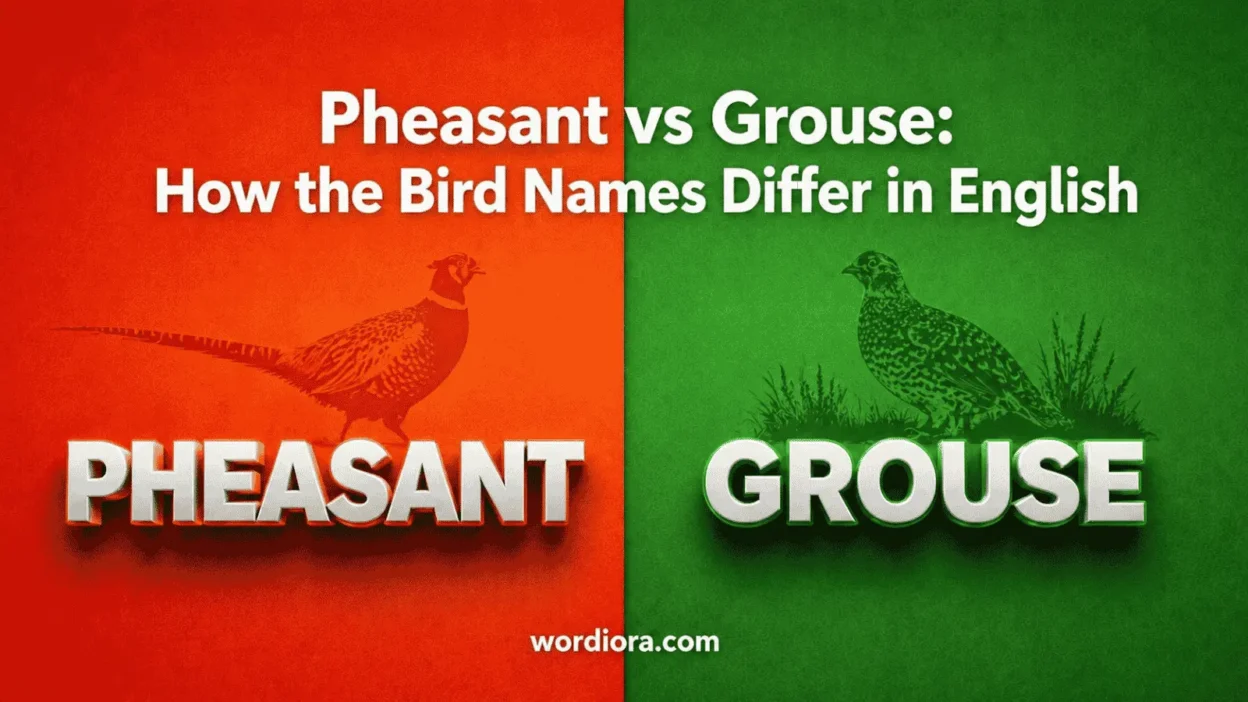
People usually search pheasant vs grouse because they know the birds are similar in a broad, everyday sense: both are ground-dwelling game birds, both look a little chicken-like, and both come up in hunting, birding, and outdoor writing. But they are not interchangeable names. A pheasant is one kind of bird, and a grouse is another. In normal American English, the right choice depends on which bird you actually mean.
Quick Answer
Use pheasant when you mean a pheasant, especially birds such as the ring-necked pheasant, which are often described as long-tailed and, in males, brightly colored. Use grouse when you mean a grouse, usually a stockier, more camouflaged bird associated with woods, brush, moorland, or other cover. They are different bird names, not two versions of the same word.
Why People Confuse Them
The confusion is easy to understand.
First, both words belong to the same broad world of upland birds and hunting vocabulary. Second, many readers are not trying to identify a species with scientific precision. They just know they saw a plump bird on the ground, or they are describing game birds in general.
Another reason is visual overlap. Female pheasants and some grouse can both look brown, mottled, and hard to spot. But once you move past that quick first impression, the terms separate clearly. Pheasants are commonly associated with longer tails and more obvious sexual dimorphism, while grouse are more often described as compact, earth-toned birds built to disappear into cover.
Key Differences At A Glance
| Context | Best Choice | Why |
| You mean a long-tailed bird like a ring-necked pheasant | Pheasant | That is the standard name for that bird |
| You mean a woodland bird like a ruffed grouse | Grouse | That is the standard name for that bird |
| You are writing about bright male plumage and a white neck ring | Pheasant | That description strongly matches common pheasant usage |
| You are writing about drumming in spring woods | Grouse | That points to grouse, especially ruffed grouse |
| You need a general label for a specific bird species | Use the exact bird name | These words are not loose substitutes |
| You are unsure which bird you saw | Neither until you confirm | Guessing creates the wrong identification |
Compact comparison block
- Pheasant: often longer-tailed, especially in familiar North American references to ring-necked pheasants
- Grouse: usually shorter-tailed, heavier-looking, and more camouflaged
- Pheasant: often linked with fields, grasslands, and edges
- Grouse: often linked with woods, scrub, and rough cover
Meaning and Usage Difference
In plain usage, pheasant names a pheasant. Grouse names a grouse.
That sounds obvious, but it matters because this is really a naming question, not a grammar question. If someone writes, “A grouse ran out of the cornfield with a very long tail and a white neck ring,” the wording sounds off because those details point toward a ring-necked pheasant instead. If someone writes, “We heard a pheasant drumming on a log in the spring woods,” that also sounds off because that description points toward a ruffed grouse.
So the usage difference is simple: choose the bird name that matches the actual bird, not the general category of “game bird.”
Tone, Context, and Formality
There is no major formality difference between pheasant and grouse. Both are standard nouns in everyday American English.
What changes is context. In hunting, birding, wildlife writing, and regional speech, readers often assume you mean a specific bird, not just any bird in that general family. Because of that, using the wrong term can make the sentence sound careless, even if the overall meaning is still understandable.
In casual conversation, people may be forgiven for mixing them up. In any published piece, field note, school assignment, or species description, it is better to be exact.
Which One Should You Use?
Use pheasant when the bird is actually a pheasant.
Use grouse when the bird is actually a grouse.
If you do not know which bird you mean, the safest choice is not to force either word. Use a broader phrase such as game bird, ground bird, or upland bird until you confirm the identification.
That is especially helpful in sentences like these:
- “We saw a game bird flush from the brush.”
- “A ground-dwelling bird crossed the trail.”
- “The guide helped us identify the upland bird later.”
Those broader choices are better than using the wrong specific label.
When One Choice Sounds Wrong
One choice sounds wrong when the details in the sentence contradict the bird named.
For example, pheasant sounds wrong if the sentence describes a compact forest bird with classic grouse behavior. Grouse sounds wrong if the sentence describes a bird that clearly matches the familiar long-tailed ring-necked pheasant seen in open fields.
These are the kinds of mismatches readers notice right away:
- wrong habitat
- wrong body shape
- wrong tail shape
- wrong behavior
- wrong species name paired with the wrong description
Common Mistakes (and Quick Fixes)
Mistake: Using grouse as a catch-all word for any game bird.
Fix: Use grouse only for actual grouse.
Mistake: Calling every brown upland bird a pheasant.
Fix: Check the tail, habitat, and overall shape before naming it.
Mistake: Mixing species clues.
Fix: Keep the noun and description aligned. If the bird has pheasant traits, call it a pheasant. If it has grouse traits, call it a grouse.
Mistake: Using the wrong word because it sounds more familiar.
Fix: Familiarity is not accuracy. Choose the term that fits the bird, not the one you hear more often.
Everyday Examples
Here are natural examples in standard American English:
- A pheasant burst out of the roadside grass and flew low across the field.
- We spotted a grouse near the edge of the woods just after sunrise.
- The guide said the long tail made it easy to rule out grouse.
- That bird was not a pheasant at all; it was a ruffed grouse.
- If you are writing a caption, do not guess between pheasant and grouse.
- The hunter described hearing grouse in the timber but seeing pheasants in the open cover.
Dictionary-Style Word Details
Verb
Pheasant: Not normally used as a verb in standard American English.
Grouse: Also exists as a verb meaning to complain or grumble, but that sense is separate from the bird name. It does not change the bird comparison here.
Noun
Pheasant: A noun for certain often long-tailed birds, especially the kinds commonly grouped as pheasants; in American usage, ring-necked pheasant is the reference many readers picture first.
Grouse: A noun for a group of chiefly ground-dwelling game birds; in North American usage, readers may think of birds such as ruffed grouse, sage-grouse, or sharp-tailed grouse.
Synonyms
Pheasant: There is no true everyday synonym that cleanly replaces it in most sentences. Sometimes a writer can use ring-necked pheasant if they want more precision.
Grouse: Also has no perfect everyday synonym. In a specific sentence, a more exact species name such as ruffed grouse may be better.
Example Sentences
Pheasant: The dog flushed a pheasant from the tall grass.
Pheasant: We saw a pheasant along the fence line by the field.
Grouse: A grouse exploded from the brush before we saw it.
Grouse: The trail camera caught a grouse moving through the woods.
Word History
Pheasant: In modern English, the word refers to the bird group known as pheasants, and standard reference works describe pheasants as part of the larger game-bird world, often noting their long tails and, in many species, bright males.
Grouse: In modern English, the noun refers to grouse as a bird group, while the separate verb sense means to complain. The two senses share the spelling but work differently in actual sentences.
Phrases Containing
Pheasant: ring-necked pheasant, pheasant hunting, pheasant field, pheasant season
Grouse: ruffed grouse, sage-grouse, grouse woods, grouse season, grouse habitat
Conclusion
Pheasant vs grouse is a straight word-choice question with a simple answer: use the name that matches the bird. A pheasant is not a grouse, and a grouse is not a pheasant. The words can sit in the same outdoor or hunting vocabulary, but they are not interchangeable in careful writing. When the species matters, be specific. When you are unsure, go broader rather than guessing. That keeps your sentence natural, accurate, and clear.