Quartile vs percentile is a true word-choice question because the two terms are related, but they do not mean the same thing.
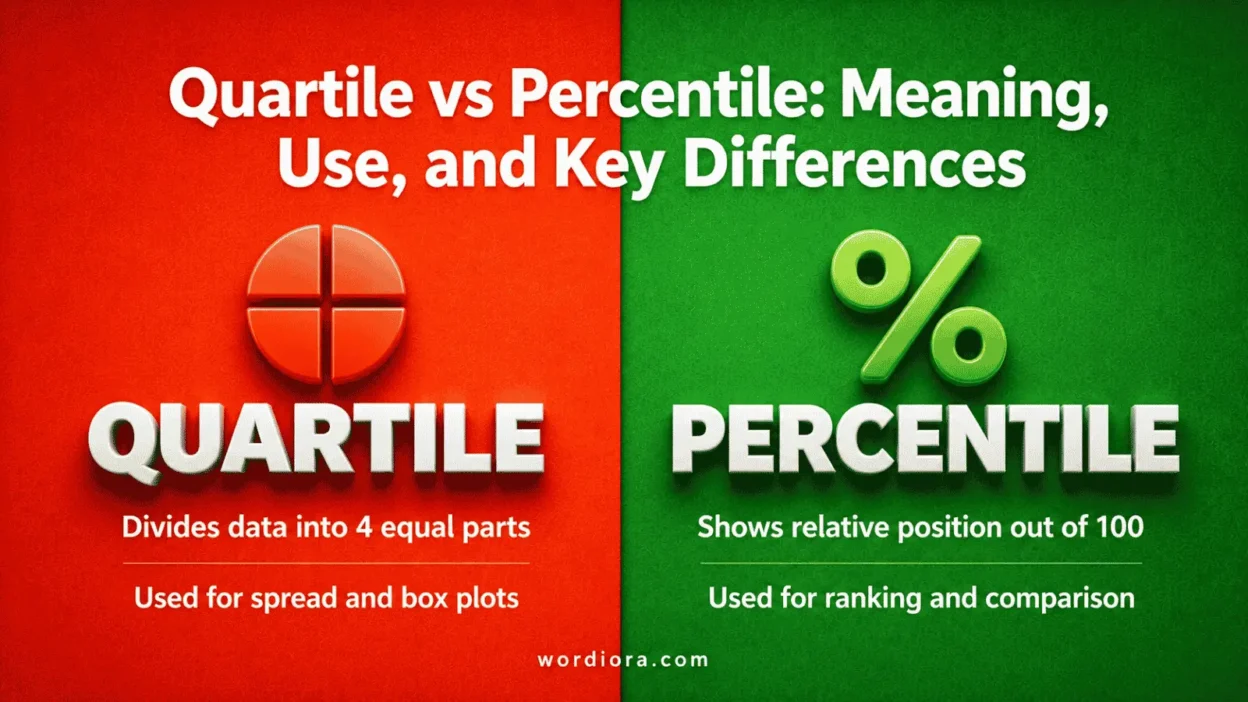
The clearest way to separate them is this: a quartile divides ordered data into four parts, while a percentile places a value on a scale of one hundred. That means quartiles are broader cut points, and percentiles are more fine-grained.
People mix them up because the first quartile matches the 25th percentile, the second quartile matches the 50th percentile, and the third quartile matches the 75th percentile. Even so, you should not treat the words as interchangeable. In most writing, the right choice depends on how specifically you want to describe position in a dataset.
Quick Answer
Use quartile when you are talking about one of the four equal sections of ordered data or the cut points that mark those sections.
Use percentile when you want to show where a value stands out of 100 possible positions.
A simple memory trick helps: quartile = fourths, percentile = hundredths.
Why People Confuse Them
The confusion starts because both words describe relative position in data.
They also overlap in a very visible way. The 25th percentile is the same location as the first quartile. The 50th percentile is the median, which is also the second quartile. The 75th percentile is the third quartile.
That overlap makes many readers assume the words are just two labels for the same thing. They are not. A quartile names one of a small set of standard divisions. A percentile gives a much more exact placement.
Another reason for confusion is that both words appear in similar settings, such as test reports, health charts, salary studies, and research summaries.
Key Differences At A Glance
| Context | Best Choice | Why |
| Dividing data into four sections | quartile | The term is built for fourths |
| Referring to Q1, Q2, or Q3 | quartile | These are quartile labels |
| Saying a student scored higher than 88% of test takers | percentile | The statement uses a position out of 100 |
| Describing a growth chart position like the 60th percentile | percentile | The position is specific, not one of four broad bands |
| Explaining the middle 50% of a dataset | quartile | This usually involves Q1, Q3, and the interquartile range |
| Giving a very precise rank in a distribution | percentile | Percentiles offer finer detail |
Compact comparison block
- Quartile: four sections, broader grouping, often shown as Q1, Q2, Q3
- Percentile: one-hundred-point scale, more precise ranking, often written as 25th, 60th, 90th percentile
- Connection: some percentiles match quartiles exactly
- Difference: not every percentile is a quartile
Meaning and Usage Difference
A quartile is tied to four-part division. In practice, writers often use it in two ways: to mean the cut points that split ordered data into quarters, or to mean the sections themselves.
A percentile tells you how a value compares with the rest of the dataset on a 100-point scale. If a score is in the 90th percentile, it means the score is as high as or higher than 90 percent of the values in that group.
So the difference is not just mathematical. It affects wording.
If you write, “The company is in the top quartile for revenue growth,” you are placing it in the top 25 percent band.
If you write, “The company is in the 93rd percentile for revenue growth,” you are giving a more exact standing.
Tone, Context, and Formality
Both words work well in formal writing, educational writing, and technical writing.
Quartile often sounds broader and more summary-based. It is common in reports, box plots, distribution summaries, and discussions of spread.
Percentile often sounds more precise and reader-friendly when people want to know exact standing. It is common in testing, medicine, child growth charts, and performance analysis.
In general American usage, percentile is the better choice when your reader is likely to ask, “Exactly where does this value fall?”
Quartile is the better choice when your reader is looking at grouped distribution, spread, or comparison bands.
Which One Should You Use?
Use quartile when your point is about distribution in fourths.
Use percentile when your point is about exact relative position.
A few quick examples make this easier:
- “Home prices in this ZIP code fall in the lowest quartile statewide.”
- “Her reading score landed in the 82nd percentile.”
- “The box plot shows the first and third quartiles.”
- “The child’s height is in the 40th percentile for age.”
A useful test is to ask whether you could naturally replace the term with “top 25 percent band” or “position out of 100.”
If the first version works, choose quartile.
If the second works, choose percentile.
When One Choice Sounds Wrong
Sometimes one word is technically related but still sounds wrong in context.
For example, “The patient is in the third quartile for height” is possible, but it sounds less natural than “The patient is in the 75th percentile” or “around the 75th percentile” in everyday health writing.
On the other hand, “The interpercentile range from Q1 to Q3” would sound wrong in ordinary statistics writing because Q1 and Q3 belong to quartile language.
Writers also create awkward wording when they mix a broad grouping word with a precise ranking idea. Saying “the 87th quartile” is simply incorrect. Quartiles do not run that way.
Common Mistakes (and Quick Fixes)
One common mistake is using percentile when you really mean percent.
- Wrong: “She scored in the 90 percent on the exam.”
- Better: “She scored 90 percent on the exam.”
- Better: “She scored in the 90th percentile on the exam.”
Another mistake is using quartile for any rank position.
- Wrong: “He ranked in the 68th quartile.”
- Better: “He ranked in the 68th percentile.”
A third mistake is assuming every quartile reference is equally specific.
- Weak: “The value is in a quartile above the median.”
- Better: “The value is in the third quartile.”
- Better still, when needed: “The value is near the 68th percentile.”
Everyday Examples
These examples show how the choice changes with context.
- “Applicants in the top quartile received interviews more often.”
- “Her LSAT result placed her in the 91st percentile.”
- “The chart compares income by quartile.”
- “His sprint time ranked in the 97th percentile nationally.”
- “The first and third quartiles define the box in a box plot.”
- “The baby’s weight is in the 55th percentile.”
In everyday writing, quartile often appears when discussing grouped comparisons. Percentile appears when readers want a more exact position.
Dictionary-Style Word Details
Verb
Quartile: Not commonly used as a verb in standard modern American writing.
Percentile: Not commonly used as a verb in standard modern American writing.
Noun
Quartile: A noun referring to one of the four equal parts of an ordered dataset, or the cut points used to mark those parts.
Percentile: A noun referring to a value that shows the percentage of a distribution at or below a given point.
Synonyms
Quartile: quarter division, fourth, data quarter, quartile group
These are only partial substitutes and usually do not replace the technical term neatly.
Percentile: percentile rank, relative standing, distribution position
These can overlap in meaning, but they are not always exact replacements.
Example Sentences
Quartile:
- “Neighborhood rents in the top quartile rose the fastest.”
- “The analyst focused on the lower quartile of responses.”
- “Q1 and Q3 are the most commonly discussed quartiles.”
Percentile:
- “Her score placed her in the 84th percentile nationwide.”
- “The child measured in the 62nd percentile for height.”
- “This result falls below the 20th percentile.”
Word History
Quartile: The word is connected to the idea of a fourth part and later took on a statistical meaning for dividing data into four sections.
Percentile: The word developed in statistics for values that divide ordered data on a scale of one hundred.
Phrases Containing
Quartile:
- first quartile
- second quartile
- third quartile
- top quartile
- bottom quartile
- interquartile range
Percentile:
- 90th percentile
- percentile rank
- percentile score
- below the 25th percentile
- above the 95th percentile
Conclusion
Choose quartile when your focus is one of four broad divisions in ordered data. Choose percentile when your focus is exact placement on a 100-point scale.
They are closely related, but they are not interchangeable. The simplest way to keep them straight is to remember that quartiles group data into fourths, while percentiles locate data more precisely in hundredths. If your sentence is about broad bands, use quartile. If it is about exact standing, use percentile.