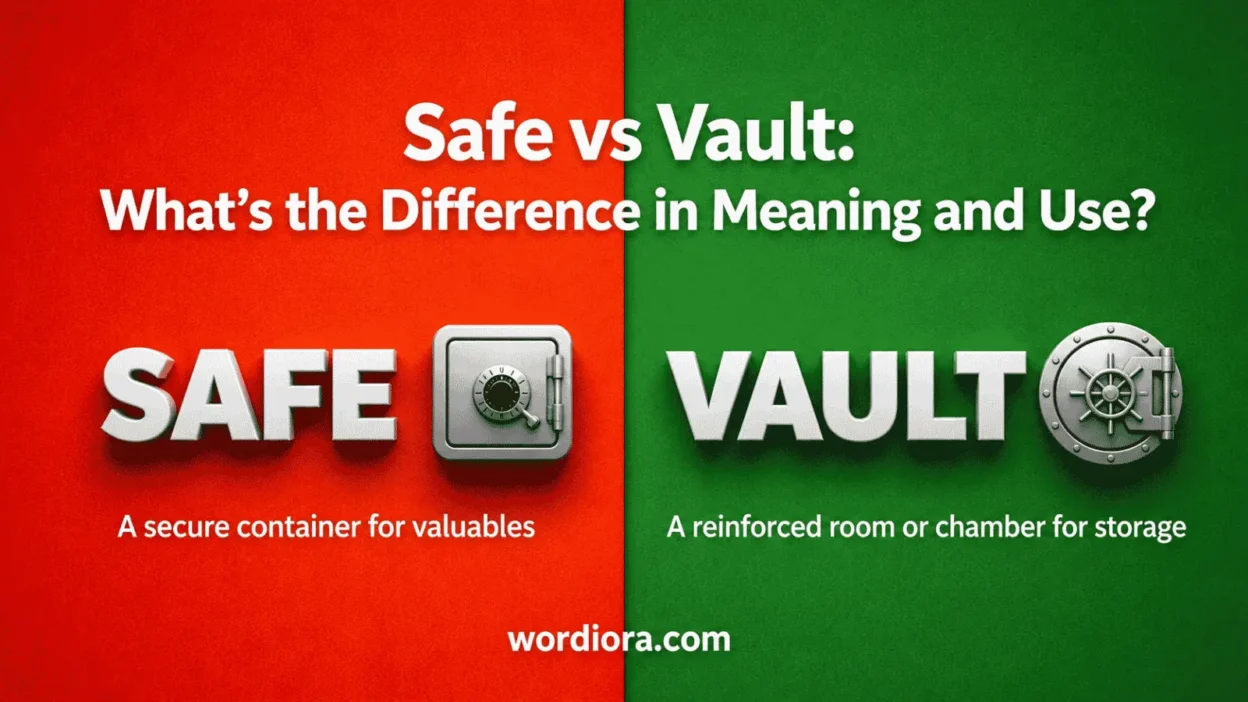
If you are choosing between safe and vault, the right word usually depends on size, setting, and meaning. In everyday American English, a safe is often a lockable box or cabinet for valuables, while a vault is more often a reinforced room or large secure compartment, especially in a bank or institutional setting. On top of that, safe is also a very common adjective meaning protected from danger, and vault has other meanings too, including an arched structure and a leap.
Quick Answer
Use safe when you mean a smaller lockable container or when you mean “protected from harm.” Use vault when you mean a much larger secure room or compartment, especially one built into a building. They overlap a little, but they are not usually the best choice in the same sentence.
Why People Confuse Them
Writers confuse these words because both can relate to protecting valuables. In fact, dictionary and thesaurus entries sometimes place them near each other. Merriam-Webster lists vault as a noun synonym for safe, which shows there is real overlap. But the overlap is limited: a safe usually suggests a container, while a vault usually suggests a room-scale security space.
Another reason for the confusion is that safe has a very common adjective use, while vault does not. A sentence like “The money is safe” uses safe as an adjective, not as the name of a storage object. That alone can make the comparison look simpler than it really is.
Key Differences At A Glance
The clearest practical distinction is this: safe usually points to a protected condition or a smaller secure container, while vault usually points to a larger built-in storage space.
- Safe: often a metal box, cabinet, or receptacle for money, jewelry, documents, or other valuables.
- Vault: often a reinforced room or compartment with thick walls and a strong door, especially in a bank or major facility.
- Safe: also very commonly means protected, secure, or not in danger.
- Vault: also has other meanings, including an arched ceiling, a burial chamber, or a leap.
Meaning and Usage Difference
As a noun, safe usually means a secure container for valuables. Oxford describes it as a strong metal box or cupboard with a complicated lock, and Merriam-Webster gives the broader idea of a place or receptacle to keep valuables safe. That makes safe the more natural word for homes, hotel rooms, offices, and small businesses.
Vault is usually larger and more structural. Cambridge defines it as a room, especially in a bank, with thick walls and a strong door for storing money or valuables. Merriam-Webster similarly defines one sense of vault as a room or compartment for the safekeeping of valuables. That makes vault the better word when you mean a secure room rather than a lockbox.
One more difference matters in real writing: safe often names a thing you can own or place somewhere, while vault often suggests part of a building or a specially constructed secure area. That is why “home safe” sounds normal, but “home vault” sounds much more specialized. This is an inference from standard dictionary definitions, not a hard legal or technical rule.
Tone, Context, and Formality
In tone, safe is the more everyday word. It sounds practical, familiar, and common. You are likely to hear it in ordinary situations: a hotel safe, a wall safe, a small office safe, or a sentence like “Keep your passport somewhere safe.”
Vault feels heavier, larger, and more institutional. It fits banks, museums, secure archives, and other places where valuables are stored in a fortified room. Because of that, it can sound too dramatic if you use it for a small household lockbox.
Which One Should You Use?
Use this rule: if you mean a container, choose safe; if you mean a room-scale security space, choose vault. If you mean “protected from danger,” choose safe as an adjective.
| Context | Best Choice | Why |
| A lockbox for cash and documents at home | safe | A safe is usually a strong metal box, cupboard, or receptacle for valuables. |
| A secure room in a bank | vault | A vault is usually a room with thick walls and a strong door for valuables. |
| “The children are ___ now.” | safe | Here the word means protected from danger, so the adjective safe is correct. |
| A museum’s reinforced storage area | vault | The room-scale, built-in sense fits vault better than safe. |
| A hotel drawer unit with a lock | safe | In ordinary usage, that is a safe, not a vault. |
When One Choice Sounds Wrong
“Put the jewelry in the vault” can sound off if you are talking about a small box in your bedroom closet. In that context, safe is the natural word. Vault suggests something much larger.
“The bank keeps cash in a safe” is not impossible, but it is less exact if you mean the large reinforced room behind a vault door. In that case, vault is the sharper word.
Writers also go wrong when they try to use safe as a verb in ordinary sentences. If you mean protect, rescue, or store securely, the usual verb is save, secure, lock up, or store, not safe. Cambridge Grammar explicitly distinguishes safe as an adjective and save as a verb.
Common Mistakes (and Quick Fixes)
A common mistake is treating vault as a fancier synonym for any locked container.
Quick fix: use vault only when the size and structure truly suggest a secure room or large compartment.
Another mistake is using safe when you really mean the protected condition of a person or thing.
Quick fix: in “The files are safe,” safe is an adjective, not a storage object.
A third mistake is forgetting that vault has other meanings.
Quick fix: check whether your sentence could be read as “arched ceiling,” “burial chamber,” or “jump.” If so, make the context clearer.
Everyday Examples
We keep our passports in a fire-resistant safe in the closet.
The bank moved the boxes into the vault before closing time.
After the storm passed, everyone was safe.
The museum stores rare manuscripts in a climate-controlled vault.
The hotel room included a small digital safe for jewelry and cash.
That sentence sounds odd because a desk drawer has a safe, not a vault.
Dictionary-Style Word Details
Verb
Safe: In everyday modern usage, safe is not usually the verb you want in this comparison. If you mean protect or rescue, the usual verb is save. If you mean place something under protection, English more often uses secure, store, or lock away.
Vault: As a verb, vault means to leap over something, often with the hands or a pole, and in another sense it can mean to form or cover with a vault or arch.
Noun
Safe: A safe is a strong metal box, cupboard, or receptacle used for storing valuables.
Vault: A vault is a room or compartment for safekeeping valuables; in other senses, it can also mean an arched structure or a burial chamber.
Synonyms
Safe: In the valuables sense, near words include strongbox, lockbox, and sometimes vault. But vault usually implies something larger than a typical safe.
Vault: In the secure-room sense, a close near word is strongroom. Be careful, though: some thesaurus entries for vault also list words tied to its burial or jumping senses, such as crypt or leap, which are not substitutes in ordinary security writing.
Example Sentences
Safe: “She locked the family papers in the safe before leaving for the weekend.”
Safe: “Now that everyone is home, they are safe.”
Vault: “The diamonds were transferred to the bank vault.”
Vault: “He vaulted over the fence to catch the dog.”
The first safe sentence uses the noun. The second uses the adjective. The first vault sentence uses the secure-room noun. The second uses the jumping verb. Those are different meanings, which is why context matters so much.
Word History
Safe: Safe comes through Middle English and Anglo-French from Latin salvus, carrying the idea of being unharmed, whole, or healthy.
Vault: Vault comes through Middle English and Anglo-French from a word tied to turning or rolling, which helps explain its older architectural sense of an arch or arched covering.
Phrases Containing
Safe: Common phrases include safe deposit box, safe haven, play it safe, and safe and sound.
Vault: Common phrases include bank vault, burial vault, barrel vault, and pole vault. Not all of those belong to the same meaning, so you should choose carefully.
Conclusion
For most writers, the cleanest distinction is simple: a safe is usually a smaller secure container, while a vault is usually a larger fortified room or compartment. If you mean “protected,” safe is also your adjective. If you mean a bank-style secure room, vault is the stronger word. Once you separate the container sense from the room sense, the choice gets much easier