
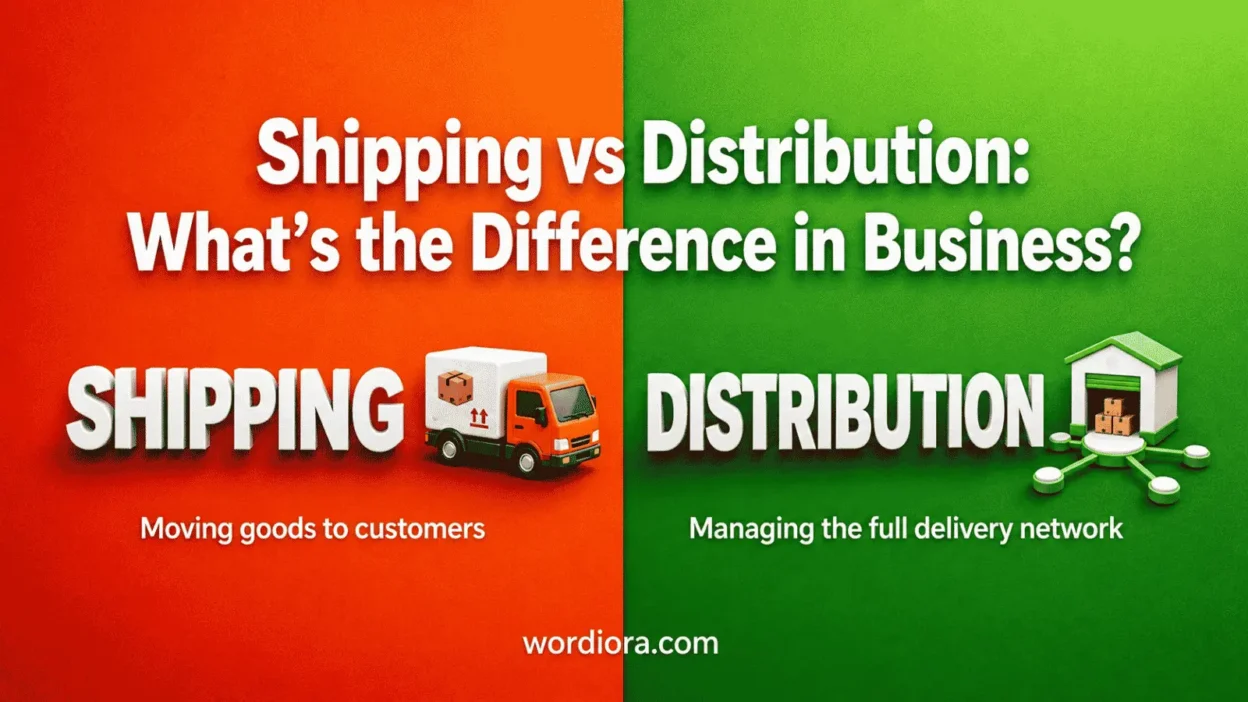
People often use shipping and distribution as if they mean the same thing, but they usually do not. In business English, shipping most often refers to sending goods from one place to another, while distribution is broader and usually refers to how goods are moved through channels, facilities, and intermediaries until they reach sellers or end users. Shipping can be one part of distribution, but distribution is not just shipping.
Quick Answer
Use shipping when you mean the physical sending or transport of goods, especially an order, package, or freight movement. Use distribution when you mean the broader system of getting products into the market, including warehouses, channels, retailers, and final delivery paths. In plain terms, shipping is a movement; distribution is a wider business process.
Why People Confuse Them
The confusion happens because the two words overlap in real operations. A company may ship inventory to a warehouse, ship orders to customers, and also talk about its distribution network, distribution center, or distribution strategy. Since all of those involve moving goods, the terms can sound interchangeable in casual conversation. But in more precise writing, distribution usually covers a bigger system than shipping does.
Another reason is that customer-facing language tends to prefer shipping. Online stores talk about shipping fees, shipping times, and free shipping. Operational or strategic language more often uses distribution for channels, allocation, placement, and network design.
Key Differences At A Glance
This is the simplest way to separate the two terms in everyday business writing. The table reflects standard dictionary meaning for shipping and standard business use of distribution and distribution channels.
| Context | Best Choice | Why |
| Sending a customer order | Shipping | The focus is the package being sent out |
| Talking about shipping fees or speed | Shipping | This is standard customer-facing wording |
| Describing a warehouse network | Distribution | The focus is the system, not one shipment |
| Explaining how products reach retailers | Distribution | This is about channels and market flow |
| Referring to a parcel already in transit | Shipping | The movement itself is the main idea |
| Referring to product placement across regions | Distribution | The idea is allocation across a network |
Meaning and Usage Difference
At its core, shipping means the act or business of sending goods. In current business English, it can refer to transport by sea, road, air, or other methods, even though the word historically came from transport by ship.
Distribution, by contrast, usually refers to the process or system by which goods are spread through the market. That may include distribution centers, wholesalers, retailers, route planning, and the broader channel that moves goods from producer to user.
A useful way to think about it is this: shipping is usually one event or one stream of transport, while distribution is usually the larger commercial setup around product movement. That reading is consistent with dictionary definitions of shipping and business definitions of distribution channels and distribution management.
| Feature | Shipping | Distribution |
| Main idea | Sending goods | Getting goods through the market |
| Scope | Narrower | Broader |
| Typical focus | Transit, orders, carriers, fees | Channels, warehouses, placement, network |
| Common audience | Customers, support teams, operations | Operations, supply teams, managers, planners |
| Typical question | “When will it ship?” | “How will we reach stores or regions?” |
Tone, Context, and Formality
Shipping usually sounds more direct and concrete. It fits product pages, emails, customer service updates, order notices, and logistics conversations about what is leaving or already in transit. It is often the clearer word when a reader cares about one package, one order, one truckload, or one outbound movement.
Distribution sounds broader and more operational. It works better in planning documents, internal reports, channel discussions, and strategy language about how products are stored, routed, or made available across markets. It is not necessarily more formal, but it is usually more system-level.
Which One Should You Use?
Use shipping when your sentence is about sending something out.
Use distribution when your sentence is about how goods are organized, routed, or made available across a business network.
Here is a practical test. If you could replace the word with sending, dispatch, or delivery movement, shipping is probably the better choice. If you could replace it with channel, allocation, market flow, or network movement, distribution is probably the better choice. That is a usage-based judgment drawn from how the terms are defined and commonly used in business references.
When One Choice Sounds Wrong
Some sentences sound off because they use distribution where ordinary readers expect shipping. For example, “Free distribution on orders over $50” sounds unnatural in most U.S. retail contexts. Customers expect “Free shipping.” Cambridge’s current definition of shipping directly supports that consumer-facing use.
The reverse also happens. “Our shipping strategy includes regional wholesalers, retail partners, and shelf placement” sounds too narrow because the sentence is really about a channel system, not just transport. In that case, distribution strategy is the better fit.
Common Mistakes (and Quick Fixes)
A common mistake is using shipping for every kind of product movement. That can blur the difference between an order leaving a facility and a company’s wider route to market. If the sentence covers warehouses, intermediaries, or sales channels, switch to distribution.
Another mistake is using distribution for customer-order language. In most everyday retail writing, readers do not ask about “distribution times” or “distribution charges.” They ask about shipping times and shipping costs.
A third mistake is assuming the words differ only by scale. Scale matters, but the bigger difference is function. Shipping is mainly about transport. Distribution is about how goods move through a business system to reach the market.
Everyday Examples
“Our warehouse started shipping replacement parts the same day.”
“The brand expanded its distribution into grocery chains across the Midwest.”
“We offer free shipping on orders over $75.”
“The company changed its distribution model by adding two regional centers.”
“The order has not finished shipping yet” sounds less natural than “The order has not shipped yet,” but the noun still works in phrases like “shipping status” or “shipping delay.” Current dictionaries reflect both the noun and verb patterns behind that difference.
Dictionary-Style Word Details
Verb
Shipping: As a verb form from ship, it means to send or transport goods from one place to another, and in modern business English that can include transport by air, road, rail, or sea.
Distribution: The common business term is usually the noun distribution. The verb behind it is distribute, meaning to give out, deliver, or spread across people, places, or channels. Merriam-Webster’s definition of distribution reflects that broader idea of distributing rather than merely sending.
Noun
Shipping: The noun usually means the act or business of sending goods.
Distribution: The noun usually means the act or process of distributing, and in business it also refers to the marketing or channel movement of goods.
Synonyms
For shipping, close choices include sending, transport, dispatch, and sometimes delivery depending on context. For distribution, close choices include allocation, circulation, channel movement, and market placement, though none is a perfect substitute in every sentence.
Example Sentences
Shipping: “The supplier is shipping the replacement units tomorrow.”
Shipping: “We reduced shipping costs by consolidating outbound orders.”
Distribution: “The company improved distribution by opening a new regional center.”
Distribution: “Their distribution agreement gives them access to large retail chains.”
These examples follow the current dictionary and business uses of the two terms.
Word History
Shipping: The noun goes back centuries, and the sense tied to sending freight developed from the older word ship. Etymonline notes the freight-related sense from the late 15th century, while current dictionaries reflect the modern broader business use.
Distribution: The word comes through French and Latin roots tied to dividing or allotting. Etymonline traces it to Latin distribuere, and Merriam-Webster records its use in English from the 14th century.
Phrases Containing
Common phrases with shipping include shipping costs, shipping delay, shipping label, shipping status, and free shipping. Common phrases with distribution include distribution channel, distribution center, distribution network, and distribution strategy. These phrase patterns reflect current dictionary, business, and logistics usage.
Conclusion
Choose shipping when the sentence is about sending goods out. Choose distribution when the sentence is about the broader path goods take through warehouses, channels, retailers, or markets. That is the cleanest way to separate the terms. They are related, and shipping often sits inside distribution, but they are not fully interchangeable. When precision matters, think movement for shipping and system for distribution.