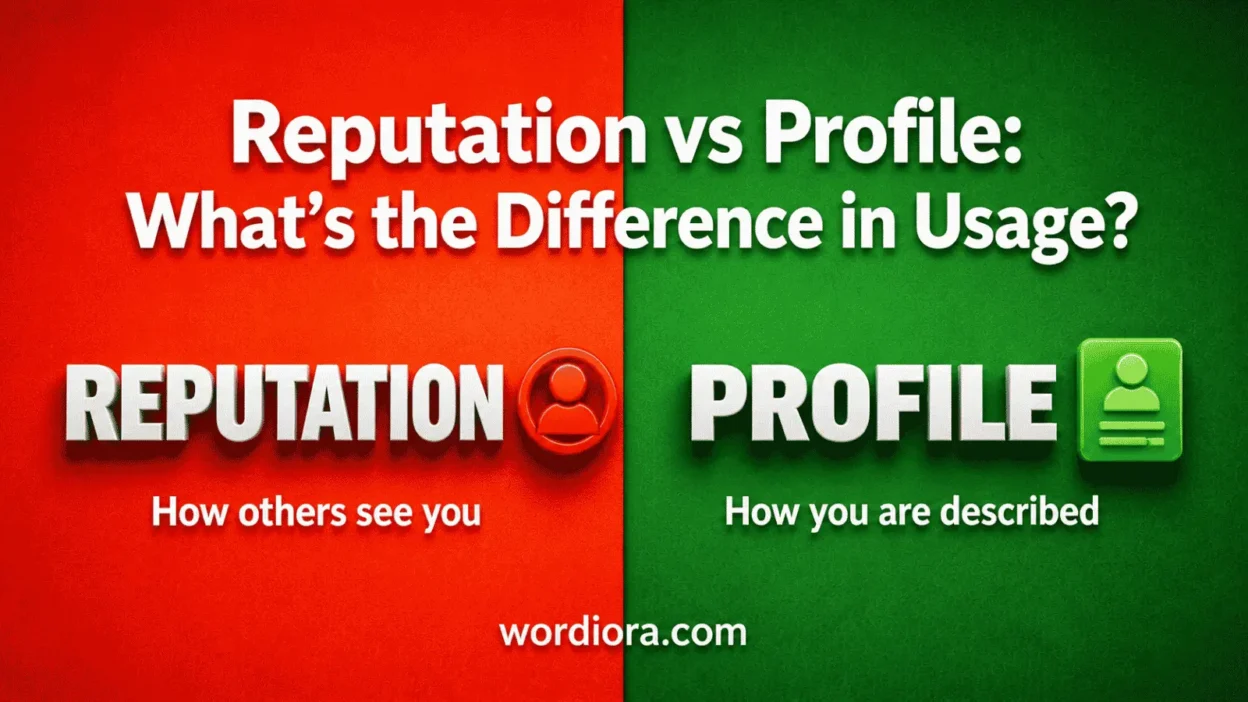
Reputation and profile are not interchangeable, even though they sometimes appear in the same conversations.
In plain English, reputation is what people think about someone or something, especially based on past behavior, performance, or character. Profile is a summary, description, or visible presentation of a person, company, or subject. One is mainly about public judgment. The other is mainly about information and presentation.
That distinction matters because using the wrong word can make a sentence sound slightly off. A business usually builds a reputation, but it updates a profile. A candidate may have a strong professional reputation, but a weak LinkedIn profile. A restaurant can have a polished profile page online and still have a poor reputation.
Quick Answer
Use reputation when you mean public opinion, trust, status, or the overall impression people have formed.
Use profile when you mean a written summary, an online account, a visible presence, or a description that presents key details.
If people are judging, remembering, trusting, or warning others, reputation is usually the right choice. If people are reading, viewing, updating, or presenting information, profile is usually the better choice.
Why People Confuse Them
People confuse these words because both relate to how someone appears in public.
They often overlap in business, hiring, marketing, and online communication. A company profile affects first impressions. A company’s reputation affects whether people believe those impressions. A personal profile can help someone look polished, but reputation comes from what others experience and say.
That overlap creates confusion. Writers sometimes use profile when they really mean visibility or standing. Others use reputation when they really mean a page, summary, or public-facing description.
A simple way to separate them is this:
- Reputation lives in other people’s minds.
- Profile lives on a page, platform, document, or presentation.
- Reputation is earned or damaged.
- Profile is created, updated, viewed, or edited.
Key Differences At A Glance
| Context | Best Choice | Why |
| People trust the company because it has been reliable for years | Reputation | The focus is public judgment built over time |
| She rewrote her LinkedIn page before applying for jobs | Profile | The focus is an online summary or account |
| The restaurant has a bad name after repeated complaints | Reputation | The issue is public opinion and standing |
| The magazine ran a short piece about the new mayor | Profile | The piece is a descriptive feature or summary |
| The brand wants to raise its visibility online | Profile | This often points to public presence or presentation |
| The law firm is known for discretion and strong results | Reputation | This describes what others think of it |
Here is the core contrast:
- Reputation = public opinion, regard, standing, name
- Profile = description, account, summary, presentation, visible presence
Meaning and Usage Difference
Reputation refers to the opinion people generally hold about someone or something. It often carries an evaluative tone. A person may have a good reputation, a bad reputation, or a reputation for being direct, generous, late, careful, or difficult.
Examples:
- That surgeon has an excellent reputation.
- The store has a reputation for slow shipping.
- He ruined his reputation with one careless decision.
Profile usually refers to a set of details that describes a person, business, group, or subject. It can mean an online account, a short written portrait, or a visible public presence.
Examples:
- Please complete your customer profile.
- Her dating profile was funny and clear.
- The newspaper published a profile of the new coach.
So the difference is not subtle once the sentence is clear. Reputation is about what people believe. Profile is about what is presented or recorded.
Tone, Context, and Formality
Reputation often sounds more weighty. It suggests history, consequences, trust, and social judgment. It fits naturally in business, legal, academic, and professional contexts, but it also works in everyday speech.
Examples:
- The company is trying to protect its reputation.
- He has a reputation for missing deadlines.
Profile is broader and often more neutral. It works in digital, editorial, social, and administrative settings. It can sound practical rather than moral or evaluative.
Examples:
- Update your employee profile before Friday.
- Her public profile has grown in the last year.
In some cases, profile can also mean prominence or visibility, as in “a high-profile case.” But that use is different from the noun in “online profile.” It points more to public attention than to a summary page.
Which One Should You Use?
Choose reputation when the sentence is about credibility, trust, social standing, or how others judge someone over time.
Choose profile when the sentence is about a visible description, a digital account, a short feature, or how something is presented to viewers or readers.
A good test is to replace the word with a simpler phrase.
If you mean:
- “what people think about them,” choose reputation
- “the page or summary about them,” choose profile
Compare these:
- The school has a strong reputation in science.
- The school’s online profile needs updated admissions information.
Both can be true, but they are not saying the same thing.
When One Choice Sounds Wrong
Sometimes one word is technically understandable but still unnatural.
These are natural:
- She has a strong professional reputation.
- He updated his social media profile.
These sound wrong or awkward:
- She has a strong professional profile.
This might work only if you mean visibility or public prominence, not trust or standing. - He updated his social media reputation.
This sounds wrong because a reputation is not something you directly edit like a page.
Another mismatch:
- The restaurant’s profile was damaged by bad reviews.
This sounds less natural if you mean public standing. Reputation is better. - The restaurant’s reputation includes hours, photos, and location.
That information belongs in a profile, not a reputation.
Common Mistakes (and Quick Fixes)
A common mistake is using profile when the real idea is approval or trust.
Wrong:
- Our brand profile depends on customer satisfaction.
Better:
- Our brand reputation depends on customer satisfaction.
Another common mistake is using reputation for a written description or platform page.
Wrong:
- Please upload a photo to your reputation.
Better:
- Please upload a photo to your profile.
Writers also blur the line in hiring language.
Less natural:
- She has an impressive profile as someone who always delivers.
Better:
- She has an impressive reputation as someone who always delivers.
But in this sentence, profile is right:
- She has an impressive profile on the firm’s website.
Everyday Examples
Here are natural everyday examples that show the difference clearly:
- That mechanic has a good reputation around town.
- I checked his dating profile before agreeing to meet.
- The hotel’s reputation dropped after the renovation problems.
- Her author profile includes a short bio and recent books.
- The bakery built its reputation through consistency and friendly service.
- Your applicant profile is missing work history.
- He wants a higher public profile, but he also needs a better reputation.
That last example shows how the two words can appear together without overlapping. A person may be more visible without being more respected.
Dictionary-Style Word Details
Verb
Reputation: Not normally used as a standard verb in everyday modern English.
Profile: Common as a verb. It can mean to describe, outline, feature, or analyze someone or something.
Examples:
- The article profiled three local business owners.
- The report profiled consumer spending habits.
Noun
Reputation: Public opinion or general regard based on character, conduct, or performance.
Profile: A summary, account, descriptive sketch, online account page, or public-facing set of details.
Synonyms
Reputation: standing, name, repute, image, credibility
Profile: summary, bio, description, account, overview
These are only partial matches. For example, image can overlap with both words depending on context, so it should be used carefully.
Example Sentences
Reputation:
- The nonprofit has a reputation for careful financial oversight.
- She earned a reputation as the person who fixes last-minute problems.
- One careless post can hurt a professional reputation.
Profile:
- His company profile reads more like a sales pitch than a summary.
- I updated my profile picture and job title this morning.
- The magazine published a profile of a rising chef in Chicago.
Word History
Reputation: This word has long been tied to ideas of public regard, character, and what people believe about someone or something.
Profile: This word developed through senses connected to outline and description, which helps explain why it now fits summaries, accounts, and featured portraits.
Phrases Containing
Reputation:
- good reputation
- bad reputation
- solid reputation
- reputation for honesty
- protect your reputation
Profile:
- online profile
- customer profile
- company profile
- public profile
- profile page
Conclusion
Choose reputation when your real meaning is trust, standing, or public opinion. Choose profile when your meaning is a written summary, online account, or public-facing description.
That is the difference in one line: reputation is what people think; profile is what people see or read about you.
When you are deciding between them, ask whether the sentence is about judgment or presentation. If it is about judgment, use reputation. If it is about presentation, use profile.