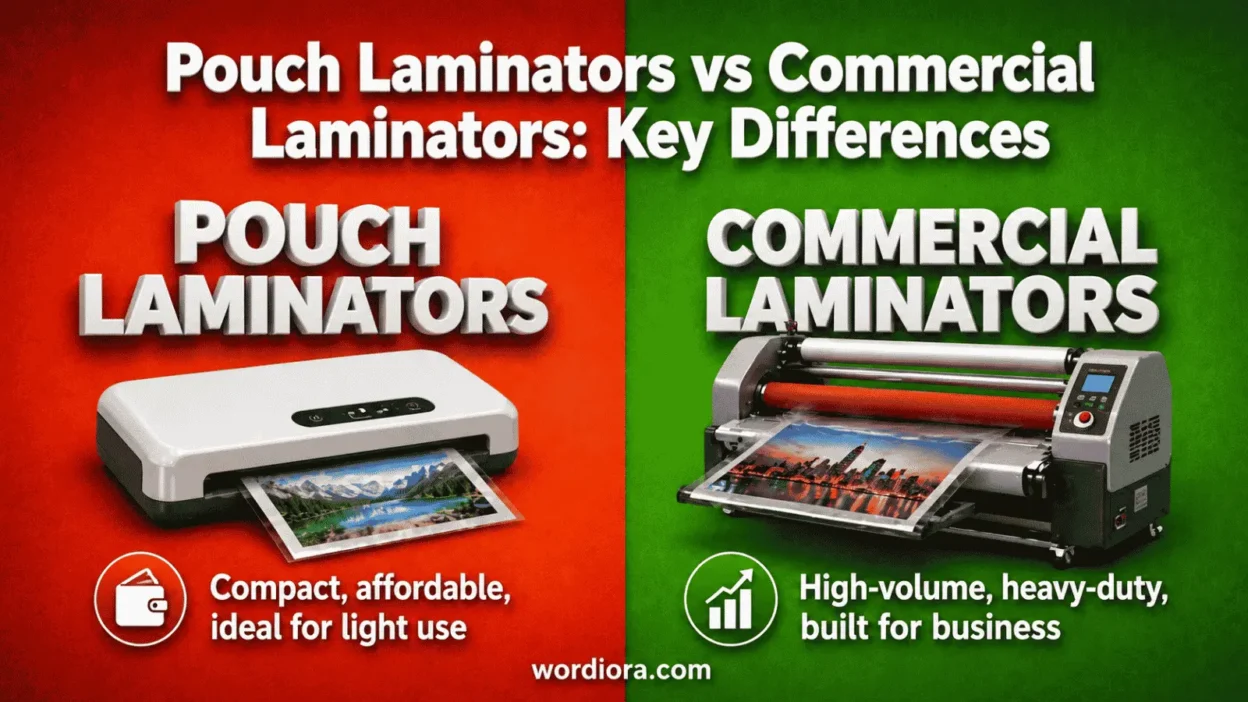
People often use pouch laminators and commercial laminators as if they mean the same thing, but they do not. A pouch laminator describes a machine type that uses presealed laminating pouches. A commercial laminator usually describes a heavier-duty machine built for higher-volume, faster, or larger-format work, and that category often includes roll laminators rather than basic pouch models.
Quick Answer
Use pouch laminator when you mean a laminator that seals documents inside laminating pouches. Use commercial laminator when you mean a machine intended for business, print-shop, school, or other high-output use. The first term points to the laminating method. The second points to the machine’s workload class and intended setting.
Why People Confuse Them
The confusion happens because many small office laminators are pouch laminators, and many people first encounter laminating through a desk-size pouch machine. That makes it easy to assume “commercial” is just a fancier way to say the same thing. But public buying guides and supplier glossaries treat these as different kinds of labels: one names the format, while the other signals scale, speed, capacity, and work environment.
Key Differences At A Glance
| Context | Best Choice | Why |
| You mean a machine that uses laminating pouches | Pouch laminator | It names the specific laminating system |
| You mean a high-volume machine for shared or professional use | Commercial laminator | It names the workload class |
| You are talking about desk-size school or office machines | Pouch laminator | Many machines in this group use pouches |
| You are talking about print-shop, signage, or large-format output | Commercial laminator | These machines are often built for faster, larger, heavier-duty work |
| You need to contrast pouch-fed and roll-fed equipment | Pouch laminator and commercial laminator only if the second machine is truly production-grade | “Commercial” is broader than “roll” |
Pouch laminator: defined by pouch-based lamination, usually compact and straightforward to use.- Commercial laminator: defined by production demands, often larger, faster, and more adjustable.
- Important point: a commercial laminator may be a roll laminator, a wide-format machine, or another production-oriented model. It is not just “any laminator used at work.”
Meaning and Usage Difference
Pouch laminator is the more exact term when the machine uses folded plastic pouches that seal around a document. That is a direct equipment description.
Commercial laminator is broader. It usually refers to a machine designed for frequent, shared, or production-level use. In real-world listings and guides, that often means roll laminators with higher speed, more adjustability, larger width capacity, or support for specialty film and mounting work.
So the difference is simple: pouch tells you how the machine laminates, while commercial tells you what level of work the machine is built to handle.
Tone, Context, and Formality
In everyday office talk, pouch laminator sounds more precise and practical. It tells the reader exactly what supplies the machine takes. That makes it the better choice for instructions, office lists, classroom supply notes, and product descriptions.
Commercial laminator sounds broader and more industry-facing. It fits buyer’s guides, vendor pages, print-room discussions, and operations planning because it highlights throughput, workspace needs, and business use rather than just feed format.
Which One Should You Use?
Use pouch laminator when the exact machine type matters.
Example: “We need a pouch laminator for staff badges and letter-size handouts.”
Use commercial laminator when the production role matters more than the feed style.
Example: “The print room needs a commercial laminator for daily poster runs.”
If you are naming a specific machine for purchasing or setup, pouch laminator is often the safer term because it is more concrete. If you are comparing light-duty equipment with production-grade equipment, commercial laminator is usually the better term.
When One Choice Sounds Wrong
Commercial laminator sounds wrong when the machine is a small personal model used occasionally at a desk. A home or classroom pouch machine may be used in a business, but that alone does not make “commercial laminator” the clearest label. Heavy-use guidance from major brands separates occasional-use and frequent-use machines rather than treating every office laminator as commercial equipment.
Pouch laminator sounds wrong when you are talking about large-format production, mounting, or sustained high-volume jobs. In those cases, supplier references usually move into roll or commercial language because the work goes beyond what people normally picture as a basic pouch setup.
Common Mistakes (and Quick Fixes)
One common mistake is using commercial laminator just to mean “expensive laminator.” Price is not the real distinction. Duty cycle, output, size range, and production features matter more.
Another mistake is using pouch laminator as if it covers all professional laminating equipment. It does not. Many production environments use roll systems because they handle larger sheets, bulk film, and higher volume more efficiently.
Quick fixes:
“Order a commercial laminator for the front desk.” → “Order a pouch laminator for the front desk.”
“We run posters through our pouch laminator in the print shop all day.” → “We run posters through our commercial laminator in the print shop all day.”
Everyday Examples
“The office manager replaced our old pouch laminator because it kept jamming on ID cards.”
“For occasional classroom projects, a pouch laminator usually makes more sense than a commercial laminator.”
“The copy center upgraded to a commercial laminator so staff could handle larger signs faster.”
“This machine is commercial, but it is not a pouch laminator.”
“We only laminate menus once in a while, so a pouch laminator is enough for us.”
Dictionary-Style Word Details
Verb
Neither pouch laminator nor commercial laminator is normally used as a verb. In natural American English, the verb is usually laminate.
Correct: “We laminate staff cards in-house.”
Less natural: “We commercial-laminator the cards.”
Noun
Pouch laminator is a count noun for a machine that laminates with pouches. Public product guides describe pouch laminators as machines that seal documents inside preformed laminating pouches.
Commercial laminator is a count noun for a business-grade or production-grade laminating machine. Public supplier pages use the term for higher-output machines meant for print centers, copy shops, and similar workspaces.
Synonyms
For pouch laminator, close alternatives include pouch machine, thermal pouch laminator, and sometimes desk laminator when the context is small-format office equipment.
For commercial laminator, close alternatives include production laminator, roll laminator in many cases, wide-format laminator for large graphics, and professional laminator in general product language. These are not always perfect substitutes, but they overlap in real usage.
Example Sentences
Pouch laminator: “Buy a pouch laminator if you mainly seal certificates, handouts, and small signs.”
Commercial laminator: “Buy a commercial laminator if your team laminates daily and needs faster output.”
Pouch laminator: “The school keeps a pouch laminator in the main office for visitor badges.”
Commercial laminator: “The print shop uses a commercial laminator for larger graphics and steady production work.”
Word History
The wording follows equipment categories that suppliers and buyers use today rather than a single fixed rule from one style manual. Public glossaries distinguish pouch from roll by feed method, while buying guides use commercial to signal heavier-use machines for shared or production environments. That is why the two labels overlap in conversation but still do different jobs.
Phrases Containing
Common phrases with pouch laminator include thermal pouch laminator, hot and cold pouch laminator, and A3 pouch laminator.
Common phrases with commercial laminator include commercial roll laminator, commercial mounting laminator, and wide-format commercial laminator.
Conclusion
If you are choosing between the two terms, the safest rule is this: use pouch laminator for the machine type, and use commercial laminator for the workload class. One names the format. The other names the level of use. When you want precision, especially in office or school settings, pouch laminator is usually the clearer label. When you are talking about production, scale, or print-room equipment, commercial laminator is the better fit.