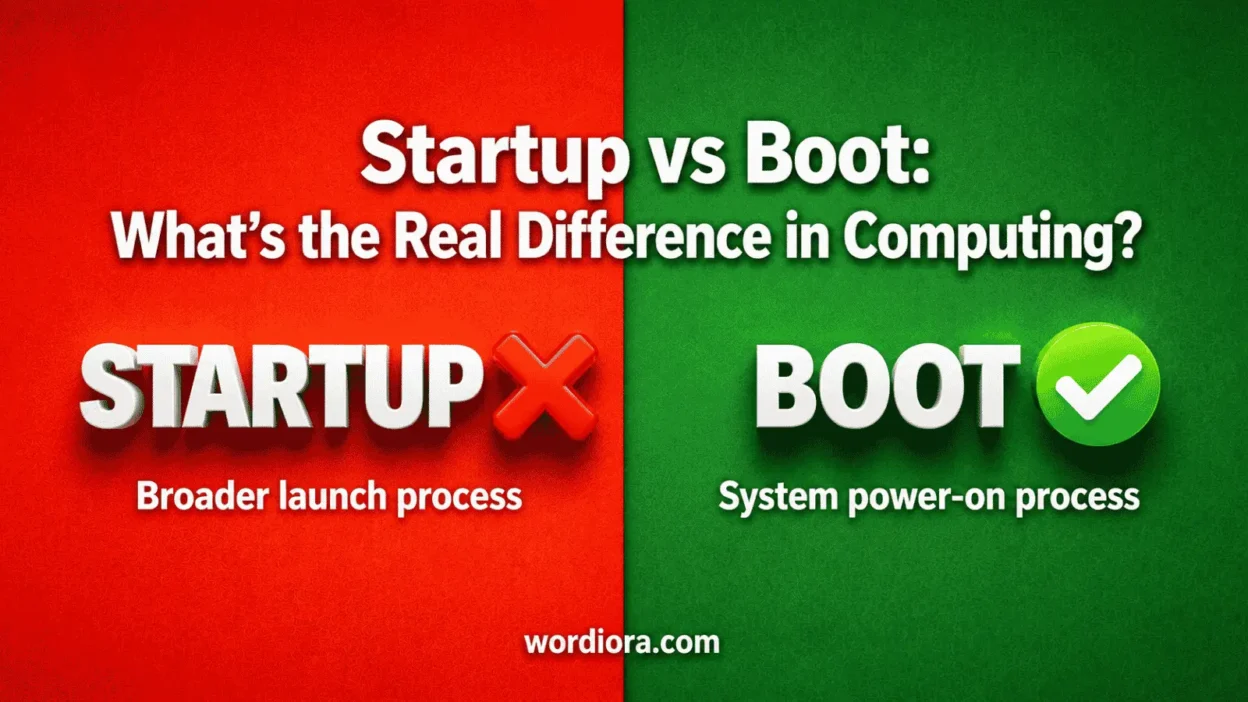
Startup vs boot is a word-choice question, but it is not the kind of comparison where one word is simply right and the other is wrong. In computing, the two terms are related, and many people use them loosely as near equivalents. Still, they are not always identical. In more precise technical writing, boot usually refers to the earlier process of loading the system, while startup often works as the broader or later label for getting the machine fully ready to use.
That distinction matters most when you are writing documentation, troubleshooting instructions, or anything that needs to sound exact. In casual conversation, either term may be understood. In technical contexts, though, choosing the better one makes your meaning clearer.
Quick Answer
Use boot when you mean the machine’s initial loading process, especially the stage where firmware, boot loaders, and the operating system begin to load. Use startup when you mean the broader getting-ready process or the later phase where the system finishes loading settings, services, and the user environment. In everyday speech, people often blur the distinction, but in careful computing English, boot is usually narrower and more specific.
Why People Confuse Them
People confuse these terms because dictionaries and general tech explanations often connect them very closely. Cambridge defines start-up in computing as the process a computer goes through when it starts operating, and Lenovo describes boot as the process of starting up a computer system. So if you look only at broad definitions, the words seem interchangeable.
The confusion grows because many operating-system resources use both words in nearby ways. Some technical references separate boot from startup as two stages, while others use startup as an umbrella label that includes boot-related phases. That is why readers often sense a difference without being sure where the line is.
Key Differences At A Glance
| Context | Best Choice | Why |
| The computer begins loading firmware and the OS | Boot | This is the most precise technical term for the initial loading stage. |
| A guide to everything that happens before the desktop is ready | Startup | This often works as the broader user-facing label. |
| “My PC won’t ___” in casual conversation | Boot or startup | Either may be understood, though boot is more technical. |
| Windows settings and recovery wording | Startup | Microsoft commonly uses startup in user-facing labels. |
| Low-level system sequence documentation | Boot | Technical sources often reserve boot for the earlier sequence. |
The shortest practical rule is this: boot points to the initial system-loading action, while startup often points to the overall readiness process or the user-facing framing of it.
Quick comparison
- Boot = narrower, more technical, earlier-stage wording
- Startup = broader, more general, often more user-facing wording
- They can overlap in casual use
- They are easiest to separate when you are describing system phases or troubleshooting steps
Meaning and Usage Difference
Boot is the stronger choice when your sentence is about the system coming alive at a low level. That includes actions like loading firmware checks, launching the boot loader, and beginning the operating-system load. If you are talking about whether a machine can begin that sequence at all, boot is usually the cleanest word.
Startup is more flexible. It can mean the act of setting something in operation in general English, and in computing it can refer to the process a computer goes through when it starts operating. Because of that broader range, startup often sounds more natural in user-facing instructions, settings labels, and discussions of what happens after the earliest boot stage.
There is also a reason some writers hesitate with startup: outside computing, it commonly means a new business. In a sentence with no computer context, startup may briefly suggest entrepreneurship instead of system launch. Boot rarely has that problem in technical writing, even though it has many other dictionary meanings outside computing.
Tone, Context, and Formality
In tone, boot sounds more technical, more exact, and more natural in engineering or system-administration contexts. It fits sentences like “the device fails to boot,” “boot order,” and “boot loader error.” Those phrases sound standard because they name specific parts of the system sequence.
Startup sounds a little broader and more user-oriented. It fits phrases like “startup settings,” “startup issues,” and “startup programs.” That wording is common in operating-system interfaces and support material because it feels accessible and covers more than the low-level loading event alone.
Neither term is inherently more formal in ordinary English. The better choice depends on what layer of the process you mean and how technical your audience is. For general users, startup may feel more familiar. For precise system language, boot often sounds better.
Which One Should You Use?
Use boot when your sentence is about whether the machine can begin the operating-system loading sequence.
Use startup when your sentence is about the broader launch experience, including settings, services, apps, or the system becoming fully ready.
Use either one in casual speech only if precision does not matter much.
A simple test helps: if you could replace the term with “initial system load,” choose boot. If you mean “the overall getting-ready process,” choose startup. That rule matches the way technical references commonly separate the ideas, even though some general definitions overlap.
When One Choice Sounds Wrong
Startup sounds wrong when the sentence is very low-level or names a boot-specific component. For example, “startup loader,” “startup sector,” or “startup order” usually sounds off because standard computing English strongly favors boot loader, boot sector, and boot order.
Boot can sound wrong when the context is clearly broader or attached to established interface wording. “Boot settings” may be possible in some technical contexts, but in common Windows user guidance, Startup Settings is the established phrase. The same goes for phrases like “startup apps” or “startup repair,” where boot would narrow the meaning too much or simply sound unnatural.
Common Mistakes (and Quick Fixes)
One common mistake is treating startup and boot as perfectly interchangeable in every sentence. They overlap, but they do not always point to the same stage. If your sentence is about the earliest load process, switch to boot. If it is about the broader launch experience, startup is often better.
Another mistake is forgetting that startup also has a strong business meaning. A sentence like “the startup failed” may sound like you are talking about a company, not a computer, unless the surrounding context makes the technical sense obvious. When clarity matters, write “the system failed to boot” or “the startup process stalled.”
A third mistake is forcing boot into phrases that are already fixed in operating-system language. Instead of rewriting familiar labels, match the established wording your readers will actually see on screen.
Everyday Examples
“The laptop will not boot after the firmware update.” This works because the problem concerns the initial loading stage.
“Too many apps are slowing down startup.” This works because the focus is on the broader launch experience after the system begins loading.
“The server completed the boot sequence, but startup services still failed.” This is a good contrast sentence because it uses the narrower technical sense of boot and the broader follow-on sense of startup in the same line. That distinction is consistent with sources that split the process into early boot and later startup stages.
“If your PC gets stuck during startup, open Startup Settings.” This sounds natural because it matches familiar user-facing Windows wording.
Dictionary-Style Word Details
Verb
Startup: As a standalone verb, startup is not the standard form. The verb phrase is usually start up, not startup. In this comparison, startup is mainly a noun or adjective.
Boot: Boot is a standard verb in computing. It means to start a computer system or for a computer to become ready by loading what it needs.
Noun
Startup: As a noun, startup can mean the act of setting something in motion, the computing launch process, or a new business. In this comparison, the computing sense is the one that matters most.
Boot: As a noun, boot has many meanings in English, but in computing it refers to the startup procedure or the act of loading the system.
Synonyms
Startup: Depending on context, near alternatives include launch, initialization, system start, and power-up sequence. None of these is always a perfect substitute, but they can be close in user-facing writing. The best synonym depends on how technical the sentence is.
Boot: Near alternatives include boot-up, initial load, system boot, and sometimes reboot if you specifically mean starting again. These are related terms rather than exact matches in every context.
Example Sentences
Startup: “Windows startup took longer after I added several background programs.” “The startup process reached the recovery menu instead of the desktop.”
Boot: “The workstation will not boot from the internal drive.” “The device booted successfully, but a service failed afterward.”
Word History
Startup: Modern dictionaries recognize both start-up and startup as noun forms. In American usage, the closed form startup is common, especially in business and technology writing.
Boot: In computing, boot comes from bootstrap, the long-established term behind booting and rebooting. Modern dictionary and tech references still reflect that connection.
Phrases Containing
Startup: startup settings, startup issues, startup apps, startup process. These phrases are especially common in user-facing operating-system language.
Boot: boot process, boot loader, boot order, boot sector, boot device, boot successfully. These phrases are common in low-level technical discussion.
Conclusion
In startup vs boot, the better word depends on the layer of meaning you need. Choose boot for the initial system-loading stage and for precise technical phrasing. Choose startup for the broader, user-facing, or later-stage process of getting the system fully ready. In casual use, people often overlap the two. In careful writing, though, boot is usually the narrower term, while startup is the wider one.