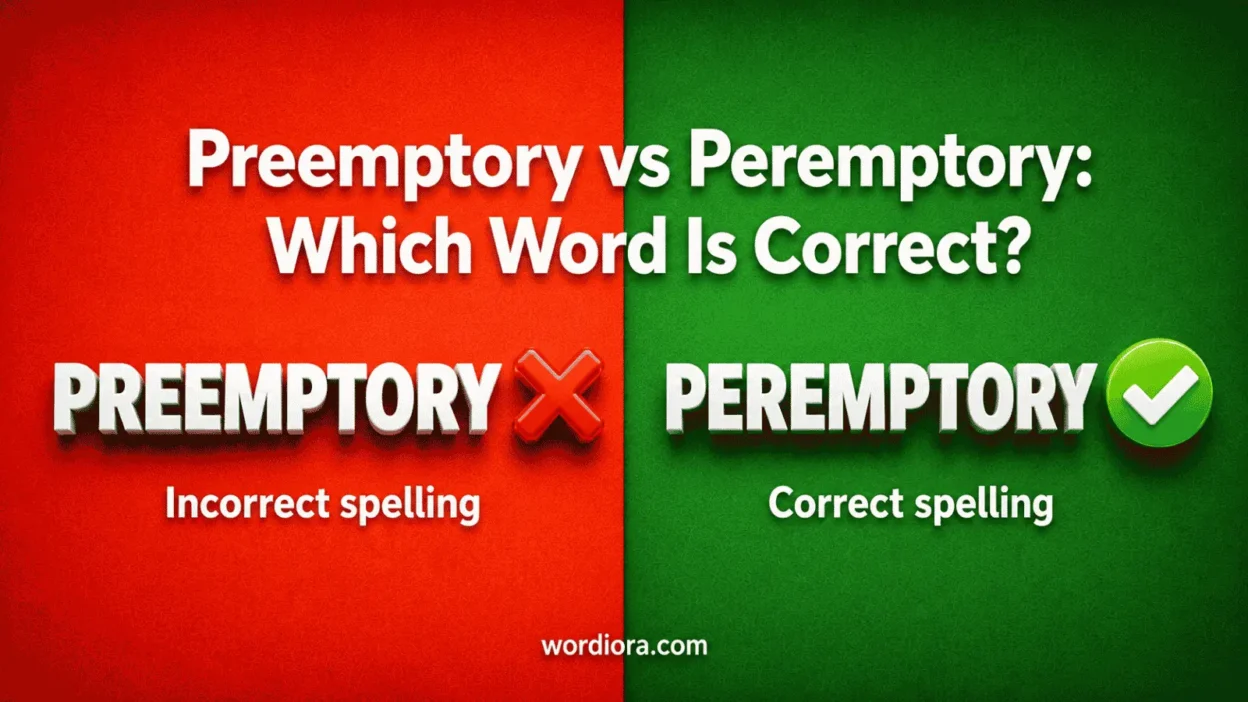
If you are choosing between preemptory and peremptory, the word most writers want is peremptory.
These two forms look close enough to cause hesitation, but they do not do the same job. In standard American English, peremptory is the established word for something abrupt, commanding, final, or not open to debate. Preemptory does exist, but it is rare and usually belongs only in writing about preemption. That means this is not a case where both choices work equally well.
Quick Answer
Use peremptory when you mean forceful, abrupt, decisive, or allowing no refusal.
Use preemptory only in the unusual case where you truly mean “related to preemption.” For most everyday, legal, academic, and professional writing, peremptory is the right choice.
Why People Confuse Them
The confusion is easy to understand.
First, the words are visually similar. Only one letter shifts, and both have a formal, Latinate sound.
Second, many readers already know the verb preempt or the adjective preemptive. Because those forms are common, preemptory can look like it ought to be the natural adjective. But in actual usage, English settled on peremptory for the idea of something commanding, final, or not open to argument.
Third, some writers assume preemptory is just an alternate spelling. In most cases, it is not. It points in a different direction.
Key Differences At A Glance
| Context | Best Choice | Why |
| A judge gives a final order | peremptory | It means decisive or not open to delay |
| A manager uses a sharp, commanding tone | peremptory | It means abrupt or authoritative |
| A legal phrase like “peremptory challenge” | peremptory | This is the fixed standard form |
| Something relating to preemption | preemptory | This rare form connects to preemption |
| Everyday writing where you mean “bossy” or “final” | peremptory | That is the recognized word readers expect |
Compact comparison
- Peremptory: standard, established, formal, often legal or high-register
- Preemptory: rare, specialized, tied to the idea of preemption
- Not interchangeable: usually no
- Safer default: peremptory
Meaning and Usage Difference
Peremptory describes something that does not leave room for refusal, delay, or contradiction. It can describe commands, deadlines, rulings, tones, and manners.
Examples of meaning:
- a peremptory order
- a peremptory tone
- a peremptory dismissal
- a peremptory legal ruling
It often carries one of two shades. The first is final and decisive. The second is brisk, bossy, or imperious.
Preemptory, by contrast, is a much narrower form. It refers to something connected to preemption. That idea belongs to language about taking priority, acting ahead of something else, or displacing another claim or action. Because that meaning is so limited, most writers never need the word at all.
Tone, Context, and Formality
Peremptory is formal and somewhat elevated. It sounds at home in legal writing, academic prose, journalism, and polished commentary. In everyday conversation, people often choose plainer alternatives like abrupt, bossy, sharp, authoritative, or final.
Examples:
- “Her reply was peremptory and ended the discussion.”
- “The court issued a peremptory order.”
- “He gave a peremptory wave that made everyone step back.”
Preemptory is not a natural choice in ordinary prose. Even in formal writing, it usually sounds odd unless the discussion truly centers on preemption. Because readers are far more familiar with preemptive than preemptory, the latter can feel mistaken even when it is technically defensible.
Which One Should You Use?
Choose peremptory in almost every normal comparison between these two words.
That is the right choice when you mean:
- commanding
- abrupt
- decisive
- not open to debate
- final in effect
- imperious in tone
Choose preemptory only when your meaning is specifically tied to preemption, and even then, consider whether a clearer word such as preemptive or a phrase like related to preemption would serve the sentence better.
For most writers, the real choice is simple: use peremptory.
When One Choice Sounds Wrong
Preemptory sounds wrong when you are describing a person’s manner, a command, a judicial action, or anything meant to suggest firmness or refusal.
These sound natural:
- “The supervisor’s peremptory tone ended the meeting.”
- “The court issued a peremptory instruction.”
- “She gave him a peremptory nod.”
These sound off:
- “The supervisor’s preemptory tone ended the meeting.”
- “The court issued a preemptory instruction.”
Why? Because readers do not hear preemption in those examples. They hear a standard tone-and-meaning context that belongs to peremptory.
Common Mistakes (and Quick Fixes)
Mistake: Using preemptory as a fancier spelling of peremptory
Fix: Replace it with peremptory unless you truly mean “related to preemption.”
Mistake: Assuming both words are equal variants
Fix: Treat peremptory as the normal word and preemptory as rare and specialized.
Mistake: Using preemptory because it resembles preemptive
Fix: Ask what you really mean. If you mean “acting ahead of something,” use preemptive or wording built around preemption. If you mean “abrupt” or “allowing no refusal,” use peremptory.
Mistake: Forcing peremptory into casual writing where it sounds stiff
Fix: In informal writing, simpler words may work better: sharp, brisk, firm, abrupt, or bossy, depending on tone.
Everyday Examples
Here are natural examples that show the difference clearly.
With peremptory:
- “The doctor’s peremptory instruction was to call 911 immediately.”
- “She rejected the proposal in a peremptory tone.”
- “His peremptory message left no room for follow-up questions.”
- “The judge set a peremptory deadline for filing the documents.”
With preemptory:
- “The article discussed the preemptory effect of federal law on the state rule.”
That second example is narrow and technical. In most general writing, it would be clearer to rewrite it:
- “The article discussed the preemptive effect of federal law on the state rule.”
- “The article discussed how federal law preempted the state rule.”
Dictionary-Style Word Details
Verb
Preemptory: Not used as a verb.
Peremptory: Not used as a verb.
Noun
Preemptory: Not normally used as a noun.
Peremptory: Not normally used as a noun.
Synonyms
Preemptory: related to preemption, preemptive, prior-claim, displacement-based
Peremptory: commanding, imperative, decisive, abrupt, authoritative, dictatorial, final
Example Sentences
Preemptory:
- “The brief examined the preemptory reach of the federal statute.”
Peremptory:
- “Her peremptory answer shut the conversation down.”
- “The attorney objected to the witness in a peremptory way.”
- “We received a peremptory notice requiring immediate action.”
Word History
Preemptory: Built from the same family as preempt and preemption, so it points to priority or prior claim. It is rare in ordinary American usage.
Peremptory: A long-established English adjective used for what is final, commanding, or not open to contradiction. It is especially common in formal and legal contexts.
Phrases Containing
Preemptory: preemptory effect, preemptory claim
Peremptory: peremptory order, peremptory tone, peremptory challenge, peremptory instruction
Conclusion
For nearly every writer, peremptory is the correct choice.
Use it when you mean abrupt, commanding, decisive, or not open to refusal. Treat preemptory as a rare, specialized word tied to preemption, not as a normal substitute. When in doubt, this rule will keep you on safe ground: if the sentence is about tone, authority, finality, or legal firmness, choose peremptory.