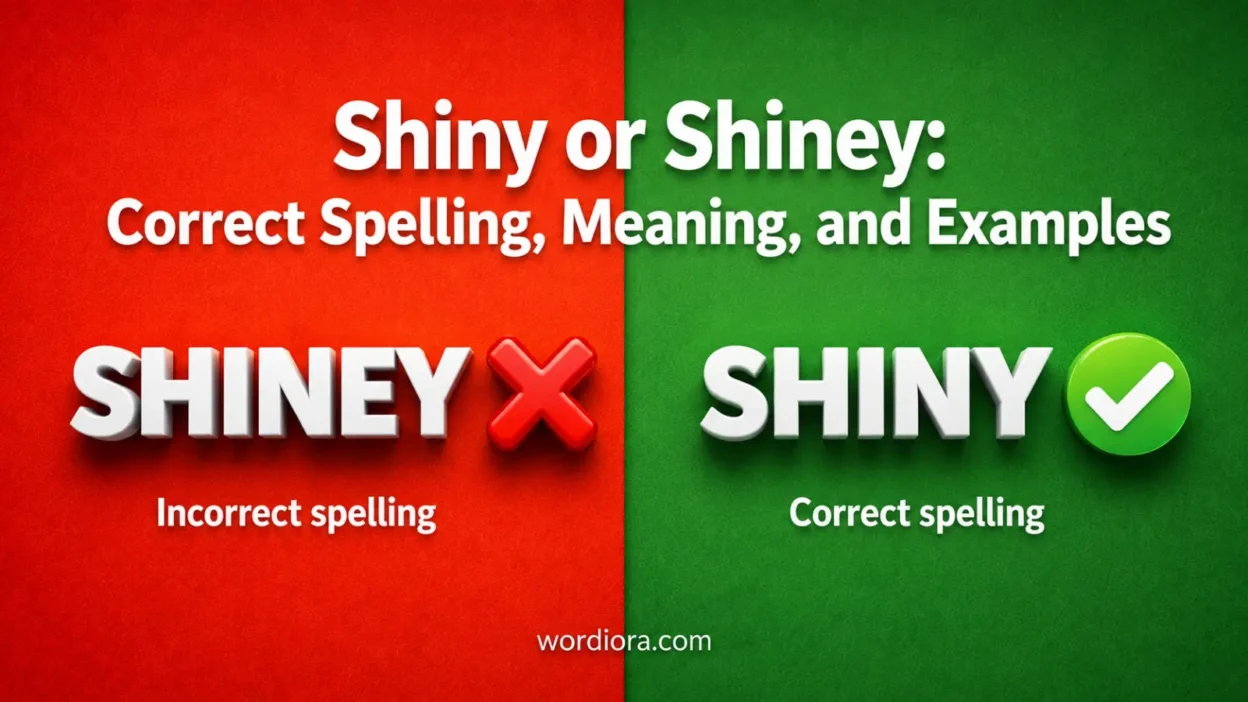
If you are choosing between shiny or shiney, the correct word is shiny. It describes something bright, smooth, glossy, or reflective. You might write about shiny shoes, shiny hair, a shiny car, or a shiny surface.
Shiney is a common misspelling. It looks believable because the base word shine ends in e, but standard English drops that e before adding -y. So the correct form is shiny, not shiney.
Quick Answer
Use shiny in standard US English. It is the correct adjective for something that reflects light, looks glossy, or appears bright and polished. Shiney is not a standard spelling, so avoid it in schoolwork, emails, articles, product descriptions, and professional writing.
Why People Confuse Them
People confuse shiny and shiney because shiney seems logical at first. The word shine already has an e, so many writers simply add y and keep the original spelling.
However, English often drops a silent e before adding a suffix that begins with a vowel sound or vowel letter. That is why shine + y becomes shiny.
The pronunciation also adds to the confusion. Both spellings would likely be read as SHY-nee, so the mistake is mostly visual. You will not hear the missing e when someone says the word.
Key Differences At A Glance
| Context | Best Choice | Why |
|---|---|---|
| Describing a polished car | shiny | It is the standard adjective. |
| Describing glossy hair | shiny | It means bright or reflecting light. |
| Writing for school | shiny | It is the accepted spelling. |
| Writing a product description | shiny | It looks clean and professional. |
| Casual texting | shiny | Correct spelling still works best. |
| Using shiney | shiny | Shiney is a misspelling. |
Meaning and Usage Difference
The real difference is simple: shiny is the correct word, and shiney is not standard.
Shiny means bright, glossy, polished, or reflective. It usually describes surfaces and objects that catch light.
Examples:
A mirror can be shiny.
A clean floor can look shiny.
A new phone case can have a shiny finish.
A person’s hair can look shiny after using conditioner.
Shiney does not have a separate meaning in standard English. It is usually just an incorrect spelling of shiny.
Here is the compact comparison:
| Feature | Shiny | Shiney |
| Standard spelling | Yes | No |
| Main role | Adjective | Misspelling |
| Meaning | Bright, glossy, reflective | No separate standard meaning |
| Use in formal writing | Correct | Avoid |
| Pronunciation | SHY-nee | Usually intended as SHY-nee |
Tone, Context, and Formality
Shiny is neutral. You can use it in casual, professional, academic, and creative writing.
It fits everyday sentences:
The table has a shiny finish.
She wore shiny black heels.
The kids picked up shiny rocks at the beach.
It also works in a slightly figurative way when something feels new, attractive, or exciting:
He bought a shiny new laptop.
The company announced a shiny new feature.
Shiney looks careless in most contexts. It may appear in typos, informal posts, or brand names, but it should not be used as the regular adjective.
Which One Should You Use?
Use shiny every time you mean bright, glossy, smooth, or reflective.
Choose shiny for:
School assignments
Blog posts
Emails
Social captions
Product pages
Business writing
Creative descriptions
Everyday messages
Avoid shiney unless it is part of a person’s name, a brand name, or quoted text. Even then, keep the spelling only because it belongs to that name or quote.
When One Choice Sounds Wrong
Shiney sounds wrong when readers notice the spelling. It may not change how the word sounds aloud, but it can make the sentence look unpolished.
Wrong: The kitchen floor looked shiney after cleaning.
Correct: The kitchen floor looked shiny after cleaning.
Wrong: He bought a shiney silver watch.
Correct: He bought a shiny silver watch.
Wrong: Her hair was soft and shiney.
Correct: Her hair was soft and shiny.
The correct form is short and easy to remember: shiny has no e before y.
Common Mistakes (and Quick Fixes)
Mistake: Keeping the e from shine
Fix: Drop the e before adding y.
Wrong: shiney
Correct: shiny
Mistake: Treating both spellings as variants
Fix: Use shiny as the standard form.
Wrong: Either shiny or shiney is fine.
Correct: Shiny is correct; shiney is a misspelling.
Mistake: Using shiney in product writing
Fix: Use shiny to keep the description clean.
Wrong: Shiney gold necklace
Correct: Shiny gold necklace
Mistake: Confusing shiny with shining
Fix: Use shiny for a quality and shining for an action or ongoing state.
The shoes are shiny.
The shoes are shining under the lights.
Everyday Examples
The shiny car looked brand-new after the wash.
She bought a shiny black purse for the party.
The dog’s coat looked shiny and healthy.
A shiny coin rolled under the couch.
The new kitchen counters are smooth and shiny.
He polished the trophy until it looked shiny.
The rain left the sidewalk shiny under the streetlights.
Her shiny earrings matched her silver necklace.
The package had a shiny label on the front.
That shiny finish may show fingerprints quickly.
Dictionary-Style Word Details
Verb
Shiny: Not commonly used as a verb in standard US English. Use shine when you need the verb.
Example: The lamp shines in the window.
Shiney: Not used as a standard verb. It is usually a misspelling of shiny, not a verb form.
Noun
Shiny: Not commonly used as a general noun in everyday standard writing. The related noun is shininess, which means the quality of being shiny. In some special communities, people may use “a shiny” as a shortened noun, but that is not the main general use.
Shiney: Not a standard noun in general English. Use shiny as the adjective or shininess for the noun idea.
Synonyms
Shiny: Closest plain alternatives include glossy, bright, polished, gleaming, lustrous, sparkling, and reflective.
Helpful opposites include dull, matte, dim, and flat, depending on context.
Shiney: No true synonyms apply because it is not a standard word. If you meant shiney, use shiny and then choose a synonym based on the sentence.
Example Sentences
Shiny: The shiny red bike stood out in the garage.
Shiny: Her shiny hair looked smooth in the sunlight.
Shiny: The bakery used shiny paper for the gift boxes.
Shiney: The word shiney should be corrected to shiny in standard writing.
Shiney: If you see shiney in your draft, remove the extra e.
Word History
Shiny: The word is connected to shine plus the adjective ending -y. In standard spelling, the final e in shine is dropped before -y, giving the form shiny.
Shiney: This spelling likely comes from keeping the e in shine by mistake. It is not treated as the standard form in everyday US English.
Phrases Containing
Shiny: Common phrases include shiny new car, shiny shoes, shiny hair, shiny surface, shiny finish, shiny object, and shiny new idea.
Shiney: No standard phrases use shiney as the correct spelling. Replace it with shiny in normal writing.
FAQs
Is shiny or shiney correct?
Shiny is correct. Shiney is a common misspelling, not a standard spelling in US English.
Why is shiny spelled without an e?
Shiny drops the final e from shine before adding -y. That gives the correct spelling: shiny.
Is shiney ever acceptable?
Use shiney only if it is part of a proper name, brand name, username, or quoted text. For the regular adjective, use shiny.
What does shiny mean?
Shiny means bright, glossy, smooth, polished, or reflective. A shiny object catches light or looks clean and bright.
Can shiny describe people’s hair or skin?
Yes. You can write shiny hair, shiny skin, or a shiny forehead when describing a glossy or light-reflecting look.
What is a good memory tip for shiny?
Remember this: shine drops e before y. That makes shiny, not shiney.
Conclusion
The correct choice is shiny. Use it when something looks bright, glossy, polished, smooth, or reflective. It is the standard spelling in US English and works in casual, school, business, and creative writing.
Avoid shiney unless it appears in a name or quoted text. For normal sentences, the rule is simple: write shiny without the extra e.