Last Updated: July 27, 2026
Smoky or smokey is confusing because both spellings appear in real English. You may see smoky flavor on a menu, Smokey Bear in wildfire safety messages, and Smokey in names, brands, songs, or movie titles.
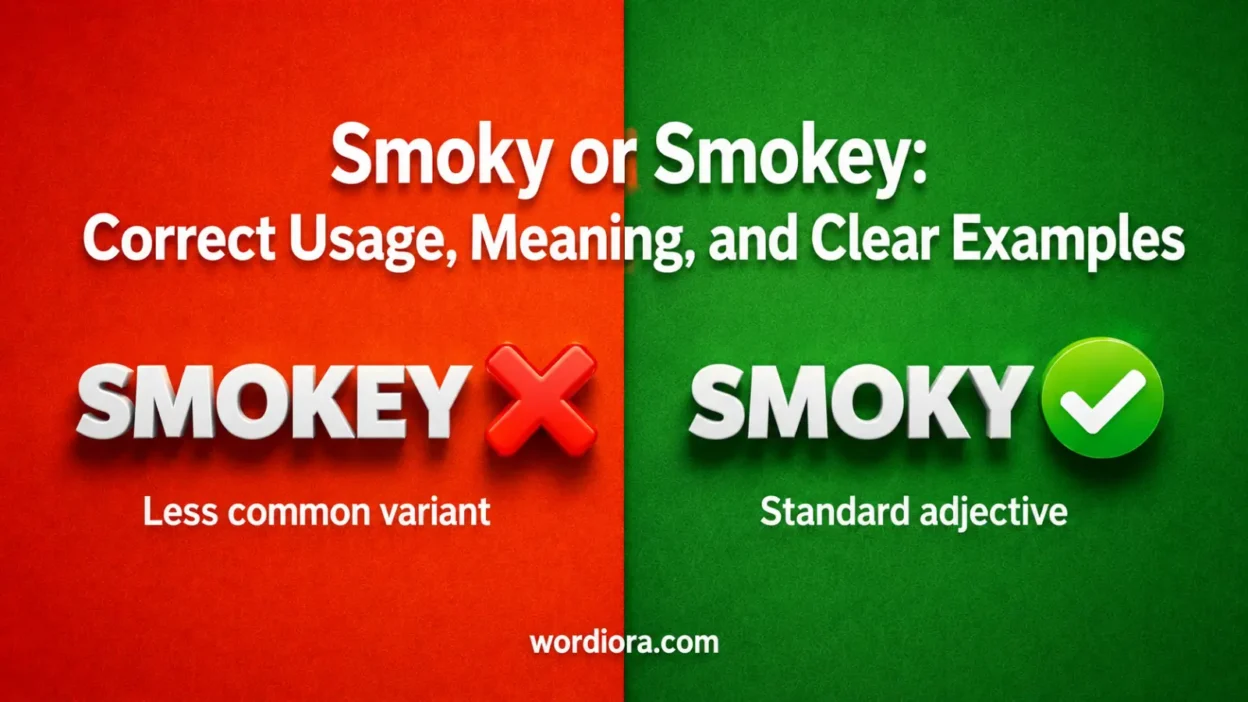
The safest choice is simple: use smoky when you are describing smoke, smell, flavor, color, haze, or atmosphere. Use Smokey only when that exact spelling is part of a name, nickname, title, or brand.
Quick Answer
Use smoky for the normal adjective: a smoky room, smoky air, smoky barbecue, smoky eyes, or a smoky voice. Smokey is much less common as a descriptive adjective. It is best saved for fixed names and titles, such as Smokey Bear, Smokey Robinson, or Smokey and the Bandit.
Why People Confuse Them
People confuse these words because smokey looks natural. The base word is smoke, so many writers expect the adjective to keep the e. However, the standard adjective drops that e and becomes smoky.
Famous names also make the confusion stronger. Smokey Bear uses the -ey spelling, so readers often assume smokey must also be the normal spelling for flavor, haze, or smell. In careful everyday writing, that is not the best choice.
The two spellings also sound the same: SMOH-kee. Since pronunciation does not help, the difference must come from context.
Key Differences At A Glance
| Context | Best Choice | Why |
|---|---|---|
| Describing air, haze, or a room | smoky | This is the standard adjective. |
| Describing barbecue, tea, whiskey, or cheese | smoky | It means tasting or smelling like smoke. |
| Describing makeup or color | smoky | It means dark, hazy, grayish, or smoke-like. |
| Referring to Smokey Bear | Smokey | That is the official proper name. |
| Referring to a person named Smokey | Smokey | Names keep their chosen spelling. |
| Writing a brand, title, or product name | Use the exact spelling | Fixed names should not be changed. |
| Writing formally for school or work | smoky | It is the safer standard form. |
Meaning and Usage Difference
Smoky is the standard adjective. It describes something that has smoke, looks like smoke, smells like smoke, tastes like smoke, or feels dark and hazy like smoke.
Use smoky in sentences like these:
A smoky haze covered the valley.
The brisket had a rich, smoky flavor.
Her smoky eye makeup looked soft, not heavy.
The singer had a deep, smoky voice.
Smokey can appear as a less common adjective, but most US readers expect smoky in ordinary descriptive writing. Smokey is strongest as a proper name or fixed spelling.
Use Smokey in sentences like these:
Smokey Bear teaches wildfire prevention.
My uncle’s old dog was named Smokey.
The poster used the title Smokey and the Bandit.
So the difference is not a deep meaning difference. It is mostly a standard-use difference. Smoky is the normal descriptive word. Smokey is usually a name, nickname, brand, or title.
Here is the compact comparison:
| Feature | smoky | smokey |
| Main role | Standard adjective | Name or less common variant |
| Best use | Descriptions | Proper names and fixed titles |
| Example | smoky flavor | Smokey Bear |
| Formal writing | Preferred | Avoid unless part of a name |
| Pronunciation | SMOH-kee | SMOH-kee |
Tone, Context, and Formality
Smoky works in casual, professional, academic, food, travel, beauty, and news writing. It looks polished because it is the form readers expect in descriptive contexts.
For example, a restaurant menu should usually say smoky sauce, not smokey sauce. A travel article should say Great Smoky Mountains, not Great Smokey Mountains. A beauty article should say smoky eyes, not smokey eyes, unless a product name uses the other spelling.
Smokey has a more name-like feel. It can look playful, branded, old-fashioned, or informal. That does not make it useless. It simply means you should use it when the spelling is fixed.
A barbecue restaurant may choose Smokey Joe’s as a brand name. A person may use Smokey as a nickname. A film title may use Smokey. In those cases, changing it to Smoky would be wrong because names and titles keep their official spelling.
Which One Should You Use?
Use smoky when you are describing something.
Choose smoky for:
a smoky kitchen
a smoky fireplace
smoky barbecue
a smoky smell
smoky gray glass
a smoky voice
a smoky mountain view
smoky eye makeup
Use Smokey only when the spelling belongs to a name, title, nickname, or brand.
Choose Smokey for:
Smokey Bear
Smokey Robinson
Smokey and the Bandit
a dog named Smokey
a restaurant named Smokey Joe’s
For everyday US writing, this rule will almost always work: If it describes smoke, use smoky. If it names someone or something, keep Smokey if that is the official spelling.
When One Choice Sounds Wrong
Smokey sounds wrong when it is used as the regular adjective in careful writing.
Less natural: The room was smokey after dinner.
Better: The room was smoky after dinner.
Less natural: The cheese had a smokey taste.
Better: The cheese had a smoky taste.
Less natural: She wore smokey eye makeup.
Better: She wore smoky eye makeup.
However, smoky sounds wrong if you change a fixed name.
Wrong: Smoky Bear
Correct: Smokey Bear
Wrong: Smoky Robinson
Correct: Smokey Robinson
Wrong: Smoky and the Bandit
Correct: Smokey and the Bandit
The key is not sound. Both spellings sound alike. The key is whether the word is describing something or naming something.
Common Mistakes (and Quick Fixes)
Mistake 1: Using smokey for food descriptions
Incorrect: The ribs had a sweet, smokey finish.
Correct: The ribs had a sweet, smoky finish.
Mistake 2: Changing proper names to smoky
Incorrect: Smoky Bear appears on wildfire safety posters.
Correct: Smokey Bear appears on wildfire safety posters.
Mistake 3: Spelling the national park name with ey
Incorrect: Great Smokey Mountains National Park
Correct: Great Smoky Mountains National Park
Mistake 4: Using both forms in the same article without a reason
Weak: The smoky sauce came from Smokey wood chips.
Better: The smoky sauce came from wood smoke.
Mistake 5: Thinking smokey is always impossible
Too strict: Smokey is never a word.
Better: Smokey exists in names, titles, brands, and some variant uses, but smoky is the standard adjective.
Everyday Examples
The campfire left a smoky smell on our jackets.
The restaurant is known for its smoky brisket and spicy beans.
A smoky haze settled over the highway after the fire.
She ordered a smoky old-fashioned with orange peel.
The room felt smoky, so we opened the windows.
His voice had a warm, smoky sound.
The photo showed the Great Smoky Mountains at sunrise.
Smokey Bear is one of the most familiar wildfire safety characters in the United States.
My neighbor has a gray cat named Smokey.
The band played a song from Smokey Robinson’s catalog.
That sauce tastes smoky, not burnt.
The makeup artist created a soft smoky eye for the photo shoot.
Dictionary-Style Word Details
Verb
smoky: Not commonly used as a verb in standard US English. It is normally an adjective. Say smoke the meat, not smoky the meat.
smokey: Not commonly used as a verb in standard US English. When capitalized, it is more often part of a name, not an action word.
Noun
smoky: Not commonly used as a noun in standard US English. It usually describes a noun, as in smoky air or smoky flavor. In place names, it may appear as part of a proper name, such as Great Smoky Mountains.
smokey: Can work as a proper name or nickname, as in Smokey Bear or a pet named Smokey. It also has some informal noun uses, but those are not the main concern for everyday writing.
Synonyms
smoky: Closest plain alternatives include smoke-filled, hazy, sooty, smoke-like, dusky, smoldering, and smoke-flavored. The best choice depends on context. For food, smoke-flavored may work. For air, smoke-filled may work. For color, dusky or grayish may work.
Clear opposites can include clear, fresh, clean, smoke-free, or unsmoked, depending on the sentence.
smokey: As a proper name, Smokey does not have true synonyms. Do not replace a person’s name, brand name, or title with a synonym. As a less common adjective, it shares the same closest alternatives as smoky, but smoky is usually the better spelling.
Example Sentences
smoky: The chili had a smoky flavor from roasted peppers.
smoky: A smoky mist hung above the hills in the morning.
smoky: The bar smelled smoky even after the doors were opened.
smoky: She chose smoky blue tiles for the bathroom wall.
smokey: Smokey Bear is spelled with ey.
smokey: Their old pickup was named Smokey because of its gray paint.
smokey: The menu kept the brand spelling in Smokey Joe’s BBQ.
smokey: He watched Smokey and the Bandit with his grandfather.
Word History
smoky: The word comes from smoke plus the adjective ending -y. In standard spelling, the silent e in smoke drops before -y, creating smoky. That same pattern appears in many English adjectives.
smokey: This spelling is best known today from names, nicknames, titles, and brands. Some dictionaries list it as a less common variant of smoky, but that does not make it the best spelling for everyday descriptions. In polished US writing, smoky remains the safer form.
Phrases Containing
smoky: smoky flavor, smoky room, smoky haze, smoky air, smoky fireplace, smoky voice, smoky eye, smoky quartz, smoky gray, Great Smoky Mountains.
smokey: Smokey Bear, Smokey Robinson, Smokey and the Bandit, Smokey Joe, a dog named Smokey, a restaurant named Smokey’s.
FAQs
Is smoky or smokey correct?
Both spellings exist, but smoky is the standard choice when you describe something related to smoke. Use smoky flavor, smoky air, smoky room, and smoky eyes. Use Smokey when it is part of a fixed name, title, brand, or nickname.
Is smokey always wrong?
No. Smokey is not always wrong. It is correct in names such as Smokey Bear and Smokey Robinson. It may also appear in brand names and titles. Still, for normal descriptive writing, smoky is the better choice.
Why is Smokey Bear spelled with an e?
Smokey Bear is a proper name, so it keeps its official spelling. Proper names do not have to follow the most common adjective spelling. That is why Smokey Bear is correct, but smoky fire is also correct.
Is it smoky flavor or smokey flavor?
Use smoky flavor. Food, drinks, sauces, cheese, meat, and tea usually take the standard adjective smoky when they taste or smell like smoke.
Is it Great Smoky Mountains or Great Smokey Mountains?
The correct official spelling is Great Smoky Mountains. Use smoky with no extra e when writing the mountain range or the national park name.
Conclusion
Use smoky when you describe smoke, haze, smell, flavor, color, atmosphere, makeup, or voice. It is the standard spelling for ordinary US English.
Use Smokey when that exact spelling is part of a name, title, nickname, or brand. The easiest memory tip is this: smoky describes; Smokey names. That rule keeps most sentences clear, natural, and correct.