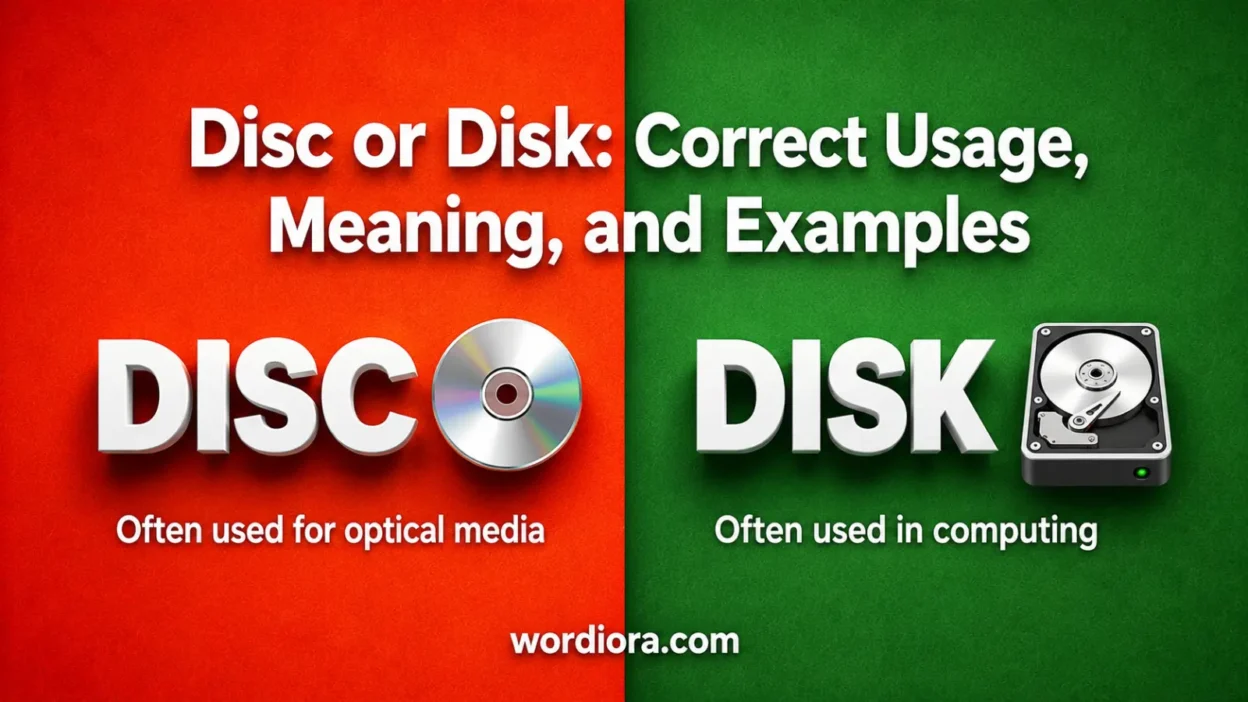
Disc or disk can be confusing because both spellings are real words, both are pronounced the same way, and both can describe something flat and round. The right choice depends mostly on context. In US English, disk is often the safer general spelling, especially for computer storage. However, disc is the expected spelling in several common phrases, especially in music, optical media, and disc golf.
This guide explains the difference without turning it into a fake rule. You will learn when to write disc, when to write disk, and why some phrases keep one spelling even when the other spelling may look possible.
Quick Answer
Both disc and disk are correct, but they are not always equally natural. Use disk for hard disks, disk drives, floppy disks, and many general US uses. Use disc for compact discs, optical discs, disc golf, disc jockey, and many music-related uses. In medical writing, both spellings appear, so follow the style used by your source, doctor, school, or publication.
Why People Confuse Them
People confuse disc and disk for a simple reason: they look almost identical and sound exactly the same. Both are pronounced like “disk.” The final letter changes, but the spoken word does not.
The confusion also comes from the fact that both words can describe a flat, round object. A CD is a flat, round object. A hard drive may contain flat, round platters. A flying disc is flat and round. Even the sun can be described as a disk-like shape in the sky.
The problem is not pronunciation. It is usage. Over time, different fields settled into different spelling habits.
Computer storage usually favors disk. Music and optical media often favor disc. Sports such as disc golf use disc. Some anatomy and medical contexts use either form, depending on the publication or professional style.
That means the best question is not “Which spelling exists?” Both exist. The better question is “Which spelling fits this context?”
Key Differences At A Glance
| Context | Best Choice | Why |
|---|---|---|
| Hard drive storage | disk | Computer storage commonly uses disk. |
| Disk drive | disk | This is the standard phrase for many computer storage devices. |
| Floppy disk | disk | This is the expected spelling in the set phrase. |
| Compact disc | disc | CD stands for compact disc in common use. |
| Optical disc | disc | Optical media is often spelled with disc. |
| Music album on a physical format | disc | Music and sound carriers often use disc. |
| Disc jockey | disc | This is the usual spelling in the phrase. |
| Disc golf | disc | The sport uses disc. |
| General flat round object in US English | disk | Disk is often the safer US general spelling. |
| Spine anatomy | disc or disk | Both appear; follow the style required by the context. |
The safest practical rule is this: use disk for computer storage and general US writing, but use disc for optical media, music, disc golf, and fixed phrases that clearly use disc.
Meaning and Usage Difference
Disc and disk share a core meaning: a thin, flat, round object or shape. The spelling choice does not create a completely different object by itself. Instead, each spelling has become more common in certain fields.
Use disk when talking about computer storage. Common examples include hard disk, disk drive, floppy disk, disk space, and disk cleanup. These phrases look natural in US English because computer storage has long favored the k spelling.
Use disc when talking about many physical media formats read by light, especially CDs, DVDs, and Blu-ray media. Common phrases include compact disc, optical disc, and Blu-ray Disc. A compact disc stores music or data, but the phrase itself strongly favors disc.
Use disc in disc golf because that is the accepted spelling in the sport. A player throws a disc, not usually a disk, in that context.
Use disc in disc jockey because that is the usual spelling of the phrase. Even though most modern DJs do not handle old records all night, the phrase still keeps the disc spelling.
For anatomy, the spelling is less simple. You may see spinal disc, spinal disk, herniated disc, or herniated disk. Many readers recognize both. In everyday health writing, do not change the spelling inside a quoted title, diagnosis, or clinic document. Follow the source you are using.
Pronunciation does not separate the words. Disc and disk both sound like “disk.” That is why the distinction matters only in writing.
Here is a compact feature comparison:
| Feature | Disc | Disk |
|---|---|---|
| Pronunciation | Sounds like “disk” | Sounds like “disk” |
| Main role | Noun | Noun |
| Common fields | Music, optical media, sports | Computer storage, general US use |
| Common phrase | compact disc | hard disk |
| Main risk | Using it for computer storage when disk is expected | Using it for CDs or disc golf when disc is expected |
Tone, Context, and Formality
Neither disc nor disk is more formal by itself. The formality depends on the phrase and field.
In technical computer writing, disk sounds more precise. A sentence like “The disk has only 5 GB of free space” sounds normal. “The disc has only 5 GB of free space” may look odd if you mean a hard drive or storage drive.
In music or media writing, disc often sounds more natural. “The band released the album on compact disc” looks standard. “Compact disk” may be understood, but it is not the usual form of the phrase.
In casual writing, many readers will understand either spelling when the meaning is broad. For example, “a flat metal disk” and “a flat metal disc” both make sense. However, US readers are more likely to expect disk in general descriptions unless a set phrase calls for disc.
In sports writing, disc is the expected spelling for disc golf, flying disc, and similar uses. Writing “disk golf” looks like a spelling slip to many readers.
In medical writing, follow the source or required style. If your doctor’s note says herniated disc, keep that spelling. If your health plan or textbook says herniated disk, keep that spelling. Switching back and forth in the same article can look careless.
Consistency matters. Once you choose the spelling required by the context, keep it steady throughout the same document.
Which One Should You Use?
Use disk when your topic is computer storage. This includes storage space, drives, old floppy media, hard drives, and system messages. In US English, this is the clearest and safest choice for technology-related storage.
Examples:
The laptop needs more disk space.
Save the backup to an external disk.
The old computer still has a floppy disk drive.
Use disc when the phrase is tied to music, optical media, or a named format that uses disc.
Examples:
I found an old compact disc in the car.
The movie came on a Blu-ray Disc.
The optical disc was scratched.
Use disc for disc golf and flying disc contexts.
Examples:
She bought a new disc for the tournament.
The park added a nine-hole disc golf course.
The dog chased the flying disc across the yard.
Use either spelling carefully in medical contexts, but do not mix them without reason.
Examples:
The report mentioned a herniated disc.
The article discussed lower-back disk problems.
If you are writing for a school, employer, publisher, or client, check the required style. If no style is given, use the spelling that matches the most common phrase in that field.
When One Choice Sounds Wrong
Sometimes both spellings exist, but one choice still looks wrong because the phrase has a strong habit.
Compact disk may be understood, but compact disc is the expected phrase. The same is true for disc jockey and disc golf. These are not places where you should freely swap the spelling.
Hard disc may be understood, but hard disk is the normal phrase in computer storage. Disk drive also looks more natural than disc drive when the device is a computer storage drive. However, an optical drive may read or write discs, so context matters.
A sentence like “The DJ played vinyl disks” may not confuse readers, but discs often fits better in music writing. A sentence like “Clear disc space on your laptop” looks less natural than “Clear disk space on your laptop.”
The choice can also affect trust. If a tech article says “hard disc drive” throughout, some readers may think the writer is unfamiliar with standard computer wording. If a disc golf article says “disk golf,” fans of the sport will likely notice.
The words are close, but phrase habits matter.
Common Mistakes (and Quick Fixes)
Mistake 1: Using disc for all round objects
A writer may choose disc every time because it looks polished or older. That can create awkward phrases in US computer writing.
Weak: The computer is low on disc space.
Better: The computer is low on disk space.
Mistake 2: Using disk for compact disc
Because disk is common in US English, some writers apply it to CDs. However, the standard phrase is compact disc.
Weak: I bought the album on compact disk.
Better: I bought the album on compact disc.
Mistake 3: Writing disk golf
The sport uses disc golf. The object thrown in that sport is a disc.
Weak: We played disk golf at the park.
Better: We played disc golf at the park.
Mistake 4: Mixing spellings in one document
Switching between spinal disc and spinal disk in the same article can distract readers.
Weak: The patient had a herniated disc. The disk caused pain.
Better: The patient had a herniated disc. The disc caused pain.
Mistake 5: Treating one spelling as always wrong
Neither spelling is always wrong. The error is choosing the spelling that does not fit the phrase or field.
Weak: Disc is always wrong in American English.
Better: Disc is correct in phrases such as compact disc, disc golf, and disc jockey.
Mistake 6: Assuming pronunciation will help
Pronunciation does not solve the issue. Both spellings sound the same.
Weak: Use the spelling that sounds right.
Better: Use the spelling that fits the context.
Everyday Examples
Here are natural examples that show how disc and disk appear in real US writing.
I need to free up disk space before the update.
The technician replaced the old hard disk.
She saved the photos to an external disk.
The school still had a box of floppy disks in the storage room.
The laptop showed a disk error during startup.
Run a disk check before you replace the drive.
The file was too large for the available disk space.
He copied the backup from one disk to another.
The band released a special compact disc edition.
The disc had a deep scratch near the edge.
I found a stack of old music discs in the closet.
The movie came with a bonus disc.
The Blu-ray Disc includes behind-the-scenes footage.
The optical disc would not load.
A disc jockey kept the party moving all night.
We played disc golf after work.
The doctor said the pain might come from a spinal disc.
The clinic’s brochure used the spelling spinal disk.
The report described a herniated disc in the lower back.
The textbook chapter discussed intervertebral disks.
Both spellings can appear in health writing, so stay consistent.
For general shapes, disk often works well in US English.
Cut the dough into a flat disk.
The moon looked like a pale disk through the clouds.
The artist painted a bright orange disk in the center.
A thin metal disk covered the opening.
For sports and throwing objects, disc often fits better.
The dog caught the flying disc.
Her new disc curved left in the wind.
The disc landed near the basket.
He joined a local disc golf league.
These examples show the real pattern: disk is common in computer and general US use, while disc remains strong in music, optical media, sports, and several set expressions.
Dictionary-Style Word Details
Verb
Disc: Not commonly used as a verb in standard US English. In normal writing, disc is a noun. You may see related technical or brand-specific uses in narrow settings, but everyday writers should not use disc as a verb.
Disk: Not commonly used as a verb in standard US English. Disk is mainly a noun. Some technical fields may form related terms, but regular US writing uses disk as a thing, not an action.
Correct noun use:
The disk failed after years of use.
The disc skipped during the song.
Avoid forced verb use:
Do not write “I will disk the file” when you mean save, copy, store, or back up the file.
Noun
Disc: A noun that usually means a thin, flat, round object. It is especially common in phrases tied to music, optical media, and throwing sports. Examples include compact disc, optical disc, disc golf, flying disc, and disc jockey.
Disk: A noun that also means a thin, flat, round object. In US English, it is common for general round shapes and especially common in computer storage. Examples include hard disk, disk drive, floppy disk, disk space, and disk error.
Both words are nouns in their main use. They do not change meaning because of grammar. They change mostly because of context and fixed phrase habits.
Synonyms
Disc: Exact synonyms are limited because disc often appears in set phrases. Closest plain alternatives include record, CD, optical medium, round plate, or flying disc, depending on context. Do not use record for every disc because a compact disc, vinyl record, and game disc are not always the same thing.
Disk: Closest plain alternatives include drive, storage device, storage medium, round shape, platter, or round plate, depending on context. Do not use drive as an exact synonym for disk in every case. A drive may contain or use a disk, but the two words are not always identical.
Clear antonyms do not fit well for either word. Since both words name objects or shapes, there is no simple opposite like hot/cold or open/closed. In a specific context, you may contrast a disk with a square, cube, or solid-state drive, but those are not true antonyms of the word itself.
Example Sentences
Disc:
The compact disc came with a booklet of lyrics.
The disc was too scratched to play.
She keeps her favorite movie discs in a case.
The team practiced at the new disc golf course.
A good flying disc should feel stable in the hand.
The disc jockey played songs from every decade.
The optical disc loaded after a few seconds.
He bought a special edition Blu-ray Disc.
Disk:
The computer warned me that the disk was almost full.
The old hard disk made a clicking sound.
Move the files to another disk before you reset the laptop.
The lab still had software saved on floppy disks.
A disk drive reads and writes stored data.
The moon looked like a white disk above the trees.
Shape the dough into a thick disk before chilling it.
The repair shop replaced the damaged disk.
Word History
Disc: The spelling disc is a variant form connected to the same broad idea: a flat, round object. Over time, it became common in several fields and phrases, especially those tied to music, optical media, and throwing sports. It is not safe to claim that disc belongs only to one country or one field, because real usage is mixed.
Disk: The spelling disk is also a standard form for a flat, round object. In modern US English, it is common in general descriptions and strongly established in computer storage terms. It is especially natural in phrases like hard disk, floppy disk, and disk drive.
The safest history note is this: the two spellings share a long connection, but modern use has divided them by field and phrase. Writers should focus less on origin and more on current context.
Phrases Containing
Disc:
Compact disc means a CD.
Optical disc means media read by light, such as many CDs, DVDs, and Blu-ray media.
Disc golf means the sport played by throwing discs toward targets.
Flying disc means a thrown round object used for play or sport.
Disc jockey means a DJ.
Bonus disc means an extra disc included with a movie, game, or album package.
Brake disc or disc brake appears in vehicle and mechanical contexts.
Disk:
Hard disk means a storage device or the storage medium inside one.
Disk drive means a device that reads or writes data on a disk.
Floppy disk means an older removable storage medium.
Disk space means available storage capacity.
Disk error means a storage-related problem.
Startup disk means the disk used to start a computer system.
Magnetic disk means a disk that stores data magnetically.
These phrases matter because many of them are fixed by common usage. You should not choose the spelling only by personal preference when a phrase already has a strong standard form.
FAQs
Is disc or disk correct?
Both disc and disk are correct spellings. The right one depends on context. Use disk for computer storage and many general US uses. Use disc for compact disc, optical disc, disc golf, flying disc, and disc jockey.
Is it hard disk or hard disc?
The standard phrase is hard disk. This spelling fits computer storage. You may see hard drive more often in everyday speech, but when the word is included, hard disk is the expected form.
Is it compact disc or compact disk?
The standard phrase is compact disc. That is why CD is commonly understood as short for compact disc. Compact disk may be understood, but it is not the usual spelling of the phrase.
Is it optical disc or optical disk?
Both can appear, but optical disc is very common and often preferred when talking about CDs, DVDs, and Blu-ray media. If you are writing for a product page, school paper, or manual, follow the spelling used by the source or brand.
Is it disc golf or disk golf?
Use disc golf. That is the normal spelling for the sport. The object thrown in the sport is called a disc, not usually a disk.
Is it slipped disc or slipped disk?
Both spellings appear in medical and health writing. Slipped disc is common, and slipped disk is also accepted in many contexts. The best choice is to match the spelling used by your doctor, textbook, clinic, or publication.
Is disk only American English?
No. Disk is common in American English, but it also appears in computer-related use outside the United States. The US/British difference helps explain some patterns, but it does not explain every phrase.
Is disc only British English?
No. Disc appears in American English too, especially in phrases such as compact disc, disc golf, disc jockey, and optical disc. It is not wrong just because the writing is for a US audience.
Do disc and disk have different pronunciations?
No. Disc and disk are pronounced the same way. Both sound like “disk.” The difference is in spelling and context, not sound.
What is the easiest way to remember disc vs disk?
Remember this simple pattern: disk for computer storage, disc for CDs, music, optical media, and disc golf. For medical use, check the style used by your source and stay consistent.
Conclusion
The choice between disc and disk is not a battle between right and wrong. Both words are standard, and both can refer to a thin, flat, round object. The key is choosing the spelling that fits the field, phrase, and reader expectation.
For US writing, disk is usually best for computer storage and many general round shapes. Use disc for compact disc, optical disc, disc golf, flying disc, and disc jockey. In medical writing, either spelling may appear, so consistency matters more than forcing one form everywhere. When a phrase has a strong spelling habit, follow it. That one decision will make your writing clearer, cleaner, and more natural