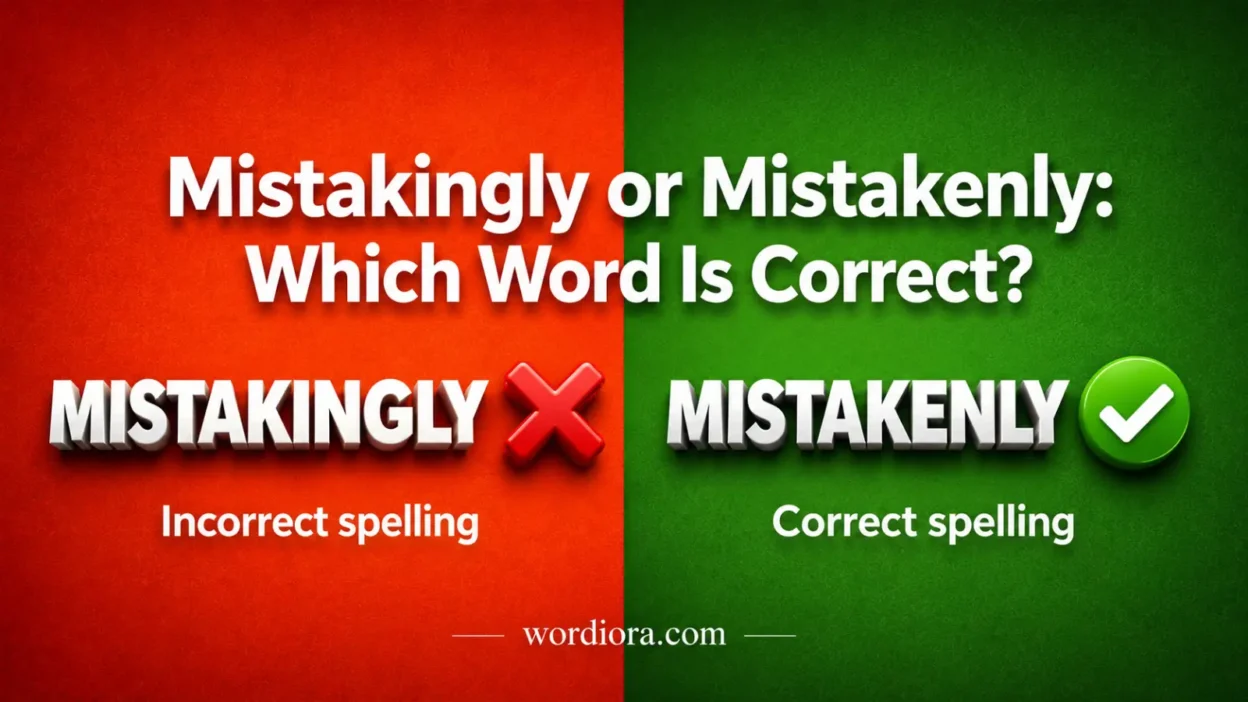
Many writers pause over mistakingly or mistakenly because both forms look possible. They come from the same word family, and both seem connected to making a mistake. Still, only one is the normal choice in modern US English.
Use mistakenly when you mean “wrongly,” “incorrectly,” or “by mistake.” The spelling mistakingly is rare and awkward in everyday writing. In most school, business, and professional contexts, it will look like an error.
Quick Answer
Mistakenly is the correct word for almost every normal sentence.
Example: “I mistakenly deleted the file.”
Mistakingly is not the standard choice in modern US English. You may see it listed in some dictionaries, but it is rare and not the form readers expect. For clear writing, choose mistakenly.
Why People Confuse Them
People confuse these words because mistake, mistaking, mistaken, and mistakenly all belong to the same general word family.
The confusion often starts with the verb form mistaking. For example, you can say, “She was mistaking one file for another.” Because mistaking is a real form, some writers add -ly and create mistakingly.
The problem is that English does not always form common adverbs from every possible word shape. The standard adverb is built from mistaken, not mistaking.
Correct: “He mistakenly thought the meeting was at noon.”
Awkward: “He mistakingly thought the meeting was at noon.”
The first sentence sounds natural. The second sentence may be understood, but it does not sound standard.
Key Differences At A Glance
| Context | Best Choice | Why |
|---|---|---|
| Formal writing | Mistakenly | It is the accepted standard adverb. |
| Business email | Mistakenly | It sounds professional and clear. |
| School writing | Mistakenly | Teachers and editors expect this form. |
| Everyday speech | Mistakenly | It is the natural word most people use. |
| “By mistake” meaning | Mistakenly | This is the normal meaning of the word. |
| Rare or unusual wording | Mistakingly | It may appear, but it sounds awkward. |
Meaning and Usage Difference
Mistakenly means “wrongly,” “incorrectly,” or “by mistake.” It is an adverb, so it usually describes an action, belief, judgment, or statement.
Examples:
“She mistakenly sent the invoice to the wrong client.”
“I mistakenly assumed the store was open late.”
“The report mistakenly listed the old address.”
In these sentences, mistakenly explains that someone did something because of an error.
Mistakingly is rare. It can mean “in a mistaking manner,” but that wording is not useful for most writers. In normal writing, it usually appears when someone means mistakenly but chooses the wrong form.
Better: “I mistakenly called the wrong number.”
Avoid: “I mistakingly called the wrong number.”
The practical rule is simple: if you mean “by mistake,” write mistakenly.
Tone, Context, and Formality
Mistakenly is neutral. You can use it in casual, academic, legal, business, and professional writing. It does not sound too formal or too relaxed.
Example: “The customer was mistakenly charged twice.”
That sentence would fit in an email, a report, or a support message.
Mistakingly sounds unusual. Even when a reader understands it, the word may distract from the sentence. Some readers may think it is a typo. Others may stop and wonder whether the writer meant something else.
That is why mistakingly is risky in polished writing. It does not help your tone. It makes the sentence look less careful.
Use mistakenly when you want your writing to sound correct, smooth, and professional.
Which One Should You Use?
Use mistakenly almost every time.
Choose it when you mean:
incorrectly
wrongly
by mistake
because of a misunderstanding
because of an error
Examples:
“I mistakenly clicked the wrong link.”
“She mistakenly believed the deadline was Friday.”
“They mistakenly shipped the order to my old address.”
You do not need mistakingly for these meanings. It does not add a useful difference. It only makes the sentence look less natural.
A good editing test is to replace the word with by mistake.
“I mistakenly deleted the message.”
“I deleted the message by mistake.”
If by mistake fits, mistakenly is the word you want.
When One Choice Sounds Wrong
Mistakingly sounds wrong when it replaces mistakenly in a normal sentence.
Awkward: “I mistakingly left my wallet at home.”
Better: “I mistakenly left my wallet at home.”
Awkward: “The company mistakingly sent two packages.”
Better: “The company mistakenly sent two packages.”
Awkward: “She mistakingly thought I was angry.”
Better: “She mistakenly thought I was angry.”
The issue is not that readers can never understand mistakingly. The issue is that it sounds nonstandard in the places where people expect mistakenly.
Meanwhile, mistakenly rarely sounds wrong when the meaning is “by mistake.” It is the safe choice for almost every sentence.
Common Mistakes and Quick Fixes
One common mistake is using mistakingly because it looks like an adverb form of mistaking.
Mistake: “I mistakingly opened your mail.”
Fix: “I mistakenly opened your mail.”
Another mistake is using mistakenly when accidentally would be clearer. These words are close, but they are not always identical.
Use mistakenly when the problem involves wrong belief, wrong identity, or wrong judgment.
“She mistakenly thought the event was canceled.”
Use accidentally when the focus is an unintended action.
“I accidentally spilled coffee on the form.”
Sometimes both can work, but the focus changes.
“I mistakenly sent the email to Mark.”
This suggests I chose Mark because of an error.
“I accidentally sent the email to Mark.”
This suggests I did not mean to send it to him.
For mistakingly or mistakenly, the quick fix is easy: replace mistakingly with mistakenly in normal writing.
Everyday Examples
Correct: “I mistakenly saved the file in the wrong folder.”
Correct: “She mistakenly believed the coupon expired today.”
Correct: “The bank mistakenly charged a late fee.”
Correct: “He mistakenly wore the wrong uniform to practice.”
Correct: “We mistakenly booked the hotel for the wrong weekend.”
Correct: “The teacher mistakenly marked the answer incorrect.”
Correct: “My neighbor mistakenly took my package.”
Correct: “The app mistakenly showed the old price.”
Correct: “I mistakenly thought you were talking to me.”
Correct: “They mistakenly sent the reminder twice.”
Avoid: “I mistakingly saved the file in the wrong folder.”
Avoid: “She mistakingly believed the coupon expired today.”
Avoid: “The app mistakingly showed the old price.”
These examples show the main pattern. When the sentence means “by mistake,” mistakenly is the natural choice.
Dictionary-Style Word Details
Verb
Mistakingly: Not commonly used as a verb in standard US English. It is an adverb form, not a verb.
Mistakenly: Not used as a verb. It is an adverb.
The related verb is mistake.
Example: “Do not mistake silence for agreement.”
Noun
Mistakingly: Not commonly used as a noun in standard US English.
Mistakenly: Not used as a noun.
The related noun is mistake.
Example: “That was an honest mistake.”
Synonyms
Mistakingly: No strong everyday synonyms are needed because this is not the normal form for most writing.
Mistakenly: Closest plain alternatives include wrongly, incorrectly, erroneously, and by mistake.
Examples:
“She mistakenly entered the wrong code.”
“She incorrectly entered the wrong code.”
“She entered the wrong code by mistake.”
These alternatives are close, but they do not always create the same tone. Mistakenly often sounds softer than wrongly or incorrectly.
Example Sentences
Mistakingly: “Mistakingly” is rare and usually best replaced with mistakenly in everyday writing.
Better sentence: “I mistakenly thought the appointment was tomorrow.”
Mistakenly: “The office mistakenly sent the notice to the old address.”
Another example: “He mistakenly believed the payment had already gone through.”
Word History
Mistakingly: This form comes from the idea of mistaking plus -ly, but it did not become the standard everyday adverb.
Mistakenly: This form comes from mistaken plus -ly. It became the normal adverb used to describe an action, belief, or statement based on an error.
The safe point for writers is not history. The safe point is current usage: mistakenly is the form readers expect.
Phrases Containing
Mistakingly: There are no common modern US phrases that require mistakingly.
Mistakenly: Common patterns include:
“mistakenly believed”
“mistakenly assumed”
“mistakenly sent”
“mistakenly identified”
“mistakenly thought”
“mistakenly charged”
These phrases are useful because they describe a wrong belief, wrong action, or wrong identification.
FAQs
Is mistakingly a real word?
Mistakingly may appear in some references, but it is not the normal choice in modern US writing. Most readers expect mistakenly when the meaning is “by mistake” or “wrongly.” For school, work, and formal writing, use mistakenly.
Is mistakenly always correct?
Mistakenly is correct when you mean “wrongly,” “incorrectly,” or “by mistake.” For example, “I mistakenly sent the text to the wrong person” is correct. However, if you mean something happened by chance without a wrong belief, accidentally may sometimes sound better.
Why is mistakenly better than mistakingly?
Mistakenly is better because it is the standard adverb in everyday English. It sounds natural, clear, and professional. Mistakingly may look logical because of mistaking, but it is not the form people usually use.
Can I use mistakingly in an essay?
It is better not to use mistakingly in an essay. Even if a reader understands it, the word may look like a spelling mistake. Use mistakenly instead.
What is a simple way to remember the difference?
Use this rule: if you can replace the word with by mistake, choose mistakenly.
Example: “I mistakenly opened the wrong file.”
Test: “I opened the wrong file by mistake.”
Because the test works, mistakenly is correct.
Conclusion
The choice between mistakingly or mistakenly is clear for most writers. Use mistakenly when you mean “wrongly,” “incorrectly,” or “by mistake.”
Mistakingly is rare and awkward in modern US English. It may be understood, but it is not the form readers expect. For clean, confident writing, choose mistakenly in emails, essays, articles, reports, and everyday sentences.
Best choice: “I mistakenly used the wrong word.”