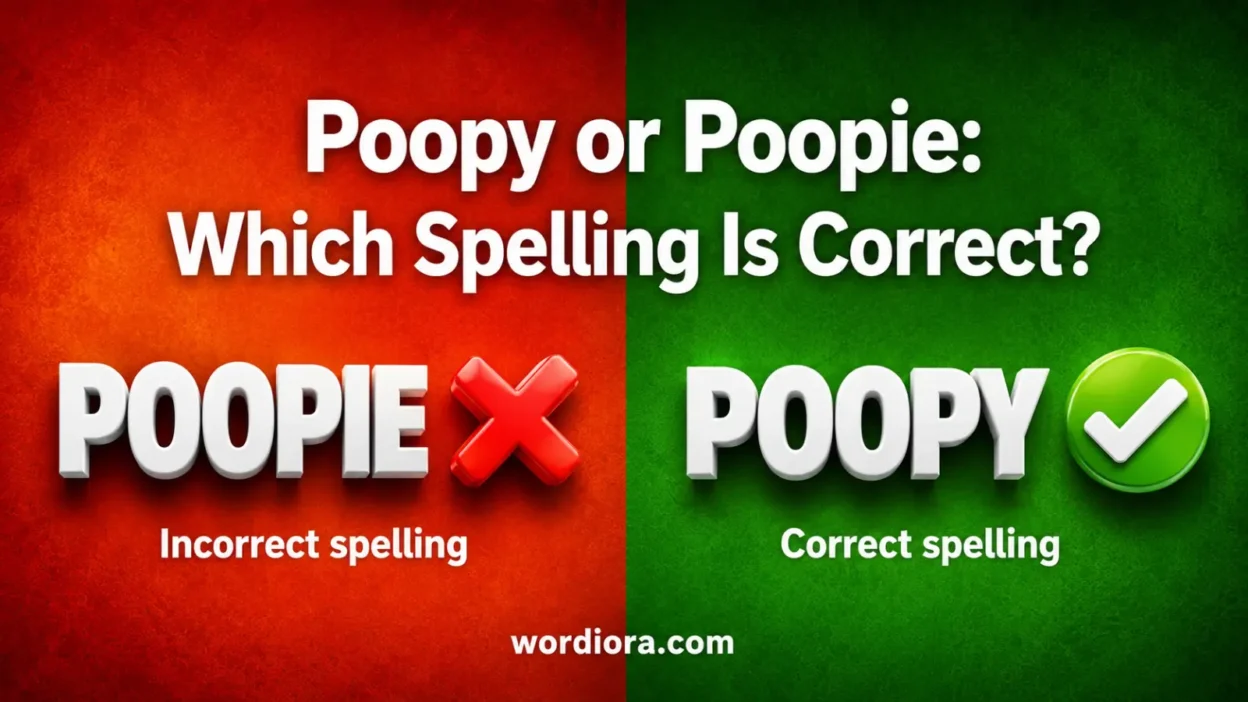
Many people pause over poopy or poopie because both spellings look possible. They sound the same, they come from the same base word, and both appear in casual writing. Still, they do not carry the same level of standard use.
In most everyday US writing, poopy is the better choice when you need an adjective. Write poopy diaper, poopy smell, or poopy mood. The spelling poopie appears more often as a rare, childish, playful, or name-like form. It may work in baby talk, jokes, nicknames, or product names, but it is not the best general spelling for clear edited writing.
Quick Answer
Use poopy when you mean “dirty with poop,” “related to poop,” or, very informally, “bad or unpleasant.” It is the clearer and more recognized spelling.
Use poopie only in very childish, playful, or name-like contexts. It can appear as a noun, as in “a poopie,” but most writers should choose poopy for the adjective.
Why People Confuse Them
People confuse poopy and poopie because English has many words that end in a long “ee” sound. Some use -y, such as happy, messy, and smelly. Others use -ie, such as cutie, sweetie, and doggie.
That makes both spellings feel natural at first glance. Since poopy and poopie sound like POO-pee, the ear cannot help much. The difference is mostly visual and contextual.
Another reason is baby talk. Words about bathroom habits often sound softer or sillier in speech. A child might say, “I made a poopie,” while a parent might say, “That is a poopy diaper.” In speech, both may pass without much thought. In writing, the spelling matters more.
The safest pattern is simple: poopy works best as the adjective. Poopie looks more childish and less standard unless you are using it on purpose.
Key Differences At A Glance
| Context | Best Choice | Why |
|---|---|---|
| Describing a diaper | poopy | It is the clearer adjective form. |
| Describing a smell | poopy | It fits the common adjective pattern. |
| Saying something is unpleasant | poopy | It works as a childish or very informal adjective. |
| Baby-talk noun | poopie | It can mean a small or childish “poop.” |
| Product, app, or nickname | Poopie | It may be used as a proper name. |
| Edited writing | poopy | It looks more standard and less distracting. |
| Serious or formal writing | neither | Use a clearer word such as fecal, dirty, or unpleasant. |
The main point is not that poopie can never appear. The point is that poopy is the spelling most readers expect when the word describes something.
Meaning and Usage Difference
Poopy is usually an adjective. It can describe something that is dirty with poop, connected to poop, or unpleasant in a silly way.
Examples:
“The toddler had a poopy diaper.”
“There was a poopy smell near the trash can.”
“I am having a poopy day.”
The last example is very informal. It sounds childish, funny, or intentionally silly. It does not belong in serious workplace writing, school essays, medical notes, or formal emails.
Poopie is less common as a general adjective. You may see it as a childish noun, especially in sentences like:
“The little boy said he made a poopie.”
In that sentence, poopie acts like a cute or softened noun for poop. It is not the best spelling for standard description. Most readers would expect poopy diaper, not poopie diaper.
Both words are informal. Neither one is elegant or professional. Still, poopy is the stronger choice for normal casual writing because it follows the common adjective pattern: poop + y.
A useful comparison is mess + y = messy and dirt + y = dirty. In the same way, poop + y = poopy.
Tone, Context, and Formality
Both poopy and poopie sound childish. That does not make them wrong. It just limits where they fit.
Use poopy in casual family writing, parenting notes, humorous captions, informal stories, or dialogue. It can sound natural when the subject is diapers, pets, kids, or a silly complaint.
Examples:
“Please pack extra wipes for poopy diapers.”
“The puppy left a poopy mess by the door.”
“This rainy weather feels poopy.”
Use poopie when you want a more babyish or playful tone. It may fit dialogue from a child, a joke, or a deliberately cute nickname.
Examples:
“She whispered that the baby made a poopie.”
“He calls the dog Poopie as a silly nickname.”
“The app uses Poopie as its playful name.”
Avoid both words in formal contexts. In medical, school, legal, or workplace writing, choose a clearer term. For example, use fecal, soiled, dirty, stool, bowel movement, unpleasant, or low-quality, depending on the meaning.
Instead of:
“The sample had poopy matter.”
Write:
“The sample contained fecal matter.”
Instead of:
“The report was poopy.”
Write:
“The report was unclear and incomplete.”
Which One Should You Use?
Choose poopy in almost every ordinary sentence where the word describes a noun.
Write:
“poopy diaper”
“poopy smell”
“poopy toilet”
“poopy water”
“poopy day”
These phrases may be casual, but the spelling is clear.
Choose poopie only when you need the childish noun or a proper name. The noun use often appears with a or the before it.
Examples:
“The toddler said he made a poopie.”
“She named the cartoon character Poopie.”
“The game uses Poopie as a joke name.”
Here is the best rule for quick writing:
Use poopy for describing.
Use poopie only when it is a childish noun, nickname, title, or name.
This rule will work for most readers because it matches the way the spellings usually feel in modern casual US English.
When One Choice Sounds Wrong
Poopie often sounds wrong when it appears before a noun in a normal adjective position.
Awkward:
“The baby has a poopie diaper.”
Better:
“The baby has a poopy diaper.”
Awkward:
“There is a poopie smell in the room.”
Better:
“There is a poopy smell in the room.”
Awkward:
“The dog made a poopy on the rug.”
Better in childish speech:
“The dog made a poopie on the rug.”
Better in normal adult speech:
“The dog pooped on the rug.”
The sentence structure matters. Before a noun, poopy usually feels better. After made a, poopie can work as a childish noun, though many adults would simply write poop.
A second problem appears when people try to make poopie sound more standard than it is. It does not make the word more polite. It usually makes the sentence look more babyish.
For clean adult writing, you often do not need either form. Poop, feces, stool, soiled, or dirty may be clearer.
Common Mistakes (and Quick Fixes)
Mistake 1: Using poopie as the regular adjective.
Incorrect: “Change the poopie diaper.”
Better: “Change the poopy diaper.”
Why: Poopy is the clearer adjective.
Mistake 2: Using poopy when you need the childish noun.
Awkward: “The child said he made a poopy.”
Better: “The child said he made a poopie.”
Also better: “The child said he pooped.”
Why: Poopie can work as a childish noun, but poop is usually clearer.
Mistake 3: Using either word in serious writing.
Too casual: “The water looked poopy.”
Better: “The water appeared contaminated.”
Too casual: “The patient reported poopy symptoms.”
Better: “The patient reported bowel-related symptoms.”
Why: Both forms are informal and childish.
Mistake 4: Assuming both spellings are equally useful.
Weak: “Poopy and poopie are always the same.”
Better: “Poopy is the safer adjective. Poopie is rare, childish, or name-like.”
Why: The difference is not deep, but it affects tone and reader expectation.
Mistake 5: Overusing the word for humor.
Too much: “The poopy dog made a poopy mess on a poopy morning.”
Better: “The dog made a poopy mess on a rough morning.”
Why: Repeating a silly word can make the sentence feel weak.
Everyday Examples
Here are natural examples that show how the two forms work.
Correct: “The daycare sent home a note about poopy diapers.”
Correct: “Please clean the poopy training seat after use.”
Correct: “The puppy had a poopy accident in the hallway.”
Correct: “A poopy smell came from the outdoor trash bin.”
Correct: “That was a poopy ending to an otherwise good day.”
Correct in childish speech: “Mom, the baby made a poopie.”
Correct as a playful name: “The cartoon dog was named Poopie.”
Correct in dialogue: “The toddler pointed at the potty and said, ‘Poopie!’”
Better choice: “The baby has a poopy diaper.”
Weaker choice: “The baby has a poopie diaper.”
Better choice: “The puppy pooped on the mat.”
More childish choice: “The puppy made a poopie on the mat.”
Better choice: “This room smells bad.”
Very informal choice: “This room smells poopy.”
Better choice for serious writing: “The diaper was soiled.”
Casual choice: “The diaper was poopy.”
The sentence goal should guide your choice. If you want casual and clear, use poopy. If you want baby-talk dialogue, poopie may fit. If you want adult, polished wording, use a different word.
Dictionary-Style Word Details
Verb
Poopy: Not commonly used as a verb in standard US English. Do not write “I poopy” when you mean “I poop” or “I pooped.” The standard informal verb is poop.
Example: “The puppy pooped outside.”
Poopie: Not commonly used as a verb in standard US English. In playful or childish speech, someone might say something like “I have to poopie,” but that sounds babyish and should not be used in normal edited writing.
Better: “I have to poop.”
Noun
Poopy: Mostly used as an adjective. It may appear as a childish noun in some informal contexts, but that use is less useful for most writers.
Example: “The child talked about poopy during potty training.”
This sounds awkward. Most adults would write poop.
Poopie: Can work as a childish noun meaning poop, especially with young children.
Example: “The toddler said he made a poopie.”
This use is informal and babyish. In adult writing, poop is usually clearer.
Synonyms
Poopy: Closest plain alternatives depend on the meaning.
For something dirty with poop: soiled, dirty, fecal, contaminated.
For something unpleasant: bad, lousy, crummy, unpleasant.
Poopie: Closest plain alternatives include poop, doo-doo, and bowel movement, depending on tone. Poop is casual. Doo-doo is childish. Bowel movement is more neutral and adult.
Clear antonyms do not always fit because these words are informal and context-based. For a poopy diaper, the opposite idea is a clean diaper. For a poopy day, the opposite could be a good day or pleasant day.
Example Sentences
Poopy:
“The babysitter packed extra wipes for poopy diapers.”
“The dog rolled in something and came home poopy.”
“The bathroom had a poopy smell after the accident.”
“My morning started with traffic, spilled coffee, and a poopy mood.”
“The kids laughed at the word poopy during the story.”
Poopie:
“The toddler said he made a poopie.”
“She used poopie as a silly nickname for the puppy.”
“The character named Poopie made the kids laugh.”
“He used the word poopie because he was copying baby talk.”
“In that children’s joke, poopie is meant to sound silly.”
Word History
Poopy: The word comes from poop plus the ending -y. That ending often turns a noun into an adjective. For example, dirt becomes dirty, and smell becomes smelly. In the same pattern, poop becomes poopy.
Poopie: The word comes from poop plus -ie, an ending often used in cute, childish, or nickname-like words. That is why poopie can feel more like baby talk or a playful name.
Do not claim a precise origin story unless a trusted dictionary gives it clearly. For everyday writers, the useful point is the spelling pattern: -y makes the stronger adjective, while -ie feels more childish or name-like.
Phrases Containing
Poopy:
“poopy diaper”
“poopy smell”
“poopy accident”
“poopy mess”
“poopy mood”
“poopy weather”
“poopy water”
Poopie:
“made a poopie”
“a little poopie”
“Poopie” as a nickname
“Poopie” as an app, game, or character name
Notice the pattern. Poopy usually comes before another noun and describes it. Poopie more often acts like a childish noun or a name.
FAQs
Is poopy or poopie correct?
Both can appear, but poopy is the better spelling for most sentences. Use poopy when the word describes a noun, as in poopy diaper, poopy smell, or poopy mess.
Poopie is much more childish. It can work as a noun in baby talk, as in “made a poopie,” or as a nickname, title, or product name. For clear casual writing, choose poopy.
Is poopy a real word?
Yes, poopy is a real informal word. It usually means dirty with poop, related to poop, or unpleasant in a childish way. It is not formal, but it is recognizable.
You can use it in casual family writing, jokes, dialogue, or parenting contexts. Avoid it in formal writing because it sounds childish.
Is poopie a real word?
Poopie appears in informal use, but it is less standard than poopy. It often feels like baby talk. It may mean a small or childish “poop,” or it may appear as a playful name.
For example, “The toddler made a poopie” sounds like child-centered speech. But “poopie diaper” looks less natural than “poopy diaper.”
Which spelling should I use for “poopy diaper”?
Use poopy diaper.
That is the clearer and more expected adjective form. The word poopy describes the diaper. The phrase poopie diaper may be understood, but it looks more childish and less standard.
Correct: “Please change the poopy diaper.”
Can I write “made a poopy”?
You can, but it sounds less natural than “made a poopie” in baby talk. In adult speech, the clearest choice is usually poop or pooped.
Childish: “The toddler made a poopie.”
Casual adult: “The toddler pooped.”
Clear noun: “There was poop in the diaper.”
Are poopy and poopie pronounced differently?
Usually, no. Both are commonly said like POO-pee. That is why people confuse them. The difference is mainly spelling, tone, and use.
Since pronunciation does not help much, look at the sentence job. If the word describes something, use poopy. If it acts as a childish noun or name, poopie may fit.
Is poopy formal or informal?
Poopy is informal. It can sound childish, silly, or humorous. It is fine in casual writing, parenting notes, and dialogue, but it does not fit serious writing.
Instead of “poopy diaper” in a formal note, write “soiled diaper.” Instead of “poopy water,” write “contaminated water.”
Is poopie more polite than poopy?
No. Poopie is not more polite. It is usually more childish. Some people use it to soften the topic, especially around children, but it does not make a sentence more professional.
For polite adult wording, use bowel movement, stool, soiled, fecal, or another context-appropriate word.
Can poopy mean bad or unpleasant?
Yes, in very informal speech, poopy can mean bad, lousy, or unpleasant.
Example: “I had a poopy day.”
This sounds playful and childish. It should not replace clear description in serious writing. Instead of “a poopy meeting,” write “an unproductive meeting” or “a frustrating meeting.”
Can poopie be a name?
Yes. Poopie can appear as a nickname, character name, app name, or playful title. In that case, capitalize it if it is a proper name.
Example: “The app is called Poopie.”
That use is different from choosing between poopy and poopie in a normal sentence.
What is the best simple rule?
Use poopy as the adjective.
Use poopie only for childish noun use, baby talk, nicknames, or proper names.
Best everyday choice: “poopy diaper.”
Childish noun choice: “made a poopie.”
Clear adult choice: “pooped” or “poop.”
Should I use either word in an article?
It depends on the article topic. If the article is about parenting, kids, diapers, pets, or word choice, poopy may be fine in examples. If the article is serious, medical, or professional, avoid both.
Use adult alternatives when accuracy matters. Good options include soiled, fecal, stool, bowel movement, dirty, contaminated, or unpleasant.
Conclusion
For poopy or poopie, the better everyday spelling is poopy. Use it as the adjective in phrases like poopy diaper, poopy smell, poopy mess, and poopy mood. It is informal, but it is the clearer choice.
Use poopie only when you want a childish noun, baby-talk tone, nickname, title, or proper name. It may work in “made a poopie,” but it is not the best spelling for normal adjective use.
The easiest rule is this: poopy describes; poopie sounds childish or name-like. When the writing needs to sound adult or serious, skip both and choose a clearer word.