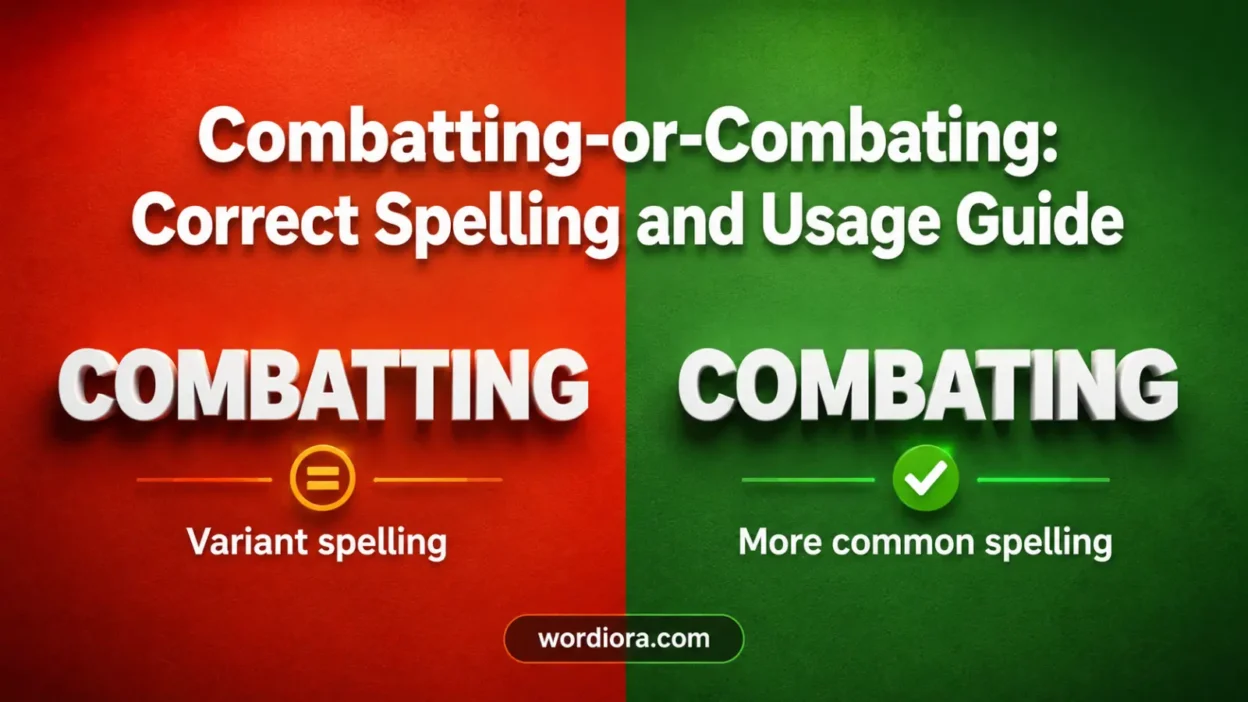
Combating is the best choice for most modern US writing. Combatting is not a different word, and it does not have a different meaning. It is a less common variant spelling of the same -ing form of the verb combat.
That means the real choice is not about meaning. It is about spelling, reader expectation, and style. In a school paper, news article, business report, government page, or professional email, combating will usually look cleaner and more familiar to American readers.
Use combatting only when you are following a style that allows or prefers that spelling, or when you are quoting a source that already uses it.
Quick Answer
Use combating in standard American English.
Both combatting and combating mean “fighting against,” “working to stop,” or “trying to reduce something harmful.” The single-t spelling, combating, is the safer and more widely expected form in the US.
Example:
The city is combating rising housing scams.
Why People Confuse Them
People confuse these spellings because many English words double the final consonant before -ing. For example, bat becomes batting, and plan becomes planning.
So combatting may look logical at first. The base word combat ends in one vowel plus one consonant, which makes some writers expect a doubled t.
But English spelling also depends on stress and established usage. In modern US writing, combating is the form readers are more likely to expect. The extra t in combatting can look unusual, even though some dictionaries record it as a variant.
Key Differences At A Glance
| Context | Best Choice | Why |
|---|---|---|
| US school writing | combating | It is the safer standard form. |
| Business writing | combating | It looks more polished and familiar. |
| News or public writing | combating | It matches common modern usage. |
| Quoting another source | combatting or combating | Keep the original spelling in the quote. |
| British or mixed-style writing | combating | Still a safe choice, though combatting may appear. |
| Search, titles, and headings | combating | It is cleaner and less likely to distract readers. |
Meaning and Usage Difference
There is no real meaning difference between combatting and combating. Both are forms of the verb combat, which means to fight against something or work to reduce it.
Compact comparison:
• Combating: preferred modern US spelling; use it in most polished writing.
• Combatting: variant spelling; understandable, but less common and more likely to distract US readers.
• Both mean the same thing.
• Both are based on the verb combat.
• Neither spelling changes the tone of the sentence by itself.
Use them in the same kinds of sentences:
The nonprofit is combating food insecurity.
The nonprofit is combatting food insecurity.
The first version looks more natural for a US audience.
Tone, Context, and Formality
Combating works well in formal, neutral, and serious contexts. You will often see it with problems such as crime, disease, fraud, inflation, corruption, addiction, pollution, and misinformation.
Combatting has the same meaning, but it may look less standard to American readers. In formal US writing, that small spelling difference can become a distraction.
Pronunciation does not create a useful difference here. Both forms are read as the -ing form of combat. The choice is mainly visual and editorial, not spoken.
For a clean US style, write:
The agency is combating fraud.
Avoid making the reader pause over:
The agency is combatting fraud.
Which One Should You Use?
Use combating almost every time.
That is the best choice when you are writing for readers in the United States, especially in:
school assignments
college essays
business reports
news-style articles
public policy writing
health and safety pages
professional emails
website copy
Use combatting only if your editor, teacher, publication, or source material specifically uses that spelling. It is not a separate word with a special meaning, so there is no reason to choose it for extra precision.
Best default sentence:
Our team is combating online scams through better reporting tools.
When One Choice Sounds Wrong
Combatting can sound or look wrong when the surrounding writing is formal and edited for a US audience.
Less natural:
The company is combatting payment fraud.
Better:
The company is combating payment fraud.
The issue is not that readers cannot understand combatting. They can. The problem is that many will see it as odd, overly British-looking, or simply misspelled.
Combating rarely creates that problem. It is the more dependable form when you do not know which spelling your readers expect.
Common Mistakes and Quick Fixes
Mistake 1: Treating the two spellings as different meanings.
Fix: They mean the same thing.
Mistake 2: Using combatting in a US business or school document.
Fix: Use combating unless a style guide tells you otherwise.
Mistake 3: Switching spellings in the same article.
Fix: Pick one spelling and stay consistent.
Mistake 4: Assuming every word ending in one vowel plus one consonant must double the consonant.
Fix: Check the accepted form. For combat, the safest US -ing form is combating.
Mistake 5: Writing “combating against.”
Fix: Usually write combating plus the problem directly.
Better:
The clinic is combating opioid misuse.
Everyday Examples
The school is combating bullying with a new reporting system.
Doctors are combating infection with early treatment.
The city is combating illegal dumping in several neighborhoods.
Parents are combating screen fatigue by setting device-free hours.
The bank is combating fraud with stronger identity checks.
Local groups are combating hunger through weekend meal programs.
The state is combating wildfire risk with controlled burns.
Teachers are combating learning loss with small-group tutoring.
The company is combating burnout by reducing unnecessary meetings.
Use combatting in these same sentences only if you have a specific reason to follow that spelling.
Dictionary-Style Word Details
Verb
• Combatting: A variant -ing form of the verb combat. It means fighting against, opposing, or working to reduce something harmful.
• Combating: The preferred modern US -ing form of the verb combat. It carries the same meaning and is the better default in American writing.
Noun
• Combatting: Not commonly used as a standalone noun in standard US English. It can work as a gerund, as in “Combatting fraud takes time,” but combating is usually better.
• Combating: Can work as a gerund, as in “Combating fraud takes time.” It names the action of fighting against or reducing a problem.
Synonyms
• Combatting: Closest plain alternatives include fighting, opposing, countering, resisting, and working against.
• Combating: Closest plain alternatives include fighting, opposing, countering, resisting, and tackling.
Antonyms depend on context. Possible opposites include supporting, allowing, enabling, or encouraging, but only when the sentence clearly supports that contrast.
Example Sentences
• Combatting: The report used the phrase “combatting poverty,” though many US editors would prefer “combating poverty.”
• Combating: The report focused on combating poverty in rural communities.
• Combatting: Some writers choose combatting because it follows a doubled-consonant pattern.
• Combating: Most US writers should choose combating for a cleaner, more familiar spelling.
Word History
• Combatting: This spelling comes from combat plus -ing, with the final t doubled. It does not have a separate origin or meaning from combating.
• Combating: This spelling also comes from combat plus -ing. The difference is spelling convention, not meaning. The base word combat traces back through French and Latin forms connected with fighting.
Phrases Containing
• Combatting: combatting crime, combatting poverty, combatting disease, combatting corruption, combatting climate risks.
• Combating: combating crime, combating poverty, combating disease, combating corruption, combating climate risks.
For US writing, the combating versions are usually the better choice.
FAQs
Is it combatting or combating?
Combating is the better choice in modern US English. Combatting is a variant spelling, but it is less common and may look unusual to American readers. For school, business, news, and professional writing, use combating.
Is combatting wrong?
Combatting is not always wrong because some dictionaries list it as a variant. Still, it is not the safest spelling for US writing. Many readers and editors expect combating, so that spelling is usually better.
What does combating mean?
Combating means fighting against something, opposing it, or working to reduce it. For example, a city may be combating crime, or doctors may be combating the spread of disease.
What does combatting mean?
Combatting means the same thing as combating. It also means fighting against or trying to reduce something harmful. The difference is spelling, not meaning.
Which spelling should I use in American English?
Use combating in American English. It looks more natural and polished in most US contexts, including essays, reports, articles, emails, and official writing.
Why does combating have one t?
Combating has one t because that is the more accepted modern spelling of the -ing form of combat. English does not always double the final consonant in every word, even when the spelling may look like it should.
Can I use combatting in formal writing?
You can, but combating is usually better for formal writing. Combatting may distract readers because it looks less familiar. If you want the cleanest and safest choice, write combating.
Are combatting and combating interchangeable?
They have the same meaning, so they can refer to the same action. However, they are not equally preferred. Combating is the stronger default choice for a US audience.
What is an example of combating in a sentence?
The organization is combating food insecurity by opening more community pantries.
What is an example of combatting in a sentence?
The article used the phrase combatting misinformation, but many US editors would prefer combating misinformation.
Should I write combating crime or combatting crime?
Write combating crime. It is the more common and professional-looking choice in modern US English.
What is the simple rule for combatting or combating?
Use combating unless you have a specific reason to use combatting, such as quoting another source or following a style that allows that spelling.
Conclusion
For a US audience, combating is the clear winner. It is the safer, more familiar, and more polished spelling in modern writing.
Combatting is a variant, not a separate word. It means the same thing, but it can look unusual in American English. When you want your sentence to feel clean and professional, choose combating.