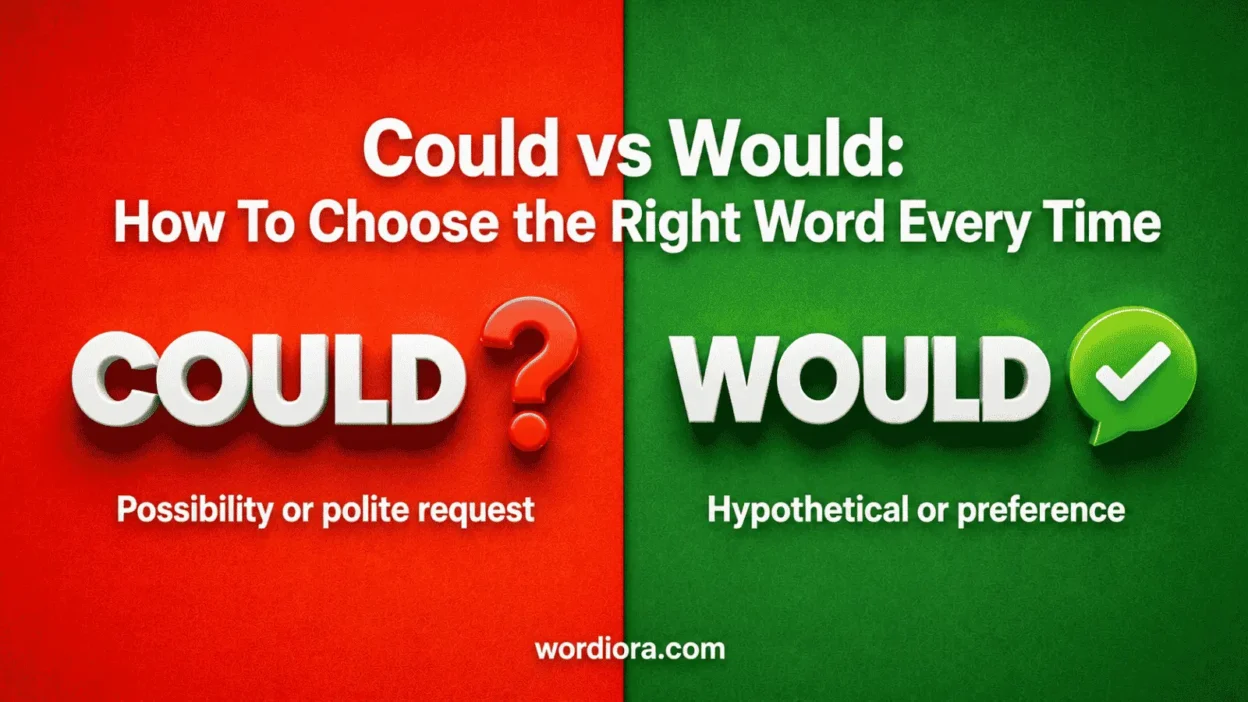
Could vs would is a common word-choice question because both words can sound polite, uncertain, or hypothetical. The difference is not about which word is “more correct” in general. It is about what you mean.
Use could when you mean possibility, ability, permission, or an option. Use would when you mean willingness, preference, an imagined result, or a repeated past action.
The easiest way to choose is to ask: am I talking about what is possible, or what someone is willing or likely to do in an imagined situation?
Quick Answer
Use could for possibility or ability.
Use would for willingness, preference, or a result in an imagined situation.
Examples:
- I could help you after work.
This means helping is possible. - I would help you after work, but I have an appointment.
This means I am willing, but something prevents it. - She could finish the report today.
This means it is possible. - She would finish the report today if she had the data.
This shows an imagined result.
Why People Confuse Them
People confuse could and would because both can make a sentence softer.
“Could you send me the file?” and “Would you send me the file?” are both polite requests. But they are not exactly the same.
Could you often asks whether the person is able to do something.
Would you often asks whether the person is willing to do it.
In everyday conversation, the difference is small. In careful writing, emails, instructions, and conditional sentences, the difference matters.
Key Differences At A Glance
| Context | Best Choice | Why |
|---|---|---|
| Asking if something is possible | could | It points to ability, chance, or an available option. |
| Asking someone to do a favor | would | It focuses on willingness. |
| Talking about past ability | could | It means someone was able to do something in the past. |
| Describing an imagined result | would | It shows what happens under a condition. |
| Making a suggestion | could | It presents one possible option. |
| Stating a preference | would | It shows choice or desire. |
| Describing repeated past behavior | would | It shows something someone regularly did. |
Meaning and Usage Difference
Could is usually about possibility or ability.
You might use it when something can happen, might happen, or was possible before.
Examples:
- We could meet on Thursday.
- I could hear music from the hallway.
- You could take the train instead.
- He could solve difficult math problems as a kid.
Would is usually about willingness, preference, habit, or an imagined result.
You might use it when someone agrees to do something, wants something, or when a condition affects the outcome.
Examples:
- I would rather leave early.
- She would help if she had time.
- When we were young, we would ride bikes after dinner.
- That plan would work if the budget changed.
A useful shortcut:
- Could = possible
- Would = willing, preferred, or conditional
Tone, Context, and Formality
Both words can sound polite, but they create different shades of meaning.
Could you call me later? sounds polite and practical. It gently asks whether the action is possible.
Would you call me later? sounds polite and direct. It asks for the person’s willingness.
In customer service, business emails, and workplace messages, both are common. Would often sounds a little more like a request for a favor. Could often sounds a little more open-ended.
Examples:
- Could you review this when you have a chance?
Polite and flexible. - Would you review this before noon?
Polite but more focused on the person’s agreement.
For suggestions, could is usually better.
- We could move the meeting to Friday.
- You could try a shorter subject line.
For preferences, would is usually better.
- I would prefer a morning appointment.
- We would rather keep the original deadline.
Which One Should You Use?
Use could when the sentence is about ability, possibility, or options.
- I could meet at 3 p.m.
- They could lower the price next month.
- You could ask your manager for clarification.
Use would when the sentence is about willingness, preference, or a conditional result.
- I would meet at 3 p.m., but I have another call.
- They would lower the price if demand dropped.
- You would get a clearer answer if you asked your manager.
Here is a compact comparison:
- could: ability, chance, permission, suggestion, possible action
- would: willingness, preference, polite request, imagined result, repeated past habit
When One Choice Sounds Wrong
The wrong choice often changes the meaning.
Say could when you mean ability:
- Correct: I could swim when I was six.
- Awkward: I would swim when I was six.
The second sentence is not about ability. It suggests a repeated habit, not skill.
Say would when you mean an imagined result:
- Correct: I would buy the house if it were cheaper.
- Awkward: I could buy the house if it were cheaper.
The second sentence means buying the house would be possible. The first means you intend or prefer to buy it under that condition.
Say could for a suggestion:
- Correct: We could order pizza.
- Less natural: We would order pizza.
The second sentence feels incomplete unless you add a condition:
- We would order pizza if the restaurant were still open.
Common Mistakes (and Quick Fixes)
One common mistake is using would when the sentence is really about possibility.
Weak: The package would arrive tomorrow.
Better: The package could arrive tomorrow.
Use could because the arrival is possible, not guaranteed.
Another mistake is using could when the sentence is really about willingness.
Weak: I could help, but I do not want to.
Better: I would help, but I do not want to.
Actually, even the better version sounds contradictory. A clearer sentence is:
- I could help, but I’d rather not.
Use could for ability, then state the preference separately.
A third mistake is treating both words as interchangeable in conditional sentences.
Weak: If I had more time, I could visit you every week.
Better: If I had more time, I would visit you every week.
Use would when you mean that the visit is the expected result of the condition.
Everyday Examples
Here are natural examples that show the difference clearly.
- I could stop by after work if traffic is light.
- I would stop by after work, but I have dinner plans.
- You could send a shorter email.
- You would get a faster reply if you sent a shorter email.
- We could use the small conference room.
- We would use the small conference room if it had a screen.
- She could speak Spanish in high school.
- She would practice Spanish with her neighbor every weekend.
- They could approve the request today.
- They would approve the request if the form were complete.
Dictionary-Style Word Details
Verb
Could is a modal verb. It is used with the base form of another verb.
Examples:
- could go
- could see
- could help
- could happen
Would is also a modal verb. It is used with the base form of another verb.
Examples:
- would go
- would see
- would help
- would happen
Neither word changes form based on the subject.
Correct:
- I could go.
- She could go.
- They could go.
Correct:
- I would go.
- She would go.
- They would go.
Noun
Could and would are not normally used as nouns in everyday English. They function mainly as modal verbs.
You may see playful or informal phrases such as “the coulds and woulds,” but that is not standard usage for clear formal writing.
Synonyms
Because could and would are modal verbs, they do not have exact one-word replacements in every sentence. Their meaning depends on context.
Possible replacements for could include:
- might
- was able to
- were able to
- may be able to
- had the option to
Possible replacements for would include:
- was willing to
- were willing to
- used to
- preferred to
- was going to
Choose replacements carefully. “Could” and “would” often carry a tone that a replacement may not fully match.
Example Sentences
- I could join the call at 2 p.m.
- I would join the call, but I will be driving.
- You could ask for a revised invoice.
- I would ask for a revised invoice if the total looked wrong.
- When my grandfather visited, he would tell the same story every time.
- As a teenager, my sister could run a mile in under seven minutes.
Word History
Could developed as the past form of can, but it now does more than talk about the past. It can also express possibility, politeness, and suggestions.
Would developed as the past form of will, but it now also expresses imagined results, preferences, polite requests, and repeated past actions.
That history explains why both words can appear in past or hypothetical contexts, but modern usage depends more on meaning than on tense alone.
Phrases Containing
Common phrases with could:
- could be
- could have
- could use
- could do with
- could you
- as best I could
Common phrases with would:
- would be
- would have
- would rather
- would like
- would you
- if I were you, I would
These phrases are useful because they show the main difference in real sentences. Could often leaves room for possibility. Would often points toward choice, willingness, or a result.
Conclusion
The difference between could vs would comes down to meaning.
Use could when you mean that something is possible, someone is able to do something, or an option exists.
Use would when you mean that someone is willing, prefers something, regularly did something in the past, or that a result depends on an imagined condition.
A simple test works in most sentences: if you mean “is able to” or “might,” choose could. If you mean “is willing to,” “preferred to,” or “as a result,” choose would.