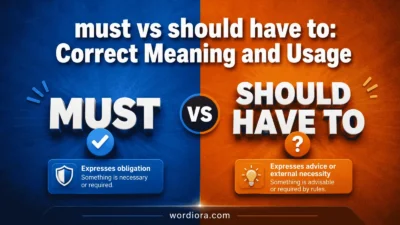
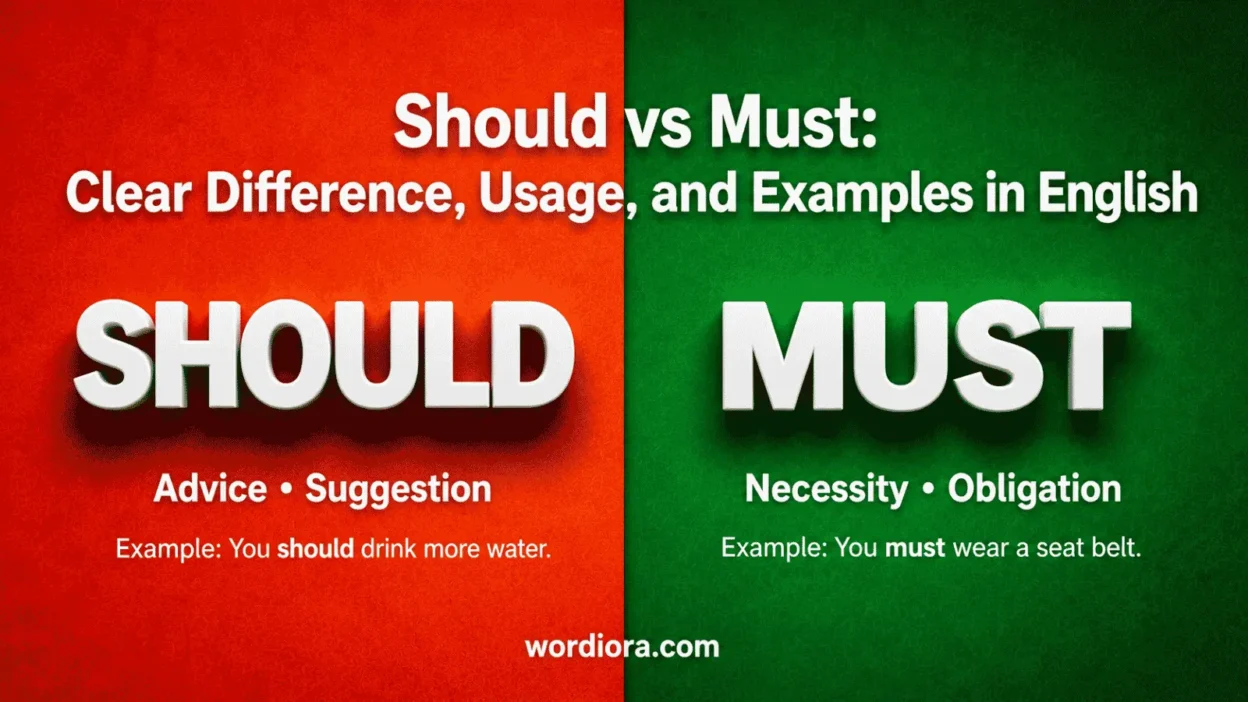
Should vs must is a choice between advice and requirement.
Use should when something is recommended, wise, expected, or morally right. Use must when something is required, necessary, unavoidable, or strongly demanded.
The difference is not just grammatical. It changes the force of the sentence.
“You should submit the form today” sounds like advice.
“You must submit the form today” sounds like a rule, order, or firm requirement.
Quick Answer
Use should for advice, recommendations, expectations, and softer obligations.
Use must for rules, strong obligations, necessity, and firm conclusions.
Examples:
You should call your doctor if the pain continues.
You must wear a seat belt.
You should save a copy of the file.
Employees must complete the training before Friday.
In everyday American English, should usually gives the listener more room to decide. Must usually removes that room.
Why People Confuse Them
People confuse should and must because both words can point to something important.
If you say, “You should pay your taxes,” the action is important.
If you say, “You must pay your taxes,” the action is required.
The subject matter may be serious in both sentences, but the wording changes the level of force. Should often sounds like guidance. Must often sounds like authority.
Another reason is that both words are modal verbs. They come before the base form of another verb:
You should go.
You must go.
Not:
You should to go.
You must to go.
Key Differences At A Glance
| Context | Best Choice | Why |
|---|---|---|
| Friendly advice | should | It sounds helpful, not forceful. |
| Legal rule | must | It shows a requirement. |
| Workplace policy | must | It makes the rule clear. |
| Health recommendation | should | It suggests a wise action unless a rule is involved. |
| Strong personal opinion | must | It adds urgency or insistence. |
| Expected result | should | It can show what is likely. |
| Logical certainty | must | It shows a strong conclusion. |
Compact comparison:
- Should = recommended, advisable, expected, softer.
- Must = required, necessary, certain, stronger.
- Should not = not recommended.
- Must not = forbidden.
- Should have = the better action was not done.
- Must have = a strong conclusion about the past.
Meaning and Usage Difference
Should means something is a good idea, the right choice, or the expected thing to do.
Examples:
You should check your email before the meeting.
We should leave by 7:30.
She should be home soon.
In the first two examples, should gives advice. In the third, it shows expectation.
Must means something is necessary, required, or strongly certain.
Examples:
Visitors must sign in at the front desk.
You must finish the application before the deadline.
That must be the package I ordered.
The first two examples show obligation. The third shows a strong conclusion.
Tone, Context, and Formality
Should usually sounds more polite and flexible. It works well when giving advice, making suggestions, or correcting someone gently.
You should update your resume before applying.
That sentence sounds useful and respectful.
Must sounds firmer. It works well in rules, instructions, warnings, and strong statements.
Applicants must include a valid phone number.
That sentence leaves no doubt that the phone number is required.
In conversation, must can sound intense if the situation does not call for it.
You must try this restaurant.
That can sound enthusiastic, not strict. Still, the word is stronger than should.
You should try this restaurant.
That sounds like a casual recommendation.
Which One Should You Use?
Use should when you mean:
- it is a good idea
- it is the better choice
- it is recommended
- it is expected
- it is morally right, but not stated as a rule
Examples:
You should drink more water during the summer.
Students should review their notes before the exam.
We should be honest about the mistake.
Use must when you mean:
- it is required
- it is necessary
- it is not optional
- it is a rule
- it is a strong conclusion
Examples:
Drivers must stop at a red light.
You must enter your password to continue.
She must be exhausted after that long shift.
If you also want to understand the subtle difference between should and ought to, read our detailed guide on Should vs Ought To to learn when each one sounds more natural, formal, or appropriate in everyday English.
When One Choice Sounds Wrong
Sometimes both words are grammatical, but only one fits the meaning.
Wrong: You should not enter this restricted area.
Better: You must not enter this restricted area.
Why: A restricted area needs a prohibition, not mild advice.
Wrong: You must consider adding more examples to your essay.
Better: You should consider adding more examples to your essay.
Why: The sentence is giving writing advice, not issuing a rule.
Wrong: The package should have arrived because I see it on the porch.
Better: The package must have arrived because I see it on the porch.
Why: The porch is strong evidence, so must have fits the conclusion.
Common Mistakes (and Quick Fixes)
One common mistake is using must when the tone should be softer.
Too strong: You must email Jenna about the schedule.
Better: You should email Jenna about the schedule.
Use must only if Jenna’s schedule email is required.
Another mistake is treating must not and should not as equal.
You should not park there.
This means parking there is a bad idea.
You must not park there.
This means parking there is not allowed.
A third mistake is adding to after either word.
Wrong: You should to call.
Correct: You should call.
Wrong: You must to leave.
Correct: You must leave.
Everyday Examples
You should bring a jacket. It gets cold at night.
You must bring your ID to enter the building.
We should compare prices before buying the laptop.
All passengers must fasten their seat belts.
You should apologize if your comment upset her.
Employees must report safety concerns right away.
The movie should start at 8:00.
The lights are off, so they must be closed.
You should back up your photos.
You must reset your password before using the account.
Dictionary-Style Word Details
Verb
Should and must work as helping verbs before a main verb.
Examples:
You should listen.
You must listen.
They do not change form for different subjects:
I should go.
She should go.
They must leave.
He must leave.
Noun
Should is not normally used as a noun in everyday English.
Must can be a noun meaning something required or highly recommended.
Examples:
Comfortable shoes are a must for this trip.
A valid ticket is a must at the entrance.
Synonyms
For should:
- ought to
- had better
- would be wise to
- is recommended to
For must:
- have to
- need to
- be required to
- be obligated to
These are not always perfect replacements. Had better can sound more urgent than should, and have to often sounds more natural than must in casual American speech.
Example Sentences
You should review the contract before signing it.
You must sign the contract before work can begin.
We should leave early to avoid traffic.
We must leave now or we will miss the flight.
The repair should take about an hour.
The repair must be finished before the inspection.
Word History
Should is closely connected to shall and has long been used for obligation, advice, expectation, and conditional meaning.
Must has long carried the idea of necessity or requirement. It also developed a noun use, as in “a must,” meaning something necessary or strongly recommended.
For modern writers, the history matters less than the present-day force: should is usually softer, and must is usually stronger.
Phrases Containing
Common phrases with should:
- should have
- should not
- should be
- should consider
- should expect
Common phrases with must:
- must have
- must not
- must be
- must see
- must read
- must-have
Examples:
You should have called first.
You must have misunderstood me.
You should not ignore the warning.
You must not share your password.
Conclusion
The difference between should vs must is mainly about strength.
Use should when you are giving advice, making a recommendation, describing what is expected, or suggesting the better choice.
Use must when something is required, necessary, prohibited, or strongly certain.
A simple rule works in most cases:
If the action is recommended, use should.
If the action is required, use must.
QA Status: Checked against current dictionary and grammar references for modal meaning, obligation, advice, and necessity.