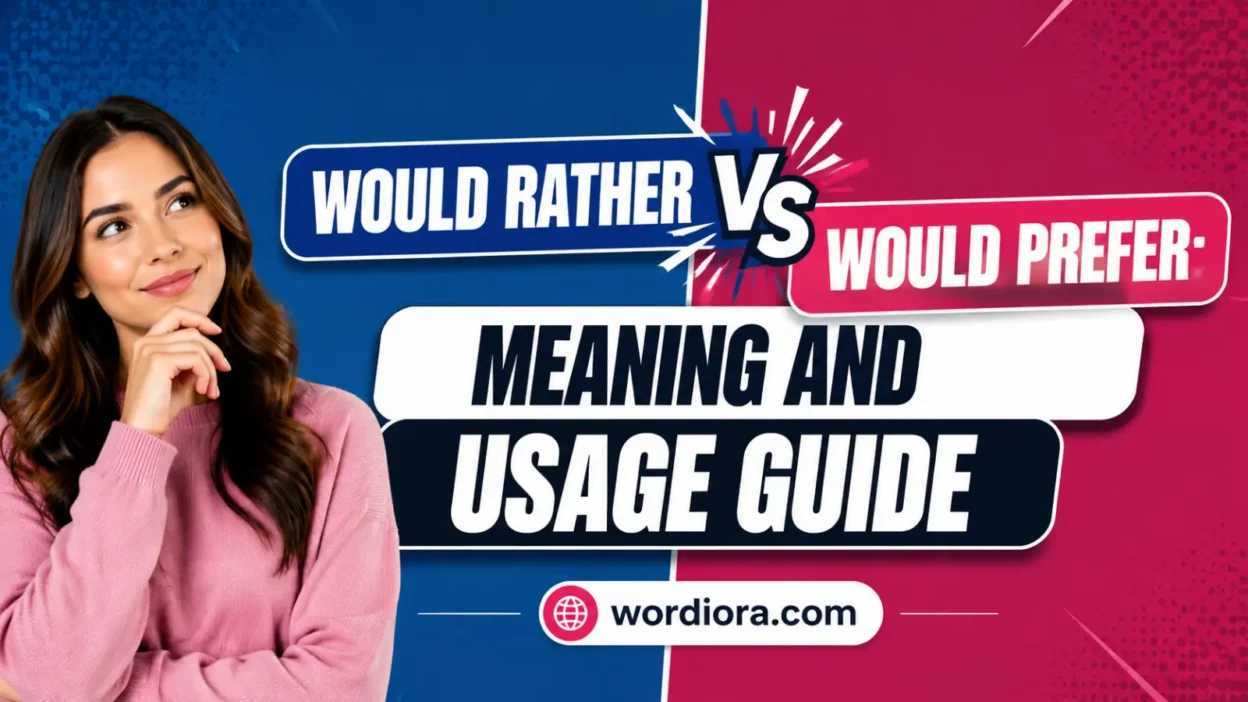
Would rather vs would prefer is a choice between two ways to express preference. Both can mean that you like one option more than another, but they do not follow the same sentence pattern.
Use would rather when you want a more direct, conversational phrase:
I’d rather stay home tonight.
Use would prefer when you want a slightly more formal, polite, or careful phrase:
I’d prefer to stay home tonight.
The meaning is often close, but the grammar changes. That is where most mistakes happen.
Quick Answer
Use would rather when the next verb is in the base form:
I’d rather stay home tonight.
I’d rather walk than drive.
Use would prefer when the next verb uses to, or when the preference is a noun:
I’d prefer to stay home tonight.
I’d prefer coffee.
Both phrases express preference, but they follow different grammar patterns. Would rather is usually more direct and conversational. Would prefer is often more polite, formal, or suitable for careful requests.
The simplest rule is this:
- would rather + base verb
- would prefer + to + verb
- would prefer + noun
What “Would Rather” Means
Would rather means you would choose one thing instead of another. It is common in everyday speech because it is short, direct, and natural.
Examples:
I’d rather eat at home.
She’d rather leave early.
We’d rather not talk about it right now.
They’d rather take the train than drive.
The verb after would rather does not use to.
Correct: I’d rather wait.
Incorrect: I’d rather to wait.
This is the most common mistake with would rather.
What “Would Prefer” Means
Would prefer also means you would choose one option over another. It sounds a little more formal, polite, or measured than would rather.
Examples:
I’d prefer to eat at home.
She’d prefer to leave early.
We’d prefer not to talk about it right now.
They’d prefer to take the train rather than drive.
Use would prefer when the preference is a noun:
I’d prefer coffee.
We’d prefer a morning appointment.
He’d prefer the smaller room.
With an action, use to + verb:
I’d prefer to wait.
They’d prefer to meet tomorrow.
She’d prefer not to answer.
Key Difference At A Glance
| Situation | Use | Example |
| Casual personal choice | would rather | I’d rather stay home. |
| Polite or formal choice | would prefer | I’d prefer to stay home. |
| Before a base verb | would rather | I’d rather call. |
| Before to + verb | would prefer | I’d prefer to call. |
| Before a noun | would prefer | I’d prefer tea. |
| Comparing two actions | either, with the right pattern | I’d rather walk than drive. / I’d prefer to walk rather than drive. |
| Saying what you want another person to do | would rather + subject + past verb | I’d rather you waited outside. |
Grammar Patterns You Need To Know
| Pattern | Correct Example | Common Mistake |
| would rather + base verb | I’d rather leave now. | I’d rather to leave now. |
| would rather not + base verb | I’d rather not discuss it. | I’d rather don’t discuss it. |
| would rather + verb + than + verb | I’d rather walk than drive. | I’d rather walk rather than drive. |
| would prefer + to + verb | I’d prefer to leave now. | I’d prefer leave now. |
| would prefer not + to + verb | I’d prefer not to discuss it. | I’d prefer to not discuss it. |
| would prefer + noun | I’d prefer tea. | I’d rather tea. |
| would prefer + to verb + rather than + verb | I’d prefer to walk rather than drive. | I’d prefer walk than drive. |
When To Use “Would Rather”
Use would rather when your sentence is direct, personal, and action-based.
I’d rather take a later flight.
I’d rather finish this tomorrow.
We’d rather eat before the movie.
He’d rather send a text than make a call.
It works especially well in speech:
I’d rather not.
I’d rather wait here.
Would you rather sit inside or outside?
Because would rather is direct, it can sometimes sound blunt in sensitive situations. That does not make it rude by itself, but tone matters.
Direct: I’d rather talk later.
Softer: I’d prefer to talk later, if that works for you.
When To Use “Would Prefer”
Use would prefer when you want to sound more polite, professional, or specific.
I’d prefer to schedule the meeting for Thursday.
We’d prefer written confirmation.
The client would prefer a shorter call.
I’d prefer not to comment until I have more information.
It is especially useful in workplace, service, travel, medical, academic, and customer-support settings because it sounds less abrupt.
Casual: I’d rather sit by the window.
More polite: I’d prefer to sit by the window, if possible.
Casual: I’d rather get an email.
More professional: I’d prefer to receive the details by email.
How To Compare Two Choices
The comparison structure changes depending on the phrase.
Use would rather + verb + than + verb:
I’d rather walk than drive.
She’d rather call than text.
We’d rather save the money than spend it now.
Use would prefer + to verb + rather than + verb:
I’d prefer to walk rather than drive.
She’d prefer to call rather than text.
We’d prefer to save the money rather than spend it now.
With nouns, would prefer is usually cleaner:
I’d prefer coffee to tea.
They’d prefer Chicago to Dallas.
We’d prefer the morning slot to the afternoon slot.
In casual speech, you can also use would rather have before a noun:
I’d rather have coffee than tea.
I’d rather have the morning slot than the afternoon slot.
Same Subject Vs Different Subject
This is where many writers make mistakes.
When the same person has the preference and does the action, use would rather + base verb.
I’d rather leave early.
She’d rather work from home.
We’d rather not wait.
The subject is the same: I want I to leave. She wants she to work from home.
When one person wants another person to do something, use would rather + subject + past verb.
I’d rather you left early.
She’d rather he worked from home.
We’d rather they waited outside.
The past form does not mean the action happened in the past. It usually refers to a present or future preference.
Compare:
I’d rather call you tomorrow.
I’d rather you called me tomorrow.
The first sentence means I want to make the call.
The second sentence means I want you to make the call.
Negative Forms
The negative form depends on the structure.
With would rather, put not before the base verb:
I’d rather not go.
She’d rather not answer.
We’d rather not delay the project.
With would prefer, use not to before the verb:
I’d prefer not to go.
She’d prefer not to answer.
We’d prefer not to delay the project.
With would rather + another subject, put the negative in the following clause:
I’d rather you didn’t go.
She’d rather he didn’t answer.
We’d rather they didn’t delay the project.
Avoid this form:
Incorrect: I wouldn’t rather you go.
Correct: I’d rather you didn’t go.
Question Forms
Both phrases work in questions, but the structure changes.
Use Would you rather + base verb:
Would you rather eat now or later?
Would you rather drive or take the train?
Would you rather meet on Monday or Tuesday?
Use Would you prefer + noun or Would you prefer + to + verb:
Would you prefer coffee or tea?
Would you prefer to eat now or later?
Would you prefer to meet on Monday or Tuesday?
In everyday conversation, Would you rather…? often sounds more relaxed. Would you prefer…? sounds more polite or service-oriented.
Casual: Would you rather sit outside?
Polite: Would you prefer to sit outside?
Past Preferences And Regret
To talk about a preference about the past, use would rather have + past participle.
I’d rather have stayed home.
She’d rather have taken the earlier flight.
We’d rather not have spent so much money.
This often suggests regret or a different wish about what happened.
I’d rather have called you before the meeting.
Meaning: I did not call, but now I think calling would have been better.
With would prefer, past-focused sentences are less common in everyday speech, but you may see forms like:
I would have preferred to stay home.
She would have preferred to take the earlier flight.
These sound more formal than I’d rather have…
Would Rather Vs Would Prefer Vs Prefer
Would rather and would prefer usually describe a specific choice in a particular situation.
I’d rather stay home tonight.
I’d prefer to stay home tonight.
Prefer often describes a general preference.
I prefer coffee to tea.
She prefers working in the morning.
They prefer direct flights.
Compare:
General preference: I prefer tea to coffee.
Specific choice now: I’d prefer tea, please.
Specific choice now, more conversational: I’d rather have tea, please.
Do not use would when you are talking about a permanent or general preference unless you are making the statement softer or more conditional.
Natural: I prefer quiet restaurants.
Specific: I’d prefer a quiet restaurant tonight.
Common Mistakes And Better Fixes
Using “To” After “Would Rather”
Incorrect: I’d rather to stay home.
Correct: I’d rather stay home.
Dropping “To” After “Would Prefer”
Incorrect: I’d prefer stay home.
Correct: I’d prefer to stay home.
Using “Would Rather” Directly Before A Noun
Awkward: I’d rather coffee.
Correct: I’d rather have coffee.
Correct: I’d prefer coffee.
Using “Would Rather Prefer”
Incorrect: I’d rather prefer to wait.
Correct: I’d rather wait.
Correct: I’d prefer to wait.
Use one phrase or the other. Do not combine them.
Using The Wrong Negative Form
Incorrect: I’d rather you don’t call late.
Correct: I’d rather you didn’t call late.
Incorrect: I’d prefer don’t go.
Correct: I’d prefer not to go.
Natural Examples In Everyday English
I’d rather cook tonight than order takeout.
I’d prefer to cook tonight rather than order takeout.
She’d rather work remotely on Friday.
She’d prefer to work remotely on Friday.
We’d rather take the earlier appointment.
We’d prefer the earlier appointment.
I’d rather you sent the file before noon.
I’d prefer that you send the file before noon.
Would you rather talk now or after lunch?
Would you prefer to talk now or after lunch?
I’d rather not make a decision today.
I’d prefer not to make a decision today.
They’d rather have a direct flight.
They’d prefer a direct flight.
Which One Sounds More Natural?
In casual American English, would rather often sounds more natural when you are talking about an action.
Natural: I’d rather drive.
Also correct: I’d prefer to drive.
In polite or professional English, would prefer often sounds better.
Natural: I would prefer to review the proposal before signing.
More direct: I’d rather review the proposal before signing.
Both are correct, but the second can sound firmer.
For nouns, would prefer is usually the cleanest choice.
Best: I’d prefer tea.
Also natural: I’d rather have tea.
Not natural: I’d rather tea.
FAQ
Is “would rather” more informal than “would prefer”?
Yes. Would rather is usually more conversational and direct. Would prefer is usually more polite, formal, or careful. The difference is tone, not just grammar.
Can I use “would rather” and “would prefer” interchangeably?
Sometimes, but not automatically. They can express the same choice, but they require different sentence patterns.
Correct: I’d rather leave early.
Correct: I’d prefer to leave early.
Incorrect: I’d rather to leave early.
Incorrect: I’d prefer leave early.
Is “I would rather prefer” correct?
No. Do not combine the two phrases. Say I would rather… or I would prefer…
Correct: I’d rather wait.
Correct: I’d prefer to wait.
Incorrect: I’d rather prefer to wait.
Do I say “I’d rather not” or “I’d prefer not”?
Both can be correct.
Use I’d rather not + base verb:
I’d rather not go.
Use I’d prefer not to + verb:
I’d prefer not to go.
Why do we say “I’d rather you called” instead of “I’d rather you call”?
In many standard grammar explanations, would rather + another subject is followed by a past-form verb for a present or future preference.
I’d rather you called before coming over.
The meaning is not past. It means you want the person to call.
Final Rule
Use would rather for a direct preference followed by a base verb:
I’d rather stay.
I’d rather not leave.
I’d rather walk than drive.
Use would prefer for a more polite or formal preference followed by to + verb or a noun:
I’d prefer to stay.
I’d prefer not to leave.
I’d prefer coffee.
When the meaning is similar, the grammar decides which phrase works. Keep the pattern correct, then choose the tone that fits the situation.
Conclusion
The difference between would rather and would prefer is mainly grammar and tone.
Use would rather for a direct, natural preference followed by a base verb:
I’d rather stay home.
Use would prefer for a slightly more formal or polite preference, especially before a noun or to + verb:
I’d prefer to stay home.
I’d prefer coffee.
If you remember one rule, make it this: would rather + base verb, but would prefer + to + verb. That single pattern will fix most mistakes.