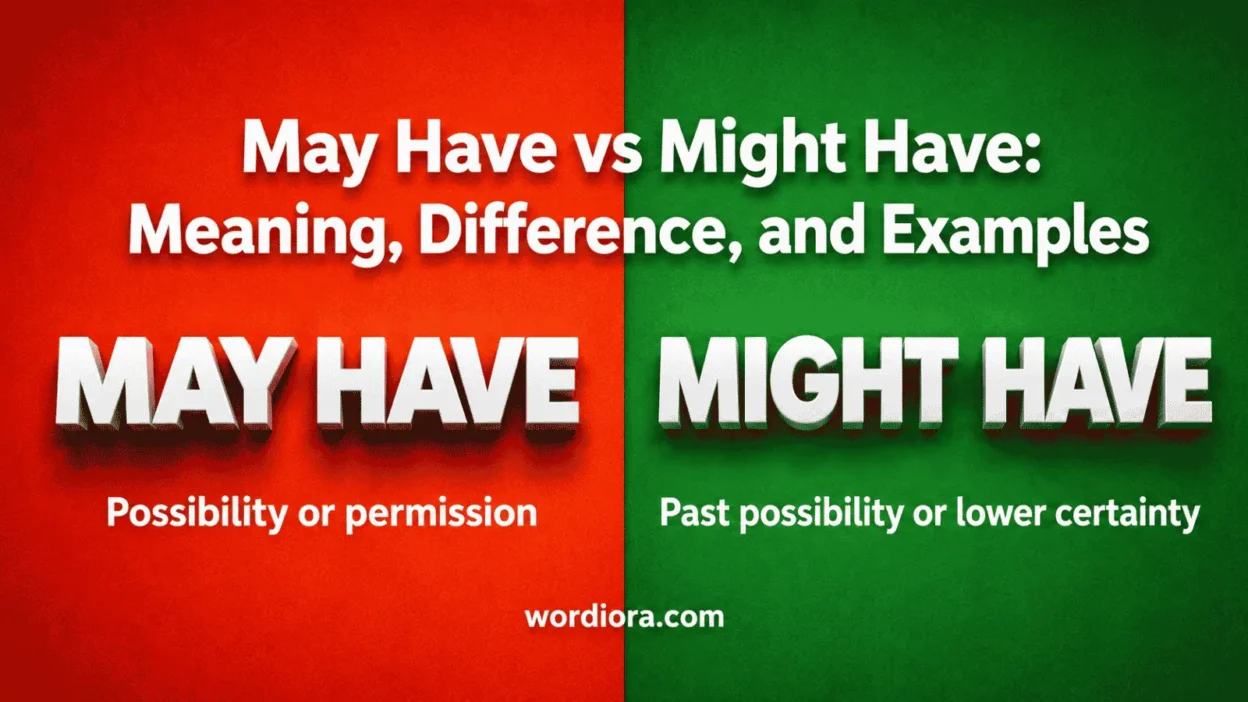
May have vs might have is a choice between two phrases that both describe a possible past event. They are often close in meaning, but they do not always feel the same.
Use may have when something is possible and may sound slightly more likely or direct. Use might have when something is more uncertain, more tentative, or connected to a possibility that did not actually happen.
The difference is subtle, so context matters more than a rigid rule.
Quick Answer
May have means something possibly happened.
Might have also means something possibly happened, but it often sounds less certain, more cautious, or more hypothetical.
Examples:
- She may have left her phone in the car.
- She might have left her phone in the car.
Both sentences are correct. The first can sound a little more confident. The second can sound a little more doubtful.
When talking about something that was possible but did not happen, might have is usually the better choice.
Example:
- I might have gone to law school if I had taken a different path.
Why People Confuse Them
People confuse may have and might have because both phrases use a modal verb plus have plus a past participle.
That structure lets writers make a guess about the past:
- may have missed
- might have forgotten
- may have changed
- might have misunderstood
The confusion gets worse because many speakers use them almost interchangeably in everyday conversation. In many sentences, either one sounds acceptable.
The real difference usually comes down to certainty, tone, and whether the sentence describes a real possibility or an unreal past possibility.
Key Differences At A Glance
| Context | Best Choice | Why |
|---|---|---|
| A possible past event | may have | It can sound direct and reasonably possible. |
| A less certain past guess | might have | It sounds more tentative. |
| A polite or cautious statement | might have | It softens the claim. |
| A missed or unreal past possibility | might have | It fits situations that did not happen. |
| A formal notice or report | may have | It can sound neutral and official. |
| Casual uncertainty | either | Both are common when the difference is not important. |
A simple rule: may have often sounds a little more likely; might have often sounds a little more doubtful.
Meaning and Usage Difference
May have is used when you think something is possible in the past.
Examples:
- The package may have arrived yesterday.
- The manager may have approved the request.
- The update may have fixed the issue.
These sentences do not say the event definitely happened. They only say it is possible.
Might have works the same way, but it often adds more distance or uncertainty.
Examples:
- The package might have arrived yesterday.
- The manager might have approved the request.
- The update might have fixed the issue.
The meaning is close, but the tone is softer.
The clearest difference appears in unreal past situations. Use might have when something was possible under different circumstances but did not happen.
Examples:
- We might have won if we had started earlier.
- She might have accepted the offer if the salary had been higher.
- I might have called, but my phone died.
In those examples, may have would sound awkward or less natural.
Tone, Context, and Formality
May have can sound more formal, neutral, or official.
Examples:
- Your payment may have been delayed.
- The form may have been submitted twice.
- The error may have occurred during processing.
This makes may have useful in business writing, customer service messages, reports, and notices.
Might have often sounds more conversational, cautious, or speculative.
Examples:
- I might have left my keys at your place.
- He might have misunderstood the instructions.
- They might have gone to lunch already.
This makes might have useful when you do not want to sound too certain.
Neither phrase is wrong by default. The better choice depends on how strong or cautious you want the sentence to feel.
Which One Should You Use?
Choose may have when the possibility feels real, direct, or reasonably likely.
Examples:
- The storm may have damaged the roof.
- She may have already seen the message.
- The file may have been deleted by accident.
Choose might have when the possibility feels weaker, more uncertain, or more imagined.
Examples:
- The storm might have damaged the roof, but we need to check.
- She might have seen the message, though I am not sure.
- The file might have been deleted, or it could be in another folder.
Use might have for past possibilities that did not happen.
Examples:
- I might have stayed longer if I had known you were coming.
- They might have finished on time with more help.
- We might have avoided the problem by testing earlier.
| Feature | may have | might have |
|---|---|---|
| Basic meaning | Possible in the past | Possible in the past |
| Certainty | Often slightly stronger | Often slightly weaker |
| Tone | Direct, neutral, formal | Tentative, cautious, hypothetical |
| Best for unreal past | Usually not | Yes |
| Everyday use | Common | Common |
When One Choice Sounds Wrong
May have can sound wrong when the sentence clearly describes something that did not happen.
Awkward:
- I may have become a doctor if I had gone to medical school.
Better:
- I might have become a doctor if I had gone to medical school.
The sentence is about an unreal past path, so might have is the natural choice.
Might have can sound too weak when the writer wants to present a serious or likely possibility.
Weak:
- Your account might have been charged twice.
Stronger:
- Your account may have been charged twice.
The stronger version works better when a company is formally warning a customer about a real possible issue.
Common Mistakes (and Quick Fixes)
One common mistake is using may of or might of instead of may have or might have.
Incorrect:
- She may of left early.
- He might of forgotten.
Correct:
- She may have left early.
- He might have forgotten.
The confusion comes from the sound of contractions like may’ve and might’ve. In careful writing, use may have and might have.
Another mistake is treating may have as always correct for the past. It is correct for possible past events, but might have is better for unreal past outcomes.
Less natural:
- We may have won if the referee had made a different call.
Better:
- We might have won if the referee had made a different call.
Everyday Examples
Here are natural examples of may have:
- The email may have gone to your spam folder.
- She may have taken the earlier train.
- The meeting may have ended before noon.
- Your password may have expired.
- He may have heard the news already.
Here are natural examples of might have:
- I might have left my jacket at the restaurant.
- They might have misunderstood the deadline.
- She might have been joking.
- We might have missed the exit.
- He might have said that, but I do not remember.
Here are examples where might have is better because the event did not happen:
- I might have studied abroad if I had saved more money.
- We might have bought the house if the inspection had gone well.
- She might have joined us if she had not been working.
Dictionary-Style Word Details
Verb
May have and might have are verb phrases. Each one combines a modal verb with have and a past participle.
Examples:
- may have known
- may have seen
- might have wanted
- might have failed
The main action comes from the past participle, such as known, seen, wanted, or failed.
Noun
May have and might have are not nouns. They do not name a person, place, thing, or idea. They function as part of a verb phrase.
Incorrect as a noun:
- The may have was confusing.
Natural revision:
- The phrase may have was confusing.
Synonyms
There is no perfect one-word synonym for either phrase. Depending on the sentence, you can sometimes replace them with:
- possibly
- perhaps
- could have
- is possible that
- it is possible
Examples:
- She may have forgotten.
- Perhaps she forgot.
- It is possible that she forgot.
Could have is close, but it is not always identical. It can also suggest ability or a missed opportunity.
Example Sentences
- The delay may have affected several orders.
- He may have sent the report to the wrong person.
- I might have left the receipt in my car.
- They might have chosen another vendor.
- We might have finished sooner if we had started earlier.
Word History
May have comes from the modal verb may plus have. Might have comes from might, which is historically connected to may, plus have.
In modern usage, the two phrases overlap often. The practical difference is not about memorizing history. It is about choosing the phrase that matches the level of certainty and the type of past possibility.
Phrases Containing
Common phrases include:
- may have been
- may have had
- may have seen
- may have caused
- might have been
- might have had
- might have known
- might have happened
- might have been able to
These phrases usually introduce uncertainty about something in the past.
Conclusion
May have and might have both describe a possible past event, but they do not always carry the same tone.
Use may have when the possibility sounds fairly real, direct, or formal. Use might have when the possibility sounds less certain, more cautious, or tied to something that did not actually happen.
For most everyday guesses, both can work. For unreal past possibilities, might have is usually the safer and more natural choice.