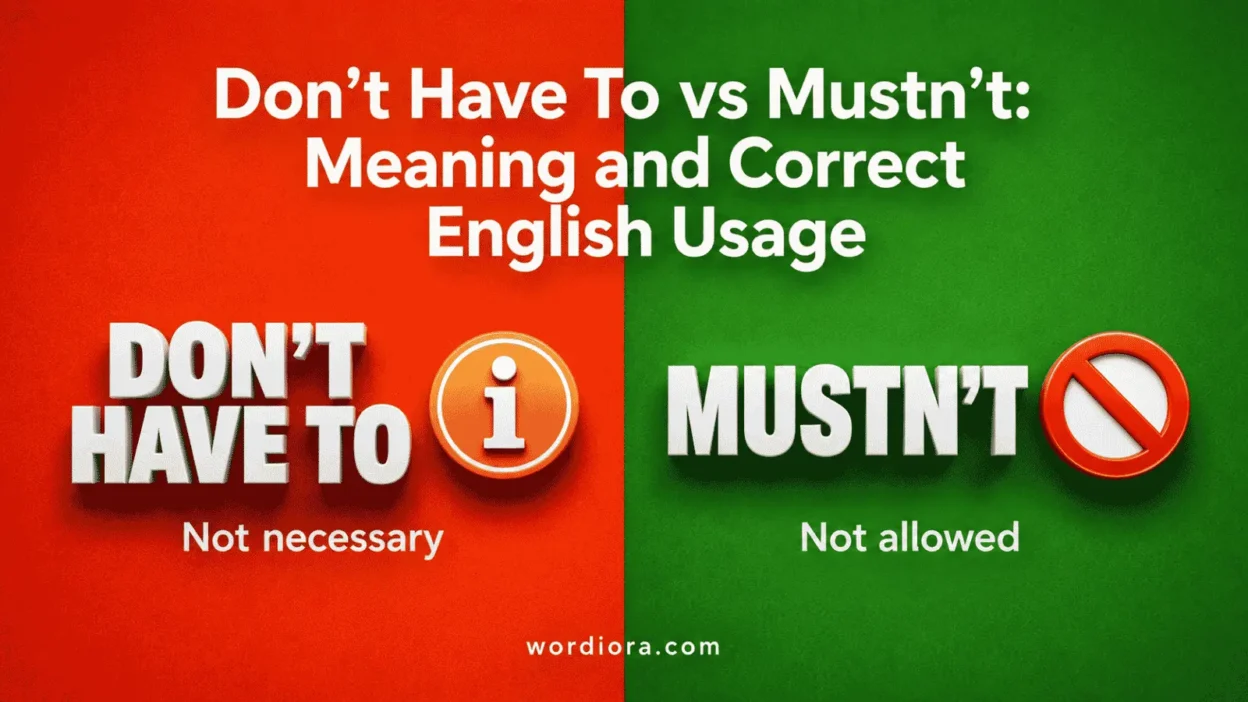
Don’t have to and mustn’t do not mean the same thing.
Use don’t have to when something is not necessary. The person may do it, but there is no requirement.
Use mustn’t when something is not allowed. The person should not do it.
That difference matters because the wrong choice can completely change the meaning of a sentence.
Quick Answer
Don’t have to means “there is no need.”
Mustn’t means “it is forbidden” or “you should not.”
Examples:
- You don’t have to bring lunch.
Meaning: Bringing lunch is optional. - You mustn’t bring lunch into the lab.
Meaning: Bringing lunch into the lab is not allowed.
The key difference is simple: don’t have to removes an obligation; mustn’t creates a prohibition.
Why People Confuse Them
People confuse these phrases because both are negative forms connected to obligation.
The positive forms can seem related:
- You have to wear a badge.
- You must wear a badge.
Both can show that something is required. But the negative forms split in meaning:
- You don’t have to wear a badge.
There is no requirement. - You mustn’t wear someone else’s badge.
That is not allowed.
This is why translating word by word can be risky. In English, the negative forms do not work as simple opposites of the positive forms.
Key Differences At A Glance
| Context | Best Choice | Why |
|---|---|---|
| Something is optional | don’t have to | It means there is no obligation. |
| Something is forbidden | mustn’t | It means the action is not allowed. |
| A rule says not to do something | mustn’t | It sounds firm and rule-based. |
| A task is unnecessary | don’t have to | It tells the listener they are free not to do it. |
| Giving permission to skip something | don’t have to | It removes pressure. |
| Warning someone against an action | mustn’t | It clearly says not to do it. |
Meaning and Usage Difference
Don’t have to is about lack of necessity.
Use it when the action is allowed, but not required.
Examples:
- You don’t have to reply tonight.
- We don’t have to attend the optional meeting.
- She doesn’t have to pay for parking on Sundays.
- They don’t have to sign up again.
In each sentence, the action is possible. It is just not required.
Mustn’t is about prohibition.
Use it when the action should not happen.
Examples:
- You mustn’t park in front of the fire hydrant.
- Employees mustn’t share private customer information.
- Children mustn’t run near the pool.
- Visitors mustn’t touch the equipment.
In each sentence, the action is not allowed or strongly warned against.
Tone, Context, and Formality
Don’t have to usually sounds neutral, helpful, or reassuring.
It often appears in everyday conversation, instructions, workplace messages, and customer service writing.
Examples:
- You don’t have to print the receipt.
- You don’t have to stay after the meeting.
- You don’t have to create a new account.
Mustn’t sounds stronger and more formal than don’t have to. In American English, people often use must not in formal rules and can’t, shouldn’t, or are not allowed to in everyday speech.
Examples:
- You must not enter this area without permission.
- You can’t use your phone during the test.
- You shouldn’t leave medicine where children can reach it.
Mustn’t is correct, but it can sound a little more formal or traditional in US conversation.
Which One Should You Use?
Use don’t have to when you mean:
- It is optional.
- It is not required.
- There is no need.
- The person can choose.
Use mustn’t when you mean:
- It is forbidden.
- It is against a rule.
- It is unsafe.
- The person should not do it.
Compact comparison:
- Don’t have to = no obligation
- Mustn’t = prohibition
- Don’t have to gives freedom
- Mustn’t gives a restriction
- Don’t have to means “you may, but it is not necessary”
- Mustn’t means “do not do it”
When One Choice Sounds Wrong
The wrong phrase can make a sentence confusing or even dangerous.
Wrong: You don’t have to touch the wet paint.
Better: You mustn’t touch the wet paint.
The first sentence means touching the paint is optional. The second sentence clearly says not to touch it.
Wrong: You mustn’t come to the meeting if you’re busy.
Better: You don’t have to come to the meeting if you’re busy.
The first sentence sounds as if attending is forbidden. The second sentence means attendance is optional.
Wrong: Guests don’t have to smoke inside the building.
Better: Guests mustn’t smoke inside the building.
Smoking inside is not optional; it is prohibited.
Common Mistakes (and Quick Fixes)
A common mistake is using don’t have to for rules.
Incorrect: Drivers don’t have to text while driving.
Correct: Drivers mustn’t text while driving.
Another mistake is using mustn’t when something is only optional.
Incorrect: You mustn’t submit the worksheet today.
Correct: You don’t have to submit the worksheet today.
A third mistake is assuming mustn’t means “not necessary.” It does not. Mustn’t means the action should not be done.
Quick fix: replace the phrase with a simple meaning.
- If you mean “not required,” use don’t have to.
- If you mean “not allowed,” use mustn’t.
Everyday Examples
Here are natural examples in American English.
- You don’t have to bring anything to the party.
- You mustn’t bring outside alcohol into the venue.
- We don’t have to finish the report today.
- We mustn’t share the draft before approval.
- Kids don’t have to wear uniforms on Friday.
- Kids mustn’t leave campus without permission.
- You don’t have to tip at the counter, but you can.
- You mustn’t block the emergency exit.
- Employees don’t have to use their personal phones.
- Employees mustn’t post confidential documents online.
Notice the pattern: don’t have to removes a duty; mustn’t blocks an action.
Dictionary-Style Word Details
Verb
Don’t have to works as a negative verb phrase. It uses do plus have to to show that something is not required.
Examples:
- I don’t have to work tomorrow.
- He doesn’t have to call back.
- They didn’t have to pay extra.
Mustn’t is the contraction of must not. It uses the modal verb must with not to show prohibition.
Examples:
- You mustn’t open that door.
- She mustn’t miss the deadline.
- They mustn’t ignore the warning.
Noun
Neither don’t have to nor mustn’t is normally used as a noun.
If you need a noun, use a related idea:
- For don’t have to: option, choice, exemption
- For mustn’t: rule, ban, prohibition
Examples:
- Attendance is an option.
- Smoking is under a ban.
Synonyms
For don’t have to, possible alternatives include:
- don’t need to
- need not
- are not required to
- are free not to
- may skip
For mustn’t, possible alternatives include:
- must not
- cannot
- are not allowed to
- are forbidden to
- should not
Choose carefully. Should not is usually softer than mustn’t, while are forbidden to is more formal and forceful.
Example Sentences
- You don’t have to wait in line if you checked in online.
- You mustn’t use this entrance during construction.
- We don’t have to decide right now.
- We mustn’t ignore the safety notice.
- Students don’t have to buy the printed book.
- Students mustn’t copy another student’s work.
Word History
Must has long been used in English to express necessity, duty, or strong requirement. In negative form, must not developed the meaning of prohibition.
Have to developed as a phrase for necessity or obligation. Its negative form, don’t have to, means the necessity is absent.
That is why the two negative forms point in different directions today.
Phrases Containing
Common phrases with don’t have to:
- don’t have to worry
- don’t have to pay
- don’t have to attend
- don’t have to choose
- don’t have to decide now
Common phrases with mustn’t:
- mustn’t forget
- mustn’t touch
- mustn’t enter
- mustn’t tell anyone
- mustn’t be late
Conclusion
Don’t have to and mustn’t are not interchangeable.
Use don’t have to when something is optional or unnecessary.
Use mustn’t when something is forbidden, unsafe, or against a rule.
The easiest test is this: if the person still has a choice, use don’t have to. If the person should not do the action, use mustn’t.