
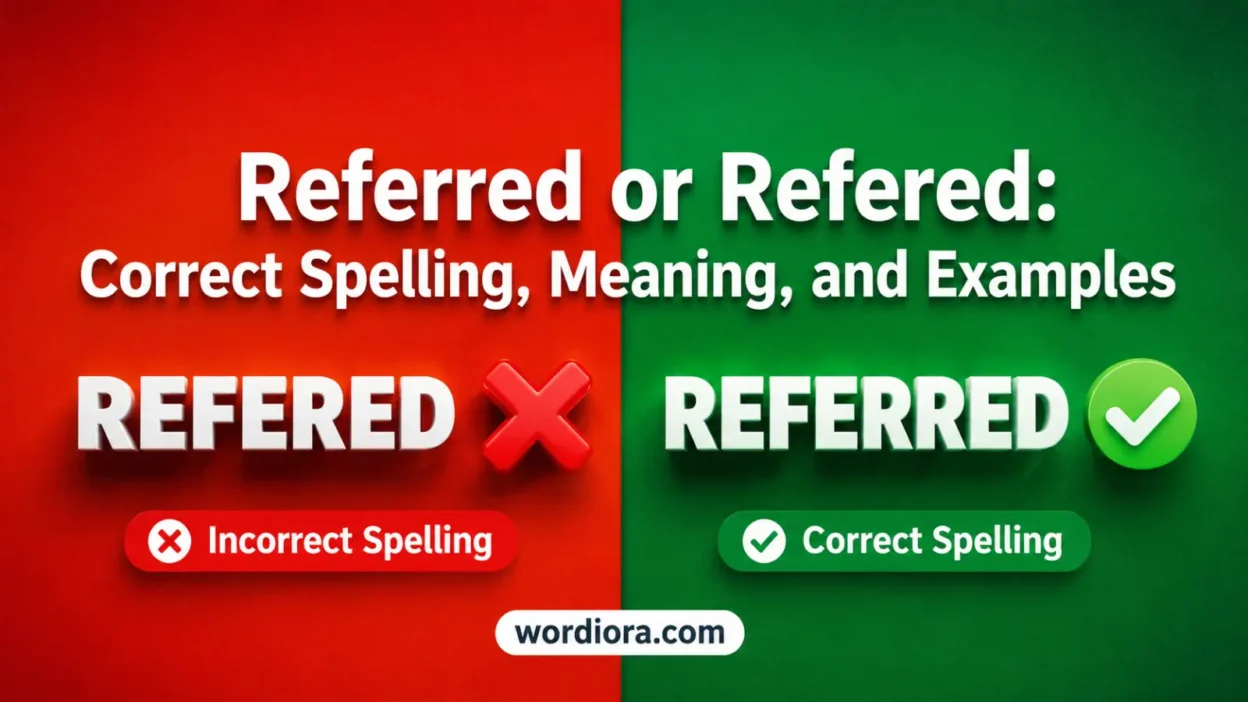
The correct spelling is referred, not refered. Use referred when you need the past tense or past participle of the verb refer. For example, you might write, “My doctor referred me to a specialist,” or “The report referred to last year’s sales.”
The form refered is a common spelling mistake. It may look reasonable because the base verb is refer, but standard English doubles the final r before adding -ed in this word. That is why the correct form is referred.
This guide explains the difference clearly, shows where people make the mistake, and gives natural examples for school, work, healthcare, and everyday writing.
Quick Answer
Use referred every time. Refered is not the standard spelling in American English.
Referred means mentioned, directed, sent, or pointed someone or something to another person, place, source, or subject. It is the past tense and past participle of refer.
Correct: She referred the client to another department.
Incorrect: She refered the client to another department.
Why People Confuse Them
People confuse referred and refered because the base word refer has only one r at the end. When writers add -ed, they may expect the word to become refered.
The spelling changes because refer ends with one vowel plus one consonant, and the stress falls on the final syllable: re-FER. In this pattern, the final consonant is often doubled before a vowel suffix. That gives us referred and referring.
The same pattern appears in words like preferred from prefer and occurred from occur. The mistake happens when writers remember the base word but forget the spelling change.
Key Differences At A Glance
| Context | Best Choice | Why |
|---|---|---|
| Past tense of refer | Referred | This is the correct standard spelling. |
| Professional email | Referred | It looks polished and correct. |
| School essay | Referred | Teachers expect the standard form. |
| Medical sentence | Referred | Used for sending a patient to another provider. |
| Legal or business writing | Referred | Fits formal records and reports. |
| Casual message | Referred | Correct in casual writing too. |
| Any standard US writing | Referred | Refered is a spelling error. |
Meaning and Usage Difference
There is no real meaning difference between referred and refered because refered is not a standard word. The actual choice is between a correct spelling and an incorrect spelling.
Referred can mean that someone mentioned something:
She referred to the budget during the meeting.
It can also mean that someone sent a person to another place or professional for help:
The clinic referred him to a cardiologist.
In writing, referred can also mean that a word, number, note, or statement pointed to something else:
The footnote referred to a source at the end of the chapter.
Use referred when the action happened in the past or when you need a past participle after words like was, were, has, or had.
Tone, Context, and Formality
Referred works in every tone: formal, neutral, academic, medical, business, and casual. It is not too fancy, and it is not limited to professional writing.
In formal writing, referred often appears in reports, emails, case notes, job records, and medical updates:
The employee was referred to human resources.
In everyday writing, it can sound natural too:
My friend referred me to a great mechanic.
Refered looks like a typo in all contexts. It may make a sentence look rushed or unedited. Even if the reader understands the meaning, the spelling can weaken the sentence.
Compact comparison:
- Referred: correct, standard, past tense, past participle.
- Refered: incorrect spelling, not recommended in edited writing.
- Refer: base verb, as in “Please refer to the guide.”
- Referring: present participle, also doubles the final r.
Which One Should You Use?
Use referred whenever you mean that someone mentioned, directed, assigned, sent, or pointed someone or something somewhere in the past.
Write:
The manager referred the issue to payroll.
The article referred to several court cases.
I was referred by a former client.
The patient had been referred for testing.
Do not use refered in emails, captions, essays, resumes, reports, applications, or business pages. It is not a casual variant. It is also not a US versus UK difference. For standard writing, the answer stays the same: referred is correct.
When One Choice Sounds Wrong
Refered sounds wrong once you know the spelling pattern. It also looks unfinished because the past form of refer needs the doubled r.
Wrong: The teacher refered us to chapter five.
Correct: The teacher referred us to chapter five.
Wrong: I was refered by my neighbor.
Correct: I was referred by my neighbor.
Wrong: The note refered to the wrong invoice.
Correct: The note referred to the wrong invoice.
The mistake is especially noticeable in professional writing because referred often appears in serious contexts, such as healthcare, hiring, customer service, and legal communication.
Common Mistakes (and Quick Fixes)
One common mistake is using refered because the writer starts with refer and simply adds -ed. The fix is simple: double the final r.
Incorrect: The agent refered my case to billing.
Correct: The agent referred my case to billing.
Another mistake is using reffered with two f’s. The base word refer has one f, so the f does not double.
Incorrect: She reffered me to her attorney.
Correct: She referred me to her attorney.
Writers also confuse referred with referral. Referred is usually a verb form. Referral is a noun.
Verb: My doctor referred me to a specialist.
Noun: My doctor gave me a referral.
Everyday Examples
Here are natural examples of referred in modern US English.
My coworker referred me to a job opening.
The school referred the family to a counselor.
The article referred to the new policy twice.
She referred to her notes before answering.
The doctor referred the patient for more tests.
Customer support referred my request to another team.
The guide referred readers to the appendix.
He referred to his childhood in the interview.
The landlord referred us to the lease agreement.
My professor referred me to three helpful books.
The report referred only to sales from March.
The email referred to an attachment, but nothing was attached.
Dictionary-Style Word Details
Verb
Referred: This is the past tense and past participle of the verb refer. It is used when the action already happened or when a sentence uses a helping verb.
Examples:
She referred the matter to the board.
The matter was referred to the board.
Refered: Not standard as a verb form. Use referred instead.
Noun
Referred: Not commonly used as a noun in standard US English. It is mainly a verb form. In medical language, referred can also appear as an adjective, as in referred pain, meaning pain felt in one area though its source is elsewhere.
Refered: Not commonly used as a noun in standard US English.
Synonyms
Referred: Closest plain alternatives depend on meaning. For “mentioned,” use mentioned, cited, noted, or alluded to. For “sent for help,” use directed, sent, recommended, or passed along.
Refered: No true synonyms because it is not the standard form. The correct replacement is referred.
Clear opposites are not always exact. For “mentioned,” a possible opposite is ignored or omitted. For “sent,” a possible opposite is kept or retained, depending on the sentence.
Example Sentences
Referred:
The nurse referred the patient to urgent care.
The speaker referred to recent survey results.
The contract referred to the payment schedule.
I was referred by someone who used your service last year.
Refered:
Do not use this spelling in standard writing.
Incorrect: The client was refered to sales.
Correct: The client was referred to sales.
Word History
Referred: The base verb refer comes through older forms connected with the idea of carrying, bringing, or directing back. In modern English, the useful point is simpler: refer becomes referred in the past tense and past participle.
Refered: No separate word history is needed because this is not a standard spelling. It is best understood as a common misspelling of referred.
Phrases Containing
Referred:
referred to as
referred by a friend
referred to a specialist
referred for review
referred back to the committee
referred pain
referred case
Refered:
No standard phrases use this spelling. Replace it with referred.
FAQs
Is it referred or refered?
Referred is correct. Refered is a misspelling. Use referred as the past tense and past participle of refer, as in “She referred me to a specialist.”
Why does referred have two r’s?
Referred has two r’s because the final syllable of refer is stressed, and the word doubles the final consonant before -ed. The same idea appears in preferred and occurred.
Is refered ever acceptable?
No. Refered is not accepted as standard spelling in American English. It may appear in drafts, texts, or search boxes, but the corrected form should be referred.
Is referred formal or casual?
Referred works in both formal and casual writing. You can use it in a medical note, business email, school essay, text message, or everyday sentence.
What is the difference between referred and referral?
Referred is usually a verb form: “The doctor referred me.” Referral is a noun: “The doctor gave me a referral.” They are related, but they do different jobs in a sentence.
How do I remember the spelling?
Remember this quick pattern: refer + red = referred. The word keeps one f but doubles the final r before -ed.
Conclusion
The choice between referred and refered is simple: referred is correct, and refered is a spelling mistake. Use referred when you mean mentioned, directed, sent, assigned, or pointed someone or something somewhere in the past.
The most useful reminder is that refer doubles the final r before -ed. That gives you referred, not refered. Whether you are writing an email, report, essay, medical note, or casual message, referred is the form readers expect.