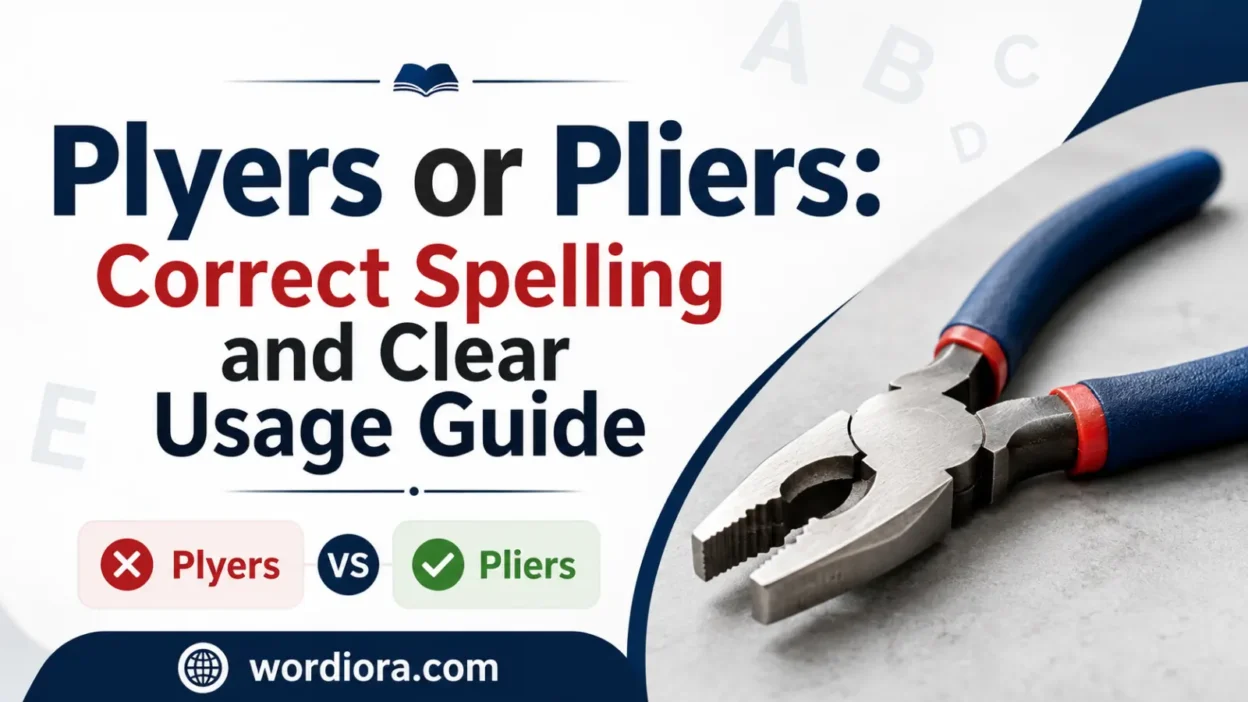
If you are choosing between plyers or pliers, use pliers in standard modern US English. It is the normal spelling for the hand tool used to grip, bend, twist, pull, or cut small items.
The spelling plyers looks possible because pliers sounds like “ply-erz.” However, most readers, editors, teachers, and product pages expect pliers. Use plyers only when you are discussing the spelling itself or quoting someone else’s text.
Quick Answer
Pliers is the correct standard spelling. Plyers may appear as a variant spelling in some references, but it is not the spelling you should choose in normal writing. Write a pair of pliers, needle-nose pliers, or cutting pliers when you mean the hand tool.
Why People Confuse Them
People confuse plyers and pliers mostly because of sound. The word pliers is pronounced like “PLY-erz,” so the spelling with y feels natural at first.
Another reason is the ending. Words such as flyers and dryers use y, so writers may copy that pattern. Still, pliers uses i, not y, when you mean the hand tool.
The plural-looking form also adds confusion. People usually say a pair of pliers, much like a pair of scissors. That makes the word feel unusual, even though it is common in everyday English.
Key Differences At A Glance
| Context | Best Choice | Why |
|---|---|---|
| Standard US writing | pliers | This is the expected spelling. |
| Product title | pliers | Buyers and readers recognize this form. |
| Repair instructions | pliers | It looks clear and professional. |
| School or work writing | pliers | This is the safer edited form. |
| Quoting a typo | plyers | Use it only if the original text has that spelling. |
| Discussing the spelling mistake | plyers | It is useful when explaining the error. |
Meaning and Usage Difference
Pliers means a hand tool with two handles and jaws. People use it to hold, pull, bend, twist, or cut items such as wire, nails, rings, small bolts, and metal pieces.
Plyers does not have a separate modern meaning. In careful writing, it usually looks like a spelling mistake for pliers. Although a few references may treat it as a variant, that does not make it the best choice for normal use.
Pronunciation matters here because pliers sounds like “PLY-erz.” That sound explains the mistake, but spelling still matters. Write the word with i: pliers.
Small comparison:
| Feature | plyers | pliers |
| Standard spelling | Not recommended | Yes |
| Meaning | Variant or mistaken spelling | Hand tool for gripping, bending, pulling, or cutting |
| Best use | Talking about the spelling itself | Normal writing |
| Reader reaction | May look like an error | Clear and expected |
Tone, Context, and Formality
Pliers works in casual, professional, technical, and instructional writing. It sounds normal in a text message, a product page, a repair guide, and a school sentence.
Plyers looks less polished. In a product listing, it may make the seller look careless. In a work note, it may distract the reader. In a school assignment, it may be marked as a spelling error.
There is no useful US-versus-UK rule here. For a US audience, the safe choice is pliers. That same spelling is also widely used in general English references.
Which One Should You Use?
Use pliers almost every time.
Write pliers when you mean the item in a toolbox:
Correct: I need pliers to pull out the bent nail.
Correct: She used needle-nose pliers to fix the clasp.
Correct: Keep a pair of pliers in the kitchen drawer.
Use plyers only when the spelling itself is your topic:
Correct: “Plyers” is a spelling many people use by mistake.
Correct: The label said “plyers,” but it should have said “pliers.”
When One Choice Sounds Wrong
Plyers sounds wrong when the reader expects the normal name of the hand tool.
Wrong: Pass me the plyers.
Better: Pass me the pliers.
Wrong: Heavy-duty plyers are on sale.
Better: Heavy-duty pliers are on sale.
Wrong: Use plyers to bend the wire.
Better: Use pliers to bend the wire.
The problem is not meaning. Most readers can guess what plyers means. The problem is trust. The spelling makes the sentence look less careful.
Common Mistakes (and Quick Fixes)
Mistake: Writing plyers because the word sounds like “ply.”
Fix: Remember that the correct spelling has i: pliers.
Mistake: Writing a pliers.
Fix: Write a pair of pliers.
Mistake: Treating plyers as a separate type of hand tool.
Fix: Use pliers for the item itself.
Mistake: Using plier when you mean the common household item.
Fix: In everyday use, write pliers or a pair of pliers.
Mistake: Capitalizing the word for no reason.
Fix: Write pliers in lowercase unless it starts a sentence or appears in a brand name.
Everyday Examples
I used pliers to loosen the small nut under the sink.
Dad handed me a pair of pliers from the garage shelf.
The electrician carried wire cutters, pliers, and tape.
These pliers are too large for jewelry repair.
A small pair of pliers works better for tight spaces.
Please bring pliers before we open the toolbox.
The product title should say stainless steel pliers, not stainless steel plyers.
She used pliers to pull the staple from the wooden frame.
Needle-nose pliers are helpful for small wires.
The old pliers still grip better than the new pair.
Dictionary-Style Word Details
Verb
Plyers: Not commonly used as a verb in standard US English.
Pliers: Not used as a verb in standard US English. It is a noun. Say use pliers, grip with pliers, or pull with pliers instead.
Noun
Plyers: A variant or mistaken spelling of pliers. It has no separate everyday meaning.
Pliers: A plural-form noun for a hand tool with handles and jaws. It can appear after a pair of, as in a pair of pliers. You may also use it directly, as in These pliers are sharp.
Synonyms
Plyers: No separate synonyms are needed because it points back to pliers.
Pliers: Closest plain alternatives include pincers, tongs, forceps, and tweezers, but these are not always exact replacements. Each one can describe a different item or a more specific use.
Clear antonyms do not really fit this word. A hand tool does not have a natural opposite.
Example Sentences
Plyers: The word plyers appeared on the sign, but the standard spelling is pliers.
Plyers: If you typed plyers, change it to pliers before publishing the repair guide.
Pliers: I used pliers to hold the wire while I tightened the screw.
Pliers: A pair of pliers can help remove a stuck nail.
Pliers: These pliers are small enough for jewelry work.
Word History
Plyers: This spelling likely comes from the sound of pliers, since the word sounds like it contains ply. It does not need a separate history for modern everyday writing.
Pliers: The word is connected to older wording related to bending. That fits the way pliers are used to bend, hold, twist, or cut small items.
Phrases Containing
Plyers: No common standard phrases use plyers as the preferred spelling.
Pliers: Common phrases include a pair of pliers, needle-nose pliers, cutting pliers, slip-joint pliers, locking pliers, and lineman’s pliers.
FAQs
Is plyers or pliers correct?
Pliers is the correct standard spelling. Plyers may appear as a variant in some places, but it is not the form most readers expect. Use pliers in normal writing.
Is plyers a real word?
Plyers can appear as a variant spelling, but it usually looks like a mistake in modern writing. For school, work, product pages, and instructions, write pliers.
Why is pliers spelled with i?
English spelling does not always follow sound. Pliers sounds like “PLY-erz,” but the accepted spelling uses i. The sound explains the confusion, but it does not change the standard spelling.
Do you say a pliers or a pair of pliers?
The natural phrase is a pair of pliers. You can also say these pliers when talking about one item, especially in casual speech.
Can I use plyers in a product title?
Do not use plyers in a product title unless it is part of a brand name or quoted text. Write pliers so the title looks clear and trustworthy.
Are pliers and pincers the same thing?
They are related, but not always the same. Pincers can mean a gripping or pulling item, while pliers is the everyday word for the common hand tool with handles and jaws.
Conclusion
Use pliers, not plyers, when you mean the hand tool. The spelling plyers is understandable because of pronunciation, but it is not the form most readers expect in clear modern writing.
For the safest choice, write a pair of pliers, needle-nose pliers, cutting pliers, or simply pliers. Save plyers for discussions about the spelling mistake itself.