
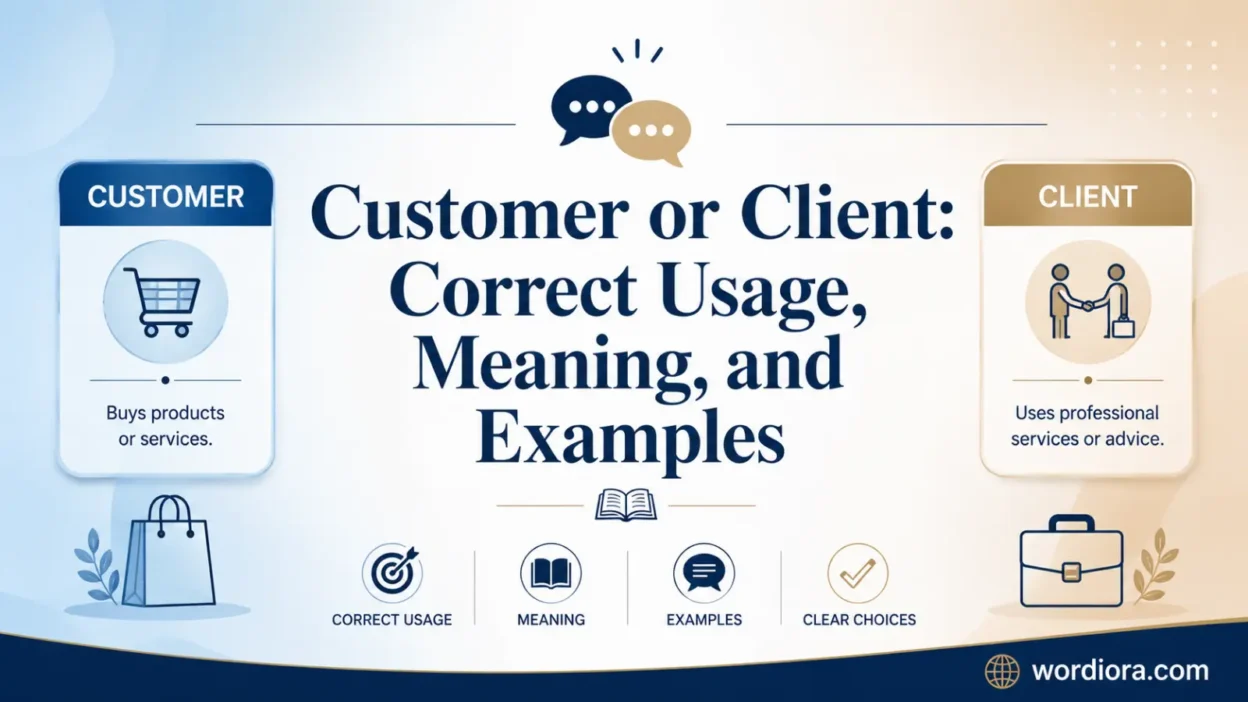
Should you say customer or client? Both words can refer to someone who pays for goods or services, but they do not always feel the same in real use.
The simple difference is this: a customer usually buys a product or general service, while a client usually receives professional, personal, or ongoing service. A grocery store has customers. A lawyer, designer, consultant, accountant, or therapist usually has clients.
Quick Answer
Use customer for someone who buys from a store, website, restaurant, company, or service desk. Use client for someone who receives professional advice, personal service, or ongoing support. The words can overlap, but client often sounds more formal, personal, and relationship-based.
Why People Confuse Them
People confuse customer and client because both can describe someone who pays a business. A person who pays a web designer is buying a service, but that person may be called a client because the work is personal and ongoing.
The confusion also happens because some companies use client to sound more polished. That does not make client correct everywhere. A coffee shop saying “our clients ordered lattes” sounds unnatural in normal US English.
Key Differences At A Glance
| Context | Best Choice | Why |
|---|---|---|
| Buying shoes from a store | Customer | The person buys a product |
| Ordering food at a restaurant | Customer | The interaction is usually short |
| Hiring a lawyer | Client | The person receives professional advice |
| Working with an accountant | Client | The service is specialized and personal |
| Calling a support line | Customer | The phrase “customer support” is standard |
| Hiring a marketing agency | Client | The relationship may be ongoing |
| Shopping online | Customer | The person buys from a business |
| Receiving therapy or coaching | Client | The service is personal and professional |
Meaning and Usage Difference
Customer means a person or organization that buys goods or services. It is the broader word. You can use it for retail, restaurants, websites, banks, phone companies, repair shops, and many everyday businesses.
Client means a person or organization that uses the services or advice of a professional person or company. It is common in law, consulting, accounting, design, real estate, therapy, coaching, and agency work.
Here is the easiest way to choose:
- A customer buys.
- A client receives professional help, advice, or ongoing service.
That rule is useful, but it is not perfect. A client can still be a kind of customer. The word client simply adds a stronger sense of service, care, expertise, or relationship.
Tone, Context, and Formality
Customer sounds normal, direct, and everyday. It fits most public-facing business language. For example, customer service, customer support, customer reviews, customer complaints, and customer satisfaction all sound natural.
Client sounds more formal and professional. It often suggests trust, privacy, expertise, or a continuing relationship. For example, client meeting, client file, client account, client consultation, and client contract all sound natural.
In US English, customer is usually safer for general business writing. Client is better when the business provides advice, strategy, representation, creative work, or personal service.
Which One Should You Use?
Use customer when the person buys something from a business in a normal buying situation.
Examples:
- The customer paid with a credit card.
- Our customers can return items within 30 days.
- The restaurant gives every customer a receipt.
Use client when the person works with a professional or receives a tailored service.
Examples:
- The attorney met with her client before court.
- Our agency sent the client three logo options.
- The financial planner called a new client this morning.
If you are writing for a business, choose the word your industry normally uses. Retailers, restaurants, and online stores usually say customers. Law firms, agencies, consultants, designers, and accountants usually say clients.
When One Choice Sounds Wrong
Customer can sound too cold in professional service settings. For example, “The lawyer’s customer asked about the case” sounds odd because lawyers normally have clients.
Client can sound too formal in everyday retail. “The grocery store client bought milk” sounds unnatural because shoppers are normally customers.
Here are better choices:
- Awkward: The dentist helped a customer with a treatment plan.
- Better: The dentist helped a patient with a treatment plan.
- Also possible: The clinic helped a client with a care plan.
- Awkward: The customer asked the attorney about the contract.
- Better: The client asked the attorney about the contract.
- Awkward: The client bought fries at the drive-thru.
- Better: The customer bought fries at the drive-thru.
Common Mistakes (and Quick Fixes)
Mistake 1: Using client just to sound fancy.
Wrong: Our gas station serves hundreds of clients each day.
Correct: Our gas station serves hundreds of customers each day.
Mistake 2: Using customer for a professional advice relationship.
Wrong: The accountant prepared taxes for three customers.
Better: The accountant prepared taxes for three clients.
Mistake 3: Treating the words as always interchangeable.
Wrong: Every customer is a client.
Better: Some clients are customers, but not every customer is a client.
Mistake 4: Ignoring fixed business phrases.
Wrong: client service desk
Better: customer service desk
Wrong: customer-attorney privilege
Better: attorney-client privilege
Everyday Examples
A clothing store helps customers find the right size.
A coffee shop gives customers a free refill.
A law firm protects client information.
A freelance designer sends a proposal to a client.
A grocery app asks customers to rate their delivery.
A consultant builds a plan for each client.
A hotel may call people guests, customers, or clients, depending on the tone. In everyday speech, guests sounds most natural for people staying at the hotel.
A software company may use customers for general users and clients for business accounts that receive managed service.
Dictionary-Style Word Details
Verb
Customer: Not commonly used as a verb in standard US English. Say “serve customers,” “help customers,” or “sell to customers.”
Client: Not commonly used as a verb in standard US English. Say “serve clients,” “advise clients,” “represent clients,” or “work with clients.”
Noun
Customer: A noun meaning a person or organization that buys goods or services.
Example: The customer asked for a refund.
Client: A noun meaning a person or organization that receives professional service, advice, care, or representation.
Example: The client approved the final design.
Synonyms
Customer: closest plain alternatives include buyer, shopper, patron, consumer, and purchaser. These do not always mean the same thing in every context.
Client: closest plain alternatives include customer, account, patron, patient, case, or advisee, depending on the field. Patient fits health care better than client in many medical contexts.
Antonyms do not clearly fit both words in a simple way. In business, seller, provider, vendor, or professional may be opposite roles, but they are not exact antonyms.
Example Sentences
Customer: The customer left a five-star review after the delivery arrived early.
Customer: Our customers can contact support seven days a week.
Customer: The store gave each customer a printed receipt.
Client: The client asked the architect to revise the floor plan.
Client: Our firm meets with each client before signing a contract.
Client: The consultant created a custom report for the client.
Word History
Customer: The word is connected to custom and older ideas of regular buying or dealing with someone. In modern use, it means someone who buys goods or services.
Client: The word has older roots connected with dependence, protection, and service. In modern use, it often means someone who receives professional advice or help.
The history helps explain the modern tone, but it should not be turned into a strict rule. Current context matters more than origin.
Phrases Containing
Customer:
- customer service
- customer support
- customer review
- customer complaint
- customer loyalty
- customer satisfaction
- customer account
- regular customer
Client:
- client meeting
- client file
- client list
- client account
- client contract
- client relationship
- client consultation
- attorney-client privilege
FAQs
Is customer or client correct?
Both are correct, but they fit different situations. Use customer for someone who buys goods or general services. Use client for someone who receives professional advice, personal service, or ongoing support.
What is the main difference between a customer and a client?
A customer usually makes a purchase. A client usually has a service relationship with a professional or company. Customer is broader, while client often sounds more personal and professional.
Can a client also be a customer?
Yes. A client can be a type of customer because the person may pay for a service. However, client adds the idea of advice, expertise, trust, or a continuing relationship.
Do lawyers have customers or clients?
Lawyers have clients. The word client is the standard choice because legal work involves advice, representation, privacy, and professional responsibility.
Do stores have customers or clients?
Stores usually have customers. A person buying groceries, clothes, coffee, or household items is normally a customer, not a client.
Is client more formal than customer?
Yes, client often sounds more formal. It is common in professional services, consulting, law, design, finance, therapy, and agency work.
Should a freelancer say customer or client?
A freelancer should usually say client. Freelance work often involves custom service, direct communication, and project-based or ongoing work.
Is customer service or client service better?
Customer service is the standard phrase for general help, support, returns, complaints, and questions. Client service can work in professional firms, but customer service is more common in everyday business language.
Conclusion
Customer and client are both correct words, but they are not always equal. Customer is the broader everyday word for someone who buys goods or services. Client is more specific and often points to professional advice, personal service, or an ongoing relationship.
Use customer for stores, restaurants, websites, support teams, and general buying. Use client for lawyers, consultants, agencies, designers, accountants, coaches, and other professional service relationships. When the choice feels unclear, ask what the relationship is based on: a simple purchase or professional service.