Both main verb and auxiliary verb are correct terms, but they do not mean the same thing.
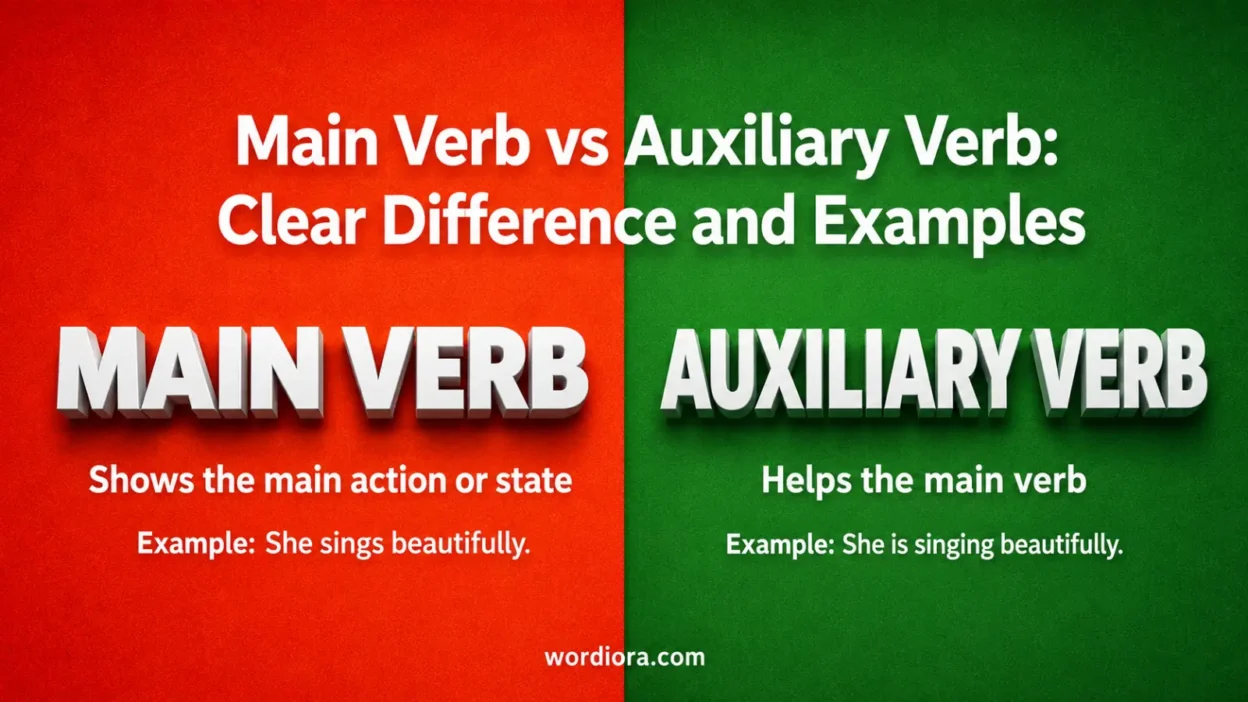
A main verb carries the core meaning of a sentence. An auxiliary verb helps another verb by adding grammar information, such as tense, question form, negative form, passive voice, or possibility.
In She is studying, studying is the main verb. It tells what she is doing. Is is the auxiliary verb. It helps show that the action is happening now.
Quick Answer
Use main verb when you mean the verb that shows the main action or state.
Use auxiliary verb when you mean a helping verb that supports the main verb.
Simple rule:
A sentence can often have a main verb by itself:
She works.
An auxiliary verb usually works with another verb:
She is working.
Here, working is the main verb, and is is the auxiliary verb.
Why People Confuse Them
People confuse main verb and auxiliary verb because they often appear together in one verb phrase.
In They have finished dinner, the full verb phrase is have finished. The word finished gives the main meaning. The word have helps form the perfect tense.
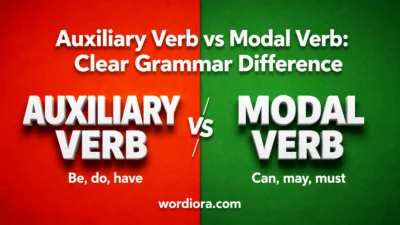
The confusion gets stronger because be, do, and have can work in both roles.
Compare:
I have a car.
Here, have is the main verb. It means “own.”
I have seen that movie.
Here, have is an auxiliary verb. It helps form the verb phrase have seen.
Key Differences At A Glance
| Context | Best Choice | Why |
|---|---|---|
| You mean the action or state | main verb | It carries the sentence’s core meaning |
| You mean a helping verb | auxiliary verb | It supports another verb |
| The verb stands alone | main verb | It can complete the basic idea |
| The verb forms a question | auxiliary verb | It helps build questions like “Do you know?” |
| The verb forms a negative | auxiliary verb | It helps build negatives like “She does not know” |
| The verb shows possibility or obligation | auxiliary verb | Modals like can, should, and must support the main verb |
Meaning and Usage Difference
A main verb tells what the subject does, is, has, feels, or experiences.
Examples:
Maya drives to work.
Main verb: drives
The soup tastes salty.
Main verb: tastes
We finished the project.
Main verb: finished
An auxiliary verb adds structure to another verb.
Examples:
Maya is driving to work.
Auxiliary verb: is
Main verb: driving
We have finished the project.
Auxiliary verb: have
Main verb: finished
Do you remember the address?
Auxiliary verb: do
Main verb: remember
In US pronunciation, auxiliary is often said like awg-ZIL-yuh-ree. Some speakers also say it in a slightly shorter way, closer to awg-ZIL-ree. The pronunciation does not change the grammar.
Compact comparison:
• Main verb: carries the main meaning
• Auxiliary verb: supports the main verb
• Main verb: can often stand alone
• Auxiliary verb: usually needs another verb nearby or understood
• Main verb: names the action or state
• Auxiliary verb: helps with tense, voice, questions, negatives, or mood
Tone, Context, and Formality
Both terms are standard in US English. Neither one is slang. Neither one is more formal in everyday grammar writing.
Main verb is usually easier for beginners because it sounds plain and direct. It points to the most important verb in the sentence.
Auxiliary verb is a more technical grammar label. In school lessons, many teachers also call it a helping verb. That term is easier, but auxiliary verb is more exact in grammar discussions.
Use main verb when explaining what the sentence is mainly about.
Use auxiliary verb when explaining how the verb phrase is built.
Which One Should You Use?
Use main verb when asking:
What is the action?
What is the state?
Which verb carries the main idea?
Example:
Alex might call later.
The main verb is call.
Use auxiliary verb when asking:
Which verb helps another verb?
Which verb forms the tense?
Which verb makes the question or negative?
Which verb shows possibility, ability, or obligation?
Example:
Alex might call later.
The auxiliary verb is might.
So the best choice depends on what you are naming. In many sentences, you need both terms because the verb phrase has both roles.
When One Choice Sounds Wrong
It sounds wrong to call the meaning-carrying verb an auxiliary verb.
Incorrect: In She has finished, finished is the auxiliary verb.
Correct: In She has finished, finished is the main verb.
It also sounds wrong to call a helping verb the main verb when another verb carries the real action.
Incorrect: In She has finished, has is the main verb.
Correct: In She has finished, has is the auxiliary verb.
But be careful with be, do, and have. Their role changes by sentence.
She is tired.
Is is the main verb because it links the subject to a state.
She is studying.
Is is an auxiliary verb because it helps the main verb studying.
Common Mistakes (and Quick Fixes)
Mistake 1: Thinking every form of be is auxiliary.
Wrong idea: Is is always an auxiliary verb.
Quick fix: Look for another verb. In She is calm, is is the main verb. In She is waiting, is is auxiliary.
Mistake 2: Thinking the first verb is always the main verb.
Wrong idea: In We have started, have must be the main verb because it comes first.
Quick fix: Ask which word carries the main action. Started carries the meaning.
Mistake 3: Forgetting auxiliary do in questions.
Wrong: You like coffee?
Correct in standard written English: Do you like coffee?
Mistake 4: Forgetting auxiliary do in negatives.
Wrong: She not work here.
Correct: She does not work here.
Mistake 5: Calling modals main verbs.
Wrong: In He can swim, can is the main verb.
Correct: Can is an auxiliary verb. Swim is the main verb.
Everyday Examples
I ordered lunch.
Main verb: ordered
There is no auxiliary verb.
I have ordered lunch.
Auxiliary verb: have
Main verb: ordered
Did you text Jordan?
Auxiliary verb: did
Main verb: text
Jordan does not answer unknown numbers.
Auxiliary verb: does
Main verb: answer
The package was delivered this morning.
Auxiliary verb: was
Main verb: delivered
We should leave by 6.
Auxiliary verb: should
Main verb: leave
My laptop is on the desk.
Main verb: is
There is no auxiliary verb in this sentence.
My laptop is charging.
Auxiliary verb: is
Main verb: charging
Dictionary-Style Word Details
Verb
• main verb: The phrase main verb names a type of verb. The phrase itself is not normally used as a verb in standard US English.
• auxiliary verb: The phrase auxiliary verb also names a type of verb. The phrase itself is not normally used as a verb in standard US English.
Noun
• main verb: A countable noun phrase. You can say a main verb, the main verb, or main verbs.
• auxiliary verb: A countable noun phrase. You can say an auxiliary verb, the auxiliary verb, or auxiliary verbs.
Synonyms
• main verb: Closest plain alternatives include principal verb, full verb, and lexical verb. These are grammar labels, so they are not always perfect substitutes in every lesson.
• auxiliary verb: A close plain alternative is helping verb. For certain kinds, you may also see modal auxiliary verb or primary auxiliary verb.
Clear antonyms are not useful here outside grammar context. The two terms are better treated as contrasting roles, not everyday opposites.
Example Sentences
• main verb: In They bought tickets online, bought is the main verb.
• main verb: In The kids seem excited, seem is the main verb.
• auxiliary verb: In They have bought tickets online, have is the auxiliary verb.
• auxiliary verb: In Can you join the call?, can is the auxiliary verb.
Word History
• main verb: This is a clear grammar label built from main plus verb. It describes the verb that carries the main meaning.
• auxiliary verb: Auxiliary is tied to the idea of helping or giving support. That matches its grammar role: an auxiliary verb supports a main verb.
Phrases Containing
• main verb: find the main verb, identify the main verb, main verb in the sentence, main verb of the clause
• auxiliary verb: helping verb, primary auxiliary verb, modal auxiliary verb, auxiliary verb in a question
FAQs
What is the difference between a main verb and an auxiliary verb?
A main verb carries the main action or state in a sentence. An auxiliary verb helps the main verb by adding tense, question form, negative form, passive voice, or meaning such as possibility.
Example:
She is reading.
Reading is the main verb. Is is the auxiliary verb.
Is an auxiliary verb the same as a helping verb?
Yes. In most grammar lessons, auxiliary verb and helping verb mean the same thing. Auxiliary verb is the more formal grammar term, while helping verb is easier for beginners.
Can a sentence have both a main verb and an auxiliary verb?
Yes. Many sentences have both.
Example:
They have finished dinner.
Have is the auxiliary verb. Finished is the main verb.
Can a main verb stand alone?
Yes. A main verb can often stand alone as the only verb in a sentence.
Example:
She works.
Here, works is the main verb.
Can an auxiliary verb stand alone?
Usually, an auxiliary verb supports another verb. However, it can appear alone in short answers when the main verb is understood.
Example:
Do you drive?
Yes, I do.
Here, do refers back to drive.
Are be, do, and have always auxiliary verbs?
No. Be, do, and have can be main verbs or auxiliary verbs, depending on the sentence.
Example:
I have a bike.
Have is the main verb.
I have seen that movie.
Have is an auxiliary verb.
Is “can” a main verb or auxiliary verb?
Can is an auxiliary verb. It helps the main verb show ability or possibility.
Example:
She can swim.
Can is the auxiliary verb. Swim is the main verb.
How do I find the main verb in a sentence?
Ask, “What is the subject doing, being, or experiencing?” The verb that answers that question is usually the main verb.
Example:
The dog was barking.
The dog was doing what? Barking.
So barking is the main verb.
How do I find the auxiliary verb in a sentence?
Look for a verb that helps another verb. Common auxiliary verbs include forms of be, do, and have, plus modals like can, should, will, may, and must.
Example:
We should leave soon.
Should is the auxiliary verb. Leave is the main verb.
Conclusion
Main verb and auxiliary verb are both correct, but they name different jobs.
A main verb carries the main action or state. An auxiliary verb helps another verb by adding grammar meaning.
In She has been working, working is the main verb. Has and been are auxiliary verbs.
The easiest test is this: ask which verb gives the core meaning. That word is the main verb. Then ask which verb supports it. That word is the auxiliary verb.