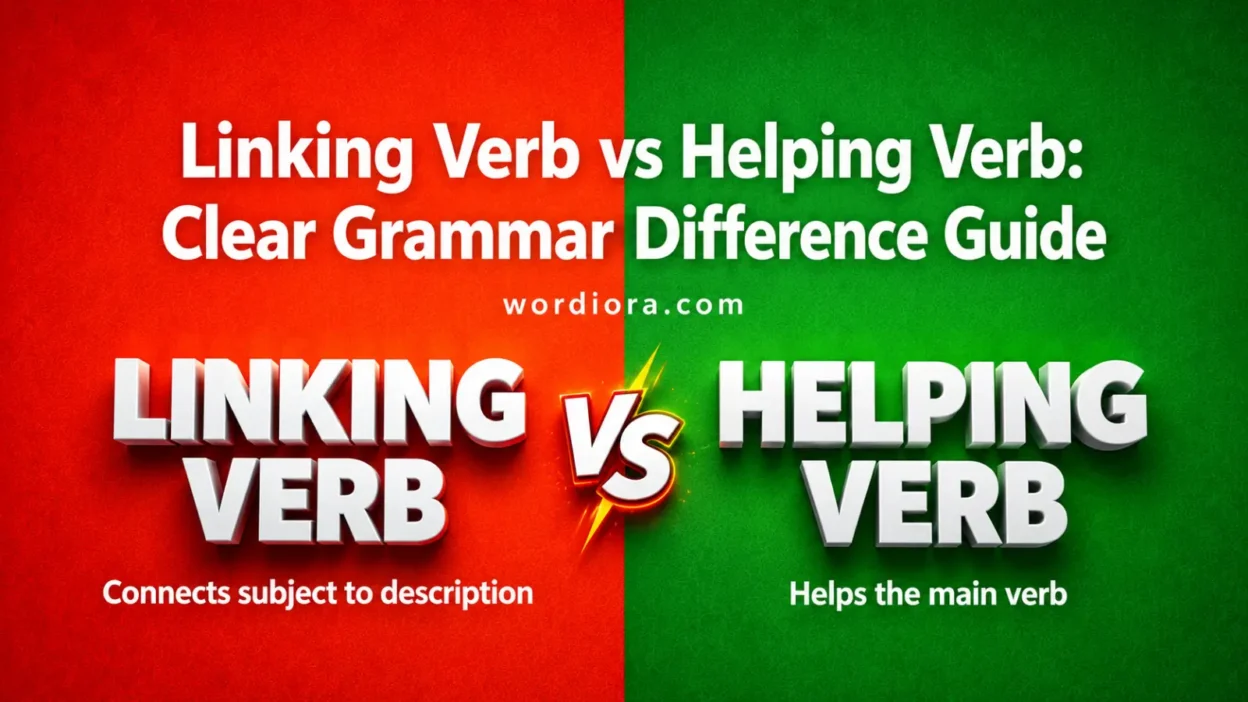
If you are choosing between linking verb vs helping verb, the correct answer depends on what the verb does in the sentence.
A linking verb connects the subject to a word or phrase that describes or identifies it.
A helping verb works with another verb. It helps show tense, voice, mood, question form, or possibility.
The tricky part is that some words can do both jobs. For example, is can be a linking verb in one sentence and a helping verb in another.
Quick Answer
Use linking verb when the verb connects the subject to more information about that same subject.
Example:
Mia is tired.
Here, is links Mia to tired.
Use helping verb when the verb supports another verb.
Example:
Mia is studying.
Here, is helps the main verb studying.
So the real difference is not the word by itself. The difference is the word’s job in the sentence.
Why People Confuse Them
People confuse these terms because many common verbs can appear in both patterns.
Words like is, are, was, were, be, being, and been often cause the most trouble.
Look at these two sentences:
The soup is hot.
The soup is boiling.
In the first sentence, is links soup to hot. It is a linking verb.
In the second sentence, is helps boiling. It is a helping verb.
Same word. Different job.
Key Differences At A Glance
Here is the simplest way to separate them:
- linking verb: connects the subject to a description, identity, or state
- helping verb: comes with another verb and helps build the verb phrase
- linking verb test: Can the word after it describe or rename the subject?
- helping verb test: Is there another main verb nearby?
- most common overlap: forms of be, such as is, are, was, and were
Do not memorize one word as always linking or always helping. Check the whole sentence.
Meaning and Usage Difference
A linking verb does not show an action by itself. It links the subject to a subject complement. That complement is often an adjective, noun, or noun phrase.
Examples:
Jordan seems nervous.
The winner is Ava.
The room became quiet.
In each sentence, the verb connects the subject to what the subject is, seems, or becomes.
A helping verb is also called an auxiliary verb. It appears with a main verb.
Examples:
Jordan is waiting outside.
Ava has finished the report.
We will call you tomorrow.
In these sentences, is, has, and will help the main verbs waiting, finished, and call.
The meaning difference is about function. A linking verb points back to the subject. A helping verb points forward to another verb.
Tone, Context, and Formality
There is no major tone difference between linking verb and helping verb. Both are standard grammar terms in US English.
Helping verb is the more classroom-friendly term. It is common in elementary and middle school grammar lessons.
Auxiliary verb means the same basic thing as helping verb, but it sounds more technical.
Linking verb is also standard in school grammar. In more technical grammar writing, you may also see copula or copular verb, especially for verbs like be.
In everyday writing advice, linking verb and helping verb are clear enough.
Which One Should You Use?
Use the term that matches the sentence role.
| Context | Best Choice | Why |
|---|---|---|
| “The baby is asleep.” | linking verb | is connects baby to asleep |
| “The baby is sleeping.” | helping verb | is helps the main verb sleeping |
| “They were quiet.” | linking verb | were connects they to quiet |
| “They were talking.” | helping verb | were helps the main verb talking |
| “She has a car.” | neither as labeled here | has is the main verb meaning owns |
| “She has left.” | helping verb | has helps form the verb phrase has left |
| “The plan sounds fair.” | linking verb | sounds connects plan to fair |
The best choice is not based on the verb alone. It is based on how the sentence is built.
When One Choice Sounds Wrong
Calling a verb a linking verb sounds wrong when it clearly helps another verb.
Wrong: In “He is driving,” is is a linking verb.
Better: In “He is driving,” is is a helping verb.
Calling a verb a helping verb sounds wrong when there is no other main verb for it to help.
Wrong: In “He is calm,” is is a helping verb.
Better: In “He is calm,” is is a linking verb.
Also, not every form of have or do is automatically a helping verb.
I have a bike.
Here, have is the main verb.
I have seen that movie.
Here, have is a helping verb.
Common Mistakes (and Quick Fixes)
Mistake 1: Judging by the word alone.
Fix: Look at the sentence pattern.
Lena is ready.
Linking verb.
Lena is leaving.
Helping verb.
Mistake 2: Thinking every “be” verb is linking.
Fix: If a form of be comes before an -ing verb or a past participle, it may be helping.
The door was locked.
This can be a helping verb in a passive structure.
Mistake 3: Missing the subject complement.
Fix: Ask, “Does this word describe or rename the subject?”
Carlos became manager.
Manager renames Carlos, so became is a linking verb.
Mistake 4: Treating “helping verb” as the main action.
Fix: Find the main verb after it.
We should leave now.
Should helps. Leave carries the main action.
Everyday Examples
Here are simple examples that show the contrast clearly.
Linking verb:
The coffee smells fresh.
My phone is dead.
That answer seems right.
Her voice sounded calm.
The meeting became tense.
Helping verb:
The coffee is cooling.
My phone has died.
We should answer soon.
Her voice was shaking.
The meeting will start at noon.
A linking verb connects. A helping verb supports another verb.
Dictionary-Style Word Details
Verb
linking verb: The full term linking verb is not normally used as a verb in standard US English. It is a noun phrase that names a type of verb. The word linking comes from the idea of connecting.
helping verb: The full term helping verb is not normally used as a verb in standard US English. It is a noun phrase that names a type of verb. The word helping points to its supporting role.
Noun
linking verb: A countable noun phrase. You can say a linking verb, the linking verb, or linking verbs.
Example:
“Seems” is a linking verb in “She seems upset.”
helping verb: A countable noun phrase. You can say a helping verb, the helping verb, or helping verbs.
Example:
“Has” is a helping verb in “She has arrived.”
Synonyms
linking verb: Closest plain alternatives are copula and copular verb, though those sound more technical.
helping verb: A standard synonym is auxiliary verb.
Clear antonyms do not fit neatly for either term. The useful contrast here is not an opposite word. It is sentence role.
Example Sentences
linking verb:
The sky looks gray.
Noah is a nurse.
The house feels cold.
helping verb:
The sky is turning gray.
Noah has worked all night.
The heater should start soon.
Word History
linking verb: The term is based on the verb link, meaning to connect. In grammar, it names a verb that connects a subject to information about that subject. No special origin story is needed to use it correctly.
helping verb: The term is based on the everyday meaning of help. In grammar, it names a verb that helps another verb do its work in the sentence. The more technical term is auxiliary verb.
Phrases Containing
linking verb:
common linking verb
linking verb example
linking verb sentence
linking verb and subject complement
helping verb:
common helping verb
helping verb example
helping verb list
helping verb and main verb
Still confused about how linking verbs differ from action verbs? Read our detailed guide on action-verb-vs-linking-verb to understand the key differences with simple examples.
FAQs
Is “is” a linking verb or a helping verb?
Is can be either one. It depends on the sentence.
Linking verb:
She is tired.
Helping verb:
She is working.
In the first sentence, is connects the subject to a description. In the second sentence, is helps the main verb working.
What is the easiest way to tell the difference?
Look for another verb.
If there is another main verb, the word is usually a helping verb.
Example:
They are playing outside.
If the verb connects the subject to a description or identity, it is a linking verb.
Example:
They are happy.
Can the same word be both a linking verb and a helping verb?
Yes. Words like is, are, was, were, be, being, and been can work both ways.
The word itself does not decide the label. The sentence decides it.
Is a helping verb the same as an auxiliary verb?
Yes. Helping verb and auxiliary verb usually mean the same thing.
Helping verb is more common in school grammar. Auxiliary verb sounds more technical.
Is “have” always a helping verb?
No. Have can be a main verb or a helping verb.
Main verb:
I have a laptop.
Helping verb:
I have finished my homework.
In the second sentence, have helps the main verb finished.
Is “seem” a linking verb or a helping verb?
Seem is usually a linking verb.
Example:
The answer seems correct.
Here, seems connects answer to correct.
Can a linking verb show action?
No. A linking verb does not show action by itself. It connects the subject to more information about the subject.
Example:
The room became quiet.
Became links room to quiet.
What comes after a linking verb?
A linking verb is usually followed by a word or phrase that describes or renames the subject.
Example:
Maya is a doctor.
The soup smells delicious.
What comes after a helping verb?
A helping verb is followed by a main verb.
Example:
We will leave soon.
He was reading in the kitchen.
Which term should students use: linking verb or helping verb?
Use linking verb when the verb connects the subject to a description, identity, or state.
Use helping verb when the verb works with another verb.
Conclusion
The difference between linking verb vs helping verb is simple once you check the sentence job.
A linking verb connects the subject to a description, identity, or state.
A helping verb works with another verb to form a verb phrase.
Use this quick test: if the verb connects the subject to what it is or is like, call it a linking verb. If it helps another verb, call it a helping verb.