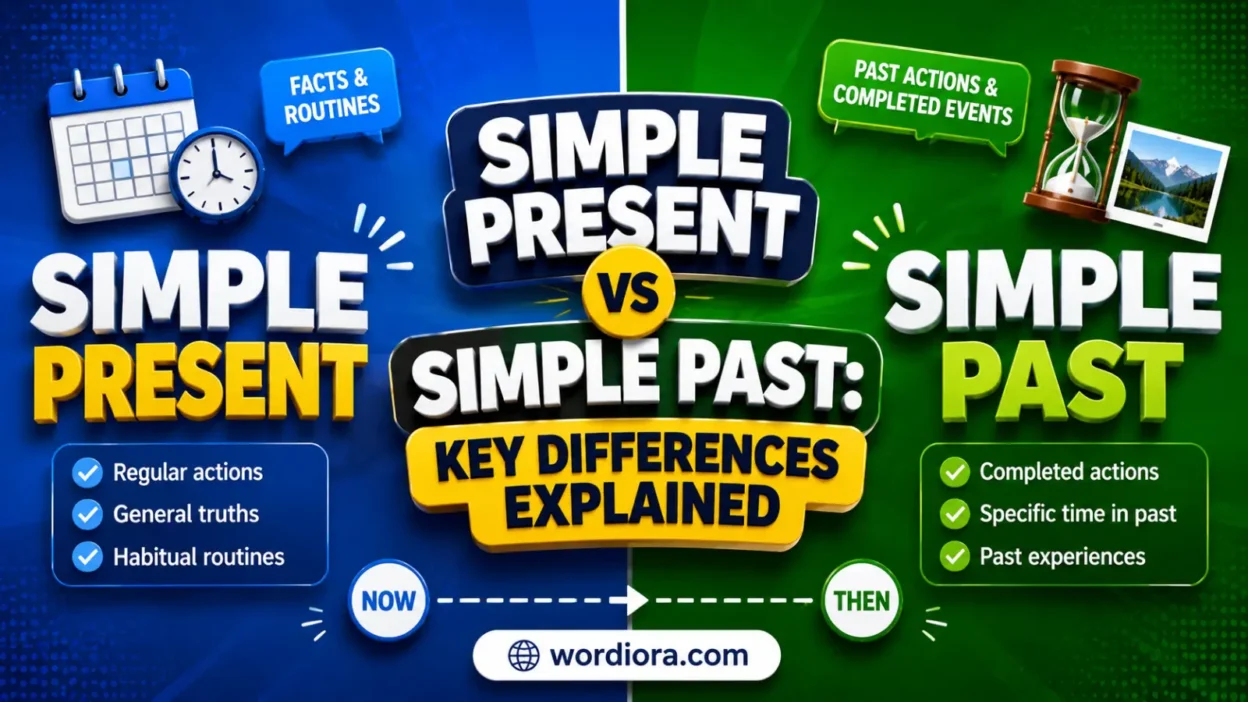
Many English learners struggle with simple present vs simple past because both tenses describe actions, but they do so from different time perspectives.
The simple present talks about things that are generally true, repeated, regular, or happening as part of a routine. The simple past talks about actions or situations that happened and finished in the past.
Understanding the difference helps you communicate clearly in everyday conversations, school assignments, workplace communication, and writing.
A small tense mistake can completely change the meaning of a sentence. For example:
- I work at a bank.
- I worked at a bank.
The first sentence suggests a current job. The second suggests a former job.
That difference is why mastering these two tenses matters.
Quick Answer
The simple present is used for:
- Facts
- Habits
- Routines
- General truths
- Scheduled events
The simple past is used for:
- Completed actions
- Finished events
- Past situations
- Experiences that happened at a specific time
Examples:
- I play basketball every weekend. (simple present)
- I played basketball last weekend. (simple past)
The action is the same, but the time frame changes.
Why People Confuse Them
The confusion often happens because both tenses can describe similar actions.
Consider these examples:
- She drives to work every day.
- She drove to work yesterday.
Both sentences involve driving to work. The difference is not the action itself but the time.
Another reason for confusion is that some languages do not mark tense the same way English does. Learners may focus on the action and overlook the time reference.
Common confusion points include:
- Forgetting past tense endings
- Mixing time expressions
- Using present tense when discussing completed events
- Using past tense for habits that still continue today
Once you focus on the timing of the action, choosing the correct tense becomes much easier.
Key Differences At A Glance
| Context | Best Choice | Why |
|---|---|---|
| Daily routines | Simple Present | Describes repeated actions |
| General facts | Simple Present | Expresses truths and facts |
| Scientific facts | Simple Present | Facts remain true |
| Completed event yesterday | Simple Past | Action finished in the past |
| Last week’s activities | Simple Past | Specific past time |
| Childhood memories | Simple Past | Refers to a finished period |
| Current habits | Simple Present | Habit continues now |
| Historical events | Simple Past | Event happened and ended |
Quick Comparison
| Feature | Simple Present | Simple Past |
|---|---|---|
| Time Focus | Now, generally | Finished past |
| Main Use | Habits and facts | Completed actions |
| Signal Words | Usually, often, always | Yesterday, last week, ago |
| Status | Current or ongoing pattern | Finished |
| Example | I walk to school. | I walked to school. |
Meaning and Usage Difference
The biggest difference is time.
Simple Present
The simple present describes:
- Habits
- Repeated actions
- General truths
- Permanent situations
- Regular schedules
Examples:
- The sun rises in the east.
- I drink coffee every morning.
- She works from home.
- They live in Texas.
- The store opens at 9 a.m.
The action is viewed as a regular part of life.
Simple Past
The simple past describes:
- Finished actions
- Completed events
- Past experiences
- Historical facts
- Situations that no longer exist
Examples:
- The sun rose at 6:01 this morning.
- I drank coffee before work.
- She worked from home last year.
- They lived in Texas for five years.
- The store opened at 9 a.m. yesterday.
The action happened and ended.
Time Expressions
Simple Present often appears with:
- always
- usually
- often
- sometimes
- every day
- every week
Simple Past often appears with:
- yesterday
- last night
- last month
- two years ago
- in 2024
- earlier today
These words often provide clues about which tense you need.
Tone, Context, and Formality
Neither tense is more formal than the other.
The choice depends on time and context.
Professional Communication
Simple Present:
- We provide customer support.
- The company offers training.
Simple Past:
- We launched the product in March.
- The company opened a new office last year.
Academic Writing
Simple Present:
- Water boils at 212°F.
- The study shows a correlation.
Simple Past:
- Researchers collected data in 2025.
- Participants completed the survey.
Casual Conversation
Simple Present:
- I watch that show every week.
- My brother plays soccer.
Simple Past:
- I watched that show last night.
- My brother played soccer yesterday.
In every context, the deciding factor is time rather than formality.
Which One Should You Use?
Ask yourself one question:
Is the action still considered current, habitual, or generally true?
If yes, use simple present.
Examples:
- I exercise every morning.
- She teaches math.
- They visit us every summer.
If the action happened and finished, use simple past.
Examples:
- I exercised this morning.
- She taught math last year.
- They visited us last summer.
A useful shortcut:
- Regular pattern = Simple Present
- Finished event = Simple Past
When One Choice Sounds Wrong
Sometimes using the wrong tense creates confusion.
Incorrect:
- I go to New York last year.
Correct:
- I went to New York last year.
Incorrect:
- She visited her grandparents every weekend.
Correct:
- She visits her grandparents every weekend.
Why?
The phrase “every weekend” describes an ongoing habit, not a completed event.
Incorrect:
- They work here from 2018 to 2022.
Correct:
- They worked here from 2018 to 2022.
The time period ended, so the past tense is needed.
Incorrect tense choices often make listeners wonder whether an action is still happening.
Common Mistakes and Quick Fixes
Mistake 1: Using Present Tense With Past Time Markers
Incorrect:
- I eat lunch yesterday.
Correct:
- I ate lunch yesterday.
Mistake 2: Forgetting Irregular Verbs
Incorrect:
- She go to the meeting last week.
Correct:
- She went to the meeting last week.
Mistake 3: Using Past Tense for Current Habits
Incorrect:
- I walked to work every day.
Correct:
- I walk to work every day.
Mistake 4: Mixing Tenses in One Time Frame
Incorrect:
- Yesterday I visit my friend and watch a movie.
Correct:
- Yesterday I visited my friend and watched a movie.
Mistake 5: Ignoring Time Signals
Incorrect:
- Last month we travel to Chicago.
Correct:
- Last month we traveled to Chicago.
Whenever you see a clear past-time marker, check whether the verb should also be in the past.
Everyday Examples
Here are realistic examples showing the difference.
Work
Simple Present:
- I answer customer emails every day.
Simple Past:
- I answered customer emails yesterday.
School
Simple Present:
- She studies biology.
Simple Past:
- She studied biology last semester.
Family
Simple Present:
- We visit our grandparents every Sunday.
Simple Past:
- We visited our grandparents last Sunday.
Travel
Simple Present:
- They travel often.
Simple Past:
- They traveled to California last year.
Exercise
Simple Present:
- He runs every morning.
Simple Past:
- He ran this morning.
Shopping
Simple Present:
- I buy groceries every Friday.
Simple Past:
- I bought groceries yesterday.
The pattern remains consistent across situations.
Dictionary-Style Word Details
Verb
Simple Present:
A verb form used for habits, routines, repeated actions, and general truths.
Examples:
- work
- play
- study
- drive
Simple Past:
A verb form used for actions completed in the past.
Examples:
- worked
- played
- studied
- drove
Noun
Simple Present:
A grammatical tense used in English.
Simple Past:
A grammatical tense used in English.
Both terms are grammar labels rather than ordinary everyday nouns.
Synonyms
Simple Present:
Closest plain alternatives:
- present tense
- present simple
Simple Past:
Closest plain alternatives:
- past tense
- past simple
These alternatives are commonly used in grammar discussions.
Example Sentences
Simple Present:
- I read every evening.
- She drives to work.
- They play soccer on weekends.
- The train leaves at noon.
- Water freezes at 32°F.
Simple Past:
- I read that book last week.
- She drove to work yesterday.
- They played soccer on Saturday.
- The train left at noon.
- Water froze overnight.
Word History
Simple Present:
The term comes from traditional English grammar classifications used to describe actions viewed as current, habitual, or generally true.
Simple Past:
The term comes from traditional English grammar classifications used to describe actions viewed as completed in the past.
Neither term represents a recently created grammatical category.
Phrases Containing
Simple Present:
Common grammar phrases include:
- simple present tense
- present simple
- simple present form
- simple present verb
Simple Past:
Common grammar phrases include:
- simple past tense
- past simple
- simple past form
- simple past verb
FAQs
Is simple present the same as present continuous?
No.
Simple present describes habits or facts.
- I work at home.
Present continuous describes actions happening right now.
- I am working at home.
Can simple past describe habits?
Yes, but only habits that existed in the past.
Example:
- When I was a child, I played outside every day.
The habit belonged to a finished period.
Which tense is used for historical events?
Simple past.
Examples:
- The United States declared independence in 1776.
- The company launched the product in 2025.
Can I use simple present for future events?
Sometimes.
It is commonly used for schedules and timetables.
Examples:
- The flight leaves at 8 p.m.
- School starts Monday.
How do I identify the correct tense quickly?
Look for time clues.
Words like “every day,” “usually,” and “often” often suggest simple present.
Words like “yesterday,” “last year,” and “ago” usually suggest simple past.
Why are irregular verbs difficult in the simple past?
Because they do not simply add “-ed.”
Examples:
- go → went
- see → saw
- eat → ate
- run → ran
These forms must be learned individually.
Conclusion
The difference between simple present vs simple past comes down to one key idea: whether the action is viewed as current, habitual, or generally true, or whether it happened and finished in the past.
Use simple present for facts, routines, habits, schedules, and ongoing situations.
Use simple past for completed actions, finished experiences, and events tied to a past time.
When you’re unsure, check the time reference. If the action is part of everyday life or remains true now, choose simple present. If it happened and ended before now, choose simple past.
Mastering this distinction will make your speaking and writing clearer, more natural, and more accurate in everyday English.