Both say to and tell can be correct, but they do not fit the same sentence pattern.
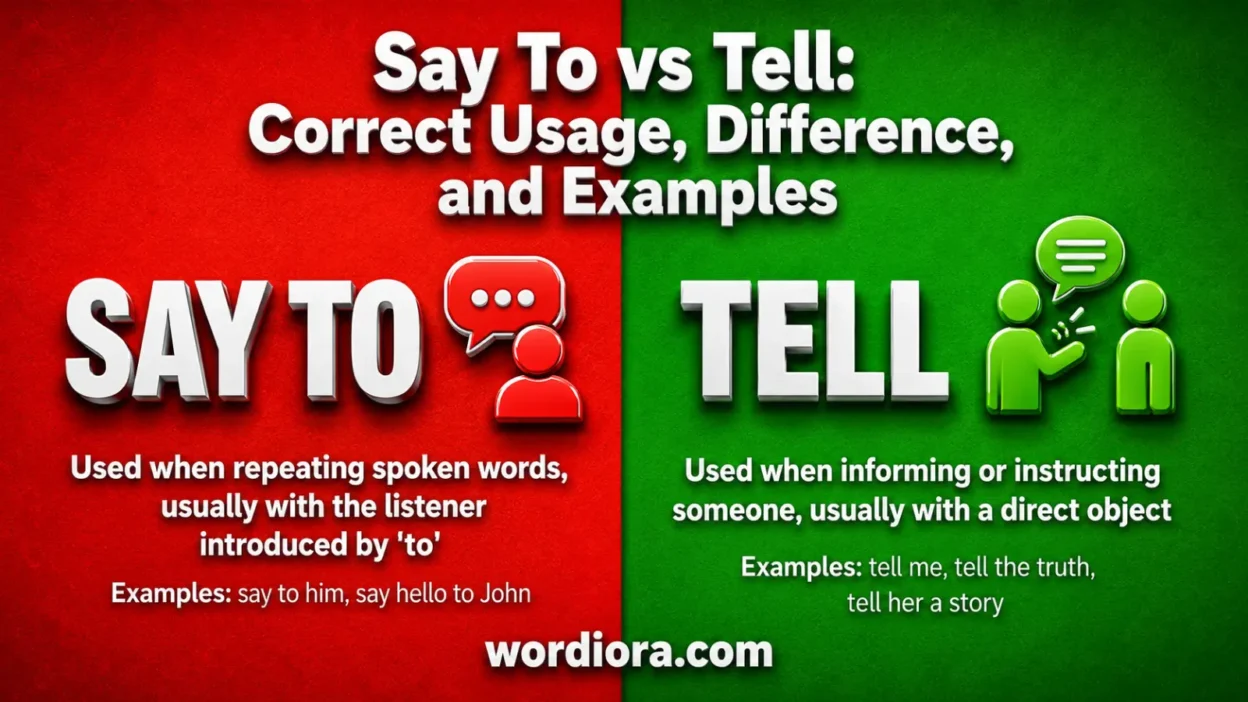
Use say to when you use say and name the listener with to.
Use tell when the listener is the object right after the verb.
The simplest contrast is this:
She said to me, “Call me later.”
She told me to call her later.
Both sentences work, but the grammar is different.
Quick Answer
Use say to when you are focusing on the words spoken to someone.
Use tell when you are giving information, instructions, news, a story, or a message to someone.
Correct:
What did she say to you?
She told me the meeting was canceled.
Incorrect in standard US English:
She said me the meeting was canceled.
She told to me the meeting was canceled.
The key is not just meaning. The key is structure.
Why People Confuse Them
People confuse say to and tell because both involve speaking.
They can also report the same message:
Maya said to me, “The office is closed.”
Maya told me the office was closed.
The message is almost the same. The sentence pattern is not.
With say, you usually say words. If you name the listener, use to.
With tell, you usually tell a person something. The person normally comes right after tell.
Key Differences At A Glance
| Context | Best Choice | Why |
|---|---|---|
| Naming the listener after say | say to | Say needs to before the listener. |
| Giving information to a person | tell | Tell takes the person as its object. |
| Direct quote | say to | It works naturally with exact words. |
| Instruction or command | tell | Use tell someone to do something. |
| Asking about words spoken | say to | “What did she say to you?” is natural. |
| Sharing news | tell | “Tell me the news” is the normal pattern. |
Here is the structure in a smaller view:
| Feature | say to | tell |
|---|---|---|
| Basic pattern | say something to someone | tell someone something |
| Listener position | after to | right after tell |
| Common use | exact words or what was spoken | information, instructions, stories, news |
| Common error | “say me” | “tell to me” in the wrong pattern |
Meaning and Usage Difference
Say to is not a separate dictionary word. It is the verb say plus the preposition to.
Use it when the sentence names the person who hears the words:
I said to Jake, “Check your email.”
What did you say to your teacher?
Tell is a verb that often means to inform, instruct, narrate, or make something known.
Use it when the listener comes right after the verb:
I told Jake to check his email.
What did you tell your teacher?
A useful rule:
say something to someone
tell someone something
That rule covers most everyday cases.
Tone, Context, and Formality
Both choices are normal in US English.
Say to can sound natural when you quote exact words or ask what words were spoken:
What did he say to you after class?
She said to me, “Don’t worry about it.”
Tell sounds more natural when the point is the message, not the exact words:
He told me not to worry about it.
She told the team the deadline changed.
In casual speech, tell me is much more natural than say to me when asking for information:
Natural: Tell me what happened.
Awkward: Say to me what happened.
But if you mean “speak these exact words,” say to me can work:
Say “I’m sorry” to me like you mean it.
If you still confuse “while writing direct or indirect speech, this detailed guide on differences, grammar rules, and examples will make everything crystal clear: said vs told
Which One Should You Use?
Use say to when:
You are asking what words someone spoke.
What did Alex say to you?
You are quoting someone directly.
Alex said to me, “I’ll be there at 7.”
You use a short expression like hello, goodbye, sorry, or thanks.
Please say hello to your mom.
Use tell when:
You give news or facts.
Tell me the address.
You give instructions.
The coach told us to stretch first.
You talk about stories, jokes, secrets, lies, or the truth.
He told a funny story.
Please tell the truth.
When One Choice Sounds Wrong
Say me is wrong in standard US English.
Wrong: She said me the answer.
Correct: She told me the answer.
Correct: She said the answer to me.
Tell to me is usually wrong when the person is the direct listener after the verb.
Wrong: She told to me that she was tired.
Correct: She told me that she was tired.
But do not overcorrect. Tell can use to when the thing being told comes first:
Correct: She told the story to me.
Correct: Tell it to me again.
So the problem is not the word to by itself. The problem is the pattern.
Common Mistakes and Quick Fixes
Mistake: He said me he was busy.
Fix: He told me he was busy.
Mistake: She told to her boss the news.
Fix: She told her boss the news.
Mistake: Can you say me your name?
Fix: Can you tell me your name?
Mistake: He told, “I’m ready.”
Fix: He said, “I’m ready.”
Mistake: I said him to wait.
Fix: I told him to wait.
Everyday Examples
Say to examples:
What did the doctor say to you?
I said to my roommate, “Please lock the door.”
She said sorry to everyone in the group chat.
Don’t say that to your sister.
He said goodbye to his coworkers before leaving.
Tell examples:
Tell me when you get home.
My manager told us the meeting moved to Friday.
Did anyone tell you about the schedule change?
The teacher told the students to put their phones away.
I told my friend the truth.
Same idea, different pattern:
Jordan said to me, “The game starts at 8.”
Jordan told me the game started at 8.
Dictionary-Style Word Details
Verb
say to: This is the verb say plus to before a listener. It is used when someone speaks words to a person.
Example: What did she say to you?
tell: This is a verb. It often means to give information, instructions, a story, or a message to someone.
Example: She told me what happened.
Noun
say to: Not commonly used as a noun in standard US English. The noun form is say, as in have a say, but say to itself is not a normal noun.
tell: Tell can be a noun in a separate sense, meaning a small sign that gives something away, as in poker. That noun meaning is not the usual meaning in this comparison.
Synonyms
say to: Closest plain alternatives include state to, mention to, speak to, and say something to. These are not always exact replacements.
tell: Meaning-matched alternatives include inform, notify, instruct, explain, report, and narrate, depending on the sentence.
Clear opposites are not always neat. For tell, possible opposites in some contexts include hide, withhold, or keep secret. For say to, the closest opposite is simply not say or stay silent.
Example Sentences
say to:
What did you say to Dad?
I said to her, “You handled that really well.”
Please do not say that to the client.
tell:
Tell Dad I’ll call him tonight.
She told her brother the password.
The nurse told me to drink more water.
Word History
say to: Say is an old English verb meaning to speak, state, or express something in words. Say to developed from the normal use of say with to before the listener.
tell: Tell also has old roots. Older uses included ideas like counting, recounting, and narrating. That history still shows in phrases like tell time, all told, and tell a story.
Phrases Containing
say to:
say to someone
say hello to
say goodbye to
say sorry to
what did you say to
tell:
tell me
tell the truth
tell a story
tell a joke
tell the difference
tell someone to do something
tell time
all told
FAQs
Is “say to me” correct?
Yes. Say to me is correct when you are naming the listener after say.
Correct: What did she say to me?
Correct: He said to me, “Don’t forget your keys.”
Is “tell to me” correct?
Usually, no. In the most common pattern, use tell me, not tell to me.
Wrong: She told to me the answer.
Correct: She told me the answer.
But to me can be correct if the thing being told comes first:
Correct: She told the story to me.
What is the main difference between “say to” and “tell”?
Say to focuses on the words spoken to someone.
Tell focuses on giving someone information, instructions, news, or a message.
Example:
He said to me, “Wait here.”
He told me to wait there.
Do I say “tell me” or “say to me”?
Use tell me when asking for information.
Correct: Tell me what happened.
Awkward: Say to me what happened.
Use say to me when asking about exact words.
Correct: What did he say to me?
Is “she said me” wrong?
Yes. She said me is not correct in standard US English.
Wrong: She said me she was busy.
Correct: She told me she was busy.
Correct: She said to me that she was busy.
Can “say” and “tell” mean the same thing?
They can report a similar message, but they use different grammar.
She said to me, “I’m tired.”
She told me she was tired.
The meaning is close, but the sentence structure changes.
Should I use “say” or “tell” with instructions?
Use tell for instructions.
Correct: The teacher told us to open our books.
Wrong: The teacher said us to open our books.
Which is more natural: “say hello to” or “tell hello to”?
Use say hello to.
Correct: Please say hello to your dad for me.
Not natural: Please tell hello to your dad for me.
Conclusion
The choice between say to and tell is mostly about sentence structure.
Use say to when you use say and name the listener:
What did she say to you?
Use tell when the listener comes right after the verb:
What did she tell you?
For most everyday sentences, remember this:
Say something to someone.
Tell someone something.
That one pattern will fix the most common mistakes.