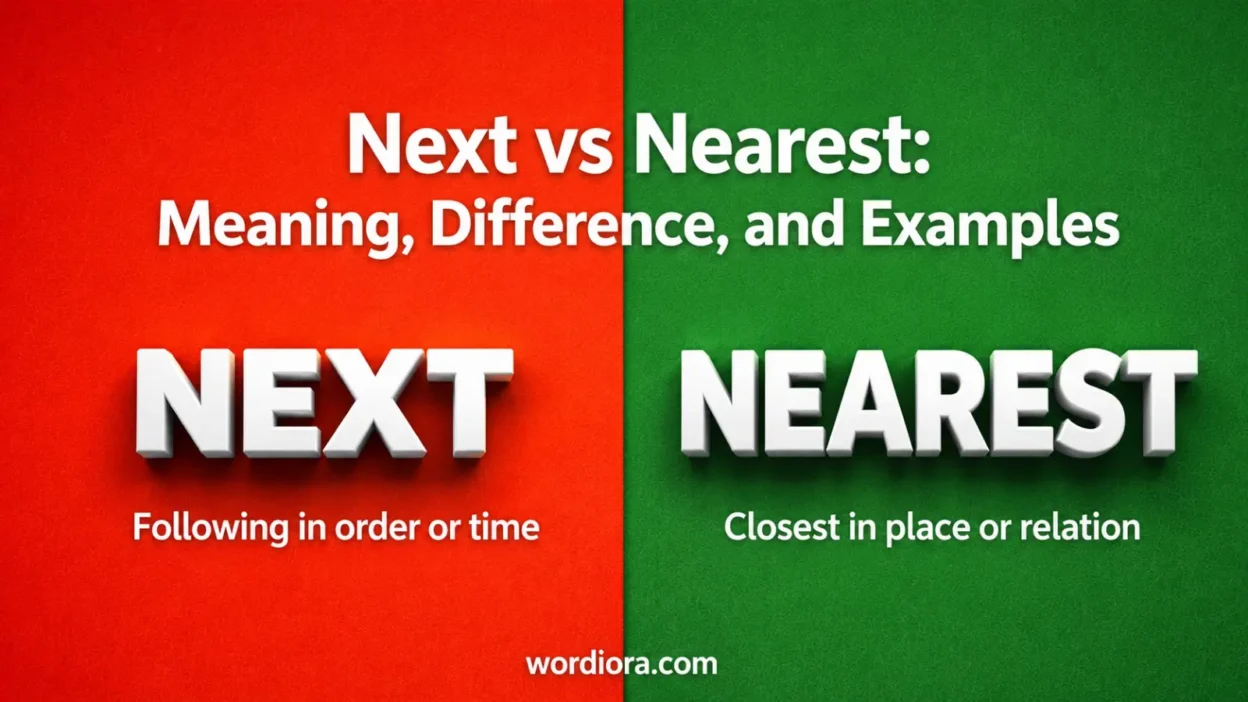
Next vs nearest is a common word-choice problem because both words can point to something close. The difference is that they are close in different ways.
Use next when you mean the one that comes immediately after the current one in time, order, or sequence. Use nearest when you mean the one that is closest in distance or sometimes closest in time. That is why “the next stop” and “the nearest hospital” both sound natural, but they do not mean the same thing.
Quick Answer
Use next for sequence: the next bus stop, the next person in line, next week. Use nearest for closeness: the nearest gas station, the nearest exit, the nearest available date. In simple terms, next answers “which one comes after this?” while nearest answers “which one is closest?”
Why People Confuse Them
People confuse next and nearest because both can refer to something close. A “next room” is close, and the “nearest room” may also be close. However, the logic is different.
Next usually depends on order. It points to the item after the current item. For example, “the next chapter” means the chapter after this one.
Nearest depends on distance or closeness. It points to the option with the shortest distance. For example, “the nearest pharmacy” means the pharmacy closest to your current location.
The confusion gets worse with travel. “The next station” means the station coming up in your route. “The nearest station” means the station closest to where you are now.
Key Differences At A Glance
| Context | Best Choice | Why |
|---|---|---|
| Asking for the closest place | nearest | It focuses on shortest distance. |
| Moving through a route | next | It focuses on the upcoming point in sequence. |
| Time after now | next | It points to the following day, week, month, or event. |
| Closest available time | nearest | It points to the closest option on a schedule. |
| People in line | next | It means the person after the current person. |
| Emergency location | nearest | It means the closest hospital, clinic, or exit. |
Meaning and Usage Difference
Next means immediately following. It can describe time, order, rank, or position in a series.
Examples:
- Your next appointment is at 3 p.m.
- Please call the next customer.
- Turn right at the next light.
In these examples, next means “the one after this one.”
Nearest means closest. It is the superlative form of near, so it compares two or more options and picks the closest one.
Examples:
- Where is the nearest grocery store?
- She drove to the nearest urgent care clinic.
- What is the nearest available appointment?
In these examples, nearest means “the closest one.”
A useful test is this: if you are thinking about order, use next. If you are thinking about distance or closeness, use nearest.
Tone, Context, and Formality
Both words are standard in everyday and formal English. The difference is not about politeness or style. It is about meaning.
Next sounds natural in schedules, lines, routes, instructions, and sequences. You will see it in phrases like “next week,” “next step,” “next chapter,” and “next stop.”
Nearest sounds natural when someone needs the closest option. You will see it in directions, maps, emergency instructions, and service searches.
The phrase next to is different from next alone. Next to means beside or adjacent to something.
Examples:
- The coffee shop is next to the bank.
- Sit next to me.
- The nearest coffee shop is two blocks away.
So, next to can describe place, but next by itself usually points to order or sequence.
Which One Should You Use?
Use next when the idea is “after this one.”
Choose next for:
- the next chapter
- the next person
- the next bus stop
- next Friday
- the next step
- the next time we meet
Use nearest when the idea is “closest.”
Choose nearest for:
- the nearest hospital
- the nearest hotel
- the nearest gas station
- the nearest exit
- the nearest available date
- the nearest airport
Here is the simplest rule:
- Next = following
- Nearest = closest
This rule works in most everyday sentences.
When One Choice Sounds Wrong
Some sentences sound wrong because the speaker is asking for distance but uses next.
Wrong: Where is the next supermarket?
Better: Where is the nearest supermarket?
The question is not asking which supermarket comes next in a route. It is asking which supermarket is closest.
Wrong: She went to the next hospital after the crash.
Better: She went to the nearest hospital after the crash.
In an emergency, the focus is usually distance, not sequence.
But sometimes next is correct for places.
Correct: Get off at the next station.
Correct: Turn left at the next traffic light.
These sentences describe movement through a route. The place is not just close. It is the upcoming point in order.
Common Mistakes and Quick Fixes
Mistake 1: Using next when asking for the closest place.
- Weak: Is there a next ATM?
- Better: Is there a nearest ATM?
- More natural: Is there an ATM nearby?
Mistake 2: Using nearest for a sequence.
- Weak: The nearest person in line can come forward.
- Better: The next person in line can come forward.
Mistake 3: Confusing next with next to.
- Weak: The store is next the pharmacy.
- Better: The store is next to the pharmacy.
Mistake 4: Using nearest for a future event in a series.
- Weak: Our nearest meeting is Monday.
- Better: Our next meeting is Monday.
Mistake 5: Using next when location is the main point.
- Weak: Where is the next exit from here?
- Better: Where is the nearest exit from here?
However, on a highway route, “Take the next exit” is correct because it means the upcoming exit in sequence.
Everyday Examples
Here are natural examples that show how the choice changes the meaning.
Next examples:
- I’ll see you next week.
- The next episode comes out Friday.
- You’re next in line.
- Take the next left after the bridge.
- Our next meeting starts at noon.
- What happens next in the story?
Nearest examples:
- Where is the nearest subway station?
- The nearest hotel is across the street.
- Please find the nearest exit.
- The nearest open pharmacy is ten minutes away.
- What is the nearest available appointment?
- She parked in the nearest garage.
Compact comparison:
- Next points forward in order: next stop, next day, next person.
- Nearest points toward closeness: nearest store, nearest exit, nearest date.
- Next to means beside: next to the door, next to my desk.
Dictionary-Style Word Details
Verb
- next: Not commonly used as a verb in standard US English.
- nearest: Not used as a verb. It is a form of near, but nearest itself is not a normal verb form.
Noun
- next: Can work as a noun or pronoun in limited patterns. Example: “One day was just like the next.”
- nearest: Not commonly used as a noun by itself in standard US English. It usually works as an adjective before a noun, as in “the nearest store.”
Synonyms
- Next: closest plain alternatives include following, upcoming, coming, and subsequent. These fit when the meaning is sequence or time.
- Nearest: closest plain alternatives include closest, most nearby, and least distant. These fit when the meaning is distance or closeness.
Useful opposites:
- Next: previous, prior, earlier.
- Nearest: farthest, most distant.
Do not treat the synonym lists as fully interchangeable in every sentence. “Upcoming” fits “next meeting,” but not “next person in line” in the same natural way.
Example Sentences
- Next: The next train leaves in five minutes.
- Next: Please read the next paragraph.
- Next: I don’t know what to do next.
- Nearest: The nearest coffee shop opens at 6 a.m.
- Nearest: Follow the signs to the nearest exit.
- Nearest: The nearest appointment is on Thursday.
Word History
- Next: The word is historically connected to older forms meaning closest or nearest, but modern everyday use often centers on sequence, order, and the following item.
- Nearest: This is the superlative form of near, so its basic idea is “most near” or “closest.”
The practical modern difference matters more than the history. In current usage, next usually answers “after this?” and nearest answers “closest?”
Phrases Containing
- Next: next week, next time, next step, next door, next to, next in line, next of kin, from one day to the next.
- Nearest: nearest exit, nearest hospital, nearest store, nearest airport, nearest available date, nearest equivalent.
Be careful with next to. It is a phrase meaning “beside,” not the same as next in “next week” or “next person.”
FAQs
Is it next or nearest hospital?
Use nearest hospital when you mean the hospital closest to your location. “Next hospital” would only make sense in a route or sequence, such as passing hospitals one by one.
Is it next or nearest station?
Both can be correct, but they mean different things. Use nearest station for the station closest to you. Use next station for the station coming up on your route.
Can next mean closest?
Sometimes, especially in phrases like next door or next to. But in most everyday choices, next means following in order, while nearest means closest.
Should I say next exit or nearest exit?
Use next exit when driving and talking about the upcoming exit on the road. Use nearest exit when you need the closest exit from your current position, such as inside a building.
Is nearest only for physical distance?
No. Nearest often refers to physical distance, but it can also refer to closeness in time, as in “the nearest available appointment.”
Why does “next supermarket” sound odd?
Because a supermarket is usually not part of a clear sequence. When asking for the closest one, say nearest supermarket or “supermarket nearby.”
Conclusion
The difference between next and nearest is simple once you know what each word is measuring. Next measures order. It points to the following person, place, time, or step. Nearest measures closeness. It points to the closest option in distance or, sometimes, time.
Use next for sequence: the next stop, the next meeting, the next person. Use nearest for closeness: the nearest hospital, the nearest exit, the nearest appointment. When in doubt, ask yourself: “Do I mean following, or do I mean closest?”