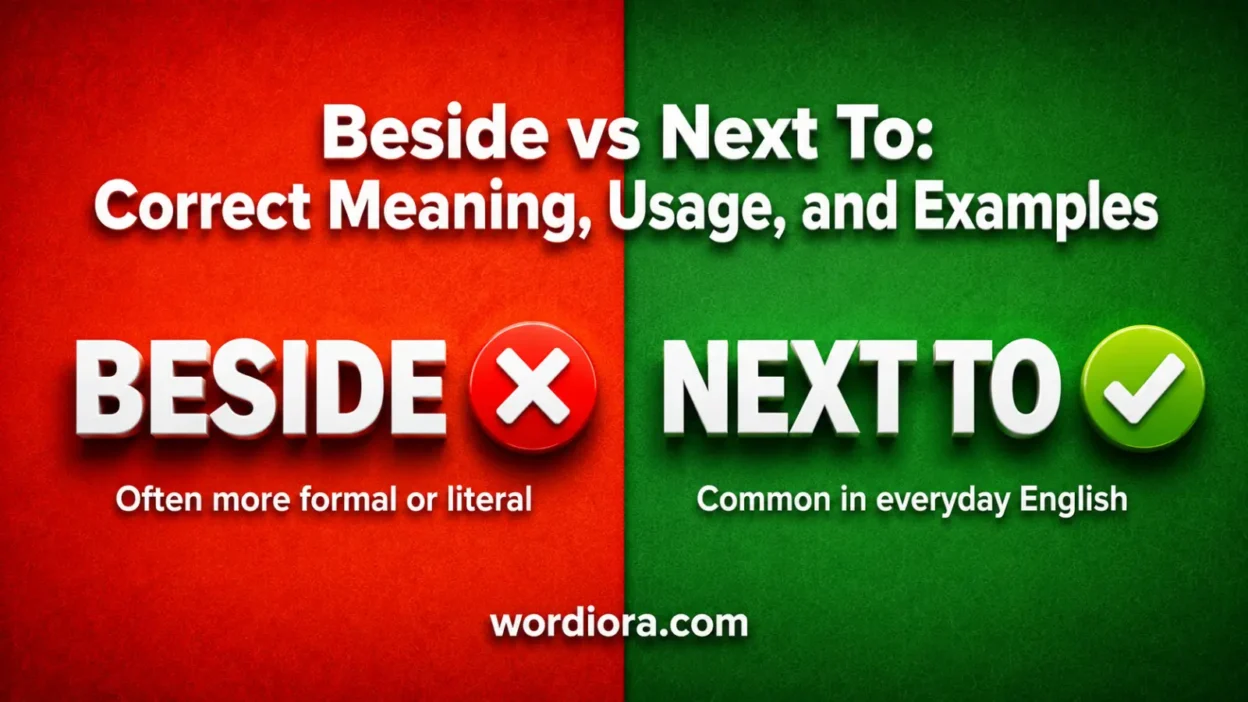
Beside and next to often point to the same basic idea: one person or thing is at the side of another. You can sit beside someone, and you can sit next to someone. Both sentences sound correct.
Still, they are not always equal. Next to is usually the clearest everyday choice for exact physical placement. Beside can sound a little more formal, and it also appears in fixed phrases like beside the point.
Quick Answer
Use next to when you mean something is directly beside another thing, especially in everyday speech: “The keys are next to my phone.” Use beside when you want a slightly more formal or written tone: “She stood beside the podium.” In many location sentences, both are correct.
Why People Confuse Them
People confuse these terms because both can describe side-by-side position. For example, these two sentences have almost the same meaning:
“She sat beside me.”
“She sat next to me.”
The confusion grows because beside has extra uses that next to does not always share. You can say, “That is beside the point,” but “That is next to the point” sounds wrong. You can also say, “next to nothing,” but “beside nothing” does not mean the same thing.
So, the overlap is real, but it has limits.
Key Differences At A Glance
| Context | Best Choice | Why |
|---|---|---|
| Everyday exact location | next to | It sounds natural and clear in casual US English. |
| Slightly formal location | beside | It can sound smoother in polished writing. |
| Sitting or standing at someone’s side | either | Both work well in most simple location sentences. |
| Fixed phrase about irrelevance | beside | The correct phrase is “beside the point.” |
| Phrase meaning almost none | next to | The correct phrase is “next to nothing.” |
| Comparison meaning “when compared with” | beside | “Beside” can work in this sense. |
| Order or importance | next to | “Next to” can mean following in order or importance. |
Meaning and Usage Difference
Beside is mainly a preposition. Its most common meaning is “at the side of” or “next to.” It places one thing near the side of another.
Examples:
“The lamp is beside the bed.”
“She walked beside her brother.”
“Please stand beside the sign.”
Next to is a prepositional phrase. It usually means “very close to” or “directly at the side of,” often with no meaningful space between the two things.
Examples:
“The lamp is next to the bed.”
“She sat next to her brother.”
“Please park next to the sign.”
The most useful difference is this: next to often feels more exact and everyday. Beside can feel a bit softer, more formal, or more written.
Here is the compact comparison:
| Feature | beside | next to |
| Main use | At the side of | Very close beside |
| Tone | Slightly more formal | More conversational |
| Best for | Writing, descriptions, idioms | Everyday location |
| Interchangeable? | Often, for physical position | Often, for physical position |
| Fixed phrase example | beside the point | next to nothing |
Tone, Context, and Formality
In everyday US English, next to is often the safest choice. It sounds simple and direct.
“The grocery store is next to the pharmacy.”
“My backpack is next to the couch.”
Beside is also normal, but it can sound a little more polished or literary.
“She stood beside the hospital bed.”
“A small cabin sat beside the lake.”
That does not mean beside is old-fashioned or wrong. It is standard English. However, in quick speech, signs, directions, and simple instructions, next to often sounds more natural.
For example:
Natural: “The charger is next to the TV.”
Also correct, slightly more formal: “The charger is beside the TV.”
Which One Should You Use?
Use next to when you want the clearest everyday wording.
Choose next to for directions, room descriptions, school writing, casual messages, and simple placement.
Examples:
“Put the box next to the door.”
“She lives next to my aunt.”
“The coffee shop is next to the bank.”
Use beside when you want a calmer, slightly more formal sound, or when the phrase is fixed.
Examples:
“He stood beside his wife during the ceremony.”
“The notebook was beside the keyboard.”
“That detail is beside the point.”
A simple guide works well:
Use next to for plain, exact location.
Use beside for a slightly formal tone or fixed phrases.
When One Choice Sounds Wrong
Sometimes both choices work. Sometimes only one sounds right.
Correct: “That is beside the point.”
Wrong: “That is next to the point.”
Here, beside the point means unrelated to the main issue. It is a fixed phrase.
Correct: “I know next to nothing about plumbing.”
Wrong: “I know beside nothing about plumbing.”
Here, next to nothing means almost nothing. It is also a fixed phrase.
Correct: “Next to math, science is her favorite subject.”
Awkward: “Beside math, science is her favorite subject.”
In that sentence, next to can show order, rank, or importance. Beside can compare things, but it does not always sound natural in that structure.
Common Mistakes and Quick Fixes
Mistake 1: Using beside when you mean besides
Wrong: “Beside pizza, we ordered wings.”
Better: “Besides pizza, we ordered wings.”
Beside usually means at the side of. Besides means in addition to.
Mistake 2: Using next to in the phrase beside the point
Wrong: “Your comment is next to the point.”
Better: “Your comment is beside the point.”
Mistake 3: Using beside in next to nothing
Wrong: “The old phone is worth beside nothing.”
Better: “The old phone is worth next to nothing.”
Mistake 4: Thinking beside and next to always differ
Too strict: “Beside is formal, and next to is always casual.”
Better: “Beside can sound a little more formal, but both can be normal.”
Everyday Examples
“The dog slept beside the couch while we watched a movie.”
“The dog slept next to the couch while we watched a movie.”
“Can I sit next to you during the meeting?”
“She stood beside me while I gave the update.”
“The restaurant is next to the movie theater.”
“A narrow trail runs beside the river.”
“Put your phone next to your wallet so you do not forget it.”
“He kept the photo beside his bed.”
“That argument is beside the point.”
“The repair cost next to nothing.”
Dictionary-Style Word Details
Verb
• beside: Not commonly used as a verb in standard US English. It works mainly as a preposition.
• next to: Not a verb. It is a phrase used mainly before a noun or pronoun.
Noun
• beside: Not commonly used as a noun in standard US English.
• next to: Not a noun. The word next can appear in other grammar roles, but next to works as a phrase.
Synonyms
• beside: closest plain alternatives include next to, by, alongside, and at the side of.
• next to: closest plain alternatives include beside, near, adjacent to, and right by.
These are not always exact matches. Near is broader because something can be near you without being directly at your side. Adjacent to is more formal and often sounds better for buildings, rooms, lots, or objects.
Clear opposite ideas include away from, far from, and not near, depending on the sentence.
Example Sentences
• beside: “She placed the flowers beside the front door.”
• beside: “The small table beside the sofa holds the remote.”
• beside: “His complaint was beside the point.”
• next to: “The pharmacy is next to the grocery store.”
• next to: “I left my notebook next to my laptop.”
• next to: “The repair cost next to nothing.”
Word History
• beside: The word comes from older English elements connected with being by the side. The exact details are not needed for everyday usage, but the side-by-side meaning is central to the word.
• next to: The phrase comes from the word next, which is connected with nearness, order, or closeness. In modern use, next to can describe physical position, order, comparison, or “almost” in fixed phrases.
Phrases Containing
• beside: beside the point, beside yourself, stand beside someone, sit beside someone.
• next to: next to nothing, next to last, next to impossible, sit next to someone, live next to someone.
FAQs
Is beside or next to more correct?
Both are correct when you mean “at the side of.” For everyday US English, next to is usually the safer and more natural choice. For a slightly more formal sound, beside also works.
Can I say “sit beside me”?
Yes. “Sit beside me” is correct and natural. “Sit next to me” is also correct and may sound more common in casual speech.
Does next to always mean touching?
No. Next to usually means very close, often side by side, but the two things do not always have to touch.
Is beside more formal than next to?
Often, yes. Beside can sound a little more formal or polished. Still, it is normal English, not rare or outdated.
What is the difference between beside and besides?
Beside means at the side of. Besides usually means in addition to or furthermore. Example: “Sit beside me” but “Besides coffee, we ordered tea.”
Which phrase is correct: beside the point or next to the point?
The correct phrase is beside the point. It means unrelated to the main issue.
Conclusion
Beside and next to overlap when they describe physical location. You can sit beside someone or next to someone, and both sentences are correct.
For everyday US English, next to is often the clearest choice for exact placement. Use beside when you want a slightly more formal tone or when the phrase is fixed, as in beside the point. The best choice depends on context, not a strict grammar rule.