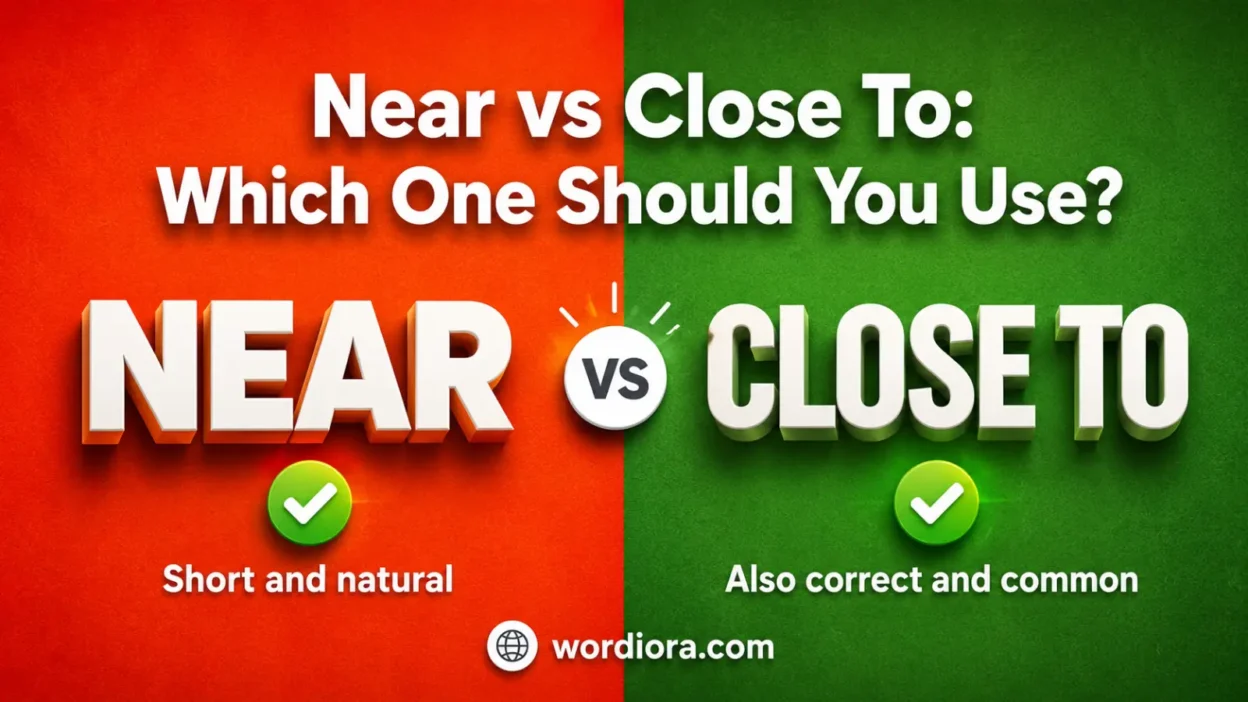
Near vs close to can confuse writers because both can describe short distance. In many everyday sentences, both sound natural. You can say, “The hotel is near the beach,” or “The hotel is close to the beach.”
The main difference is grammar and feel. Near can stand directly before a noun. Close to uses the full phrase before a noun. Also, close to often sounds a little more personal or conversational, especially when you talk about relationships.
Quick Answer
Both near and close to are correct. Use near when you want the shortest, cleanest way to say something is not far away. Use close to when the sentence needs the full phrase or when you want a natural, conversational feel. Do not write close the station for distance; write close to the station.
Why People Confuse Them
People confuse near and close to because they often point to the same idea: something is not far away.
These sentences mean almost the same thing:
The pharmacy is near my apartment.
The pharmacy is close to my apartment.
The confusion usually starts when writers drop to after close. Near can work by itself before an object, but close usually cannot when it means “not far from.”
Correct: The park is near our house.
Correct: The park is close to our house.
Wrong: The park is close our house.
Another reason is that both terms can refer to time, distance, or relationship. Still, they do not fit every phrase the same way.
Key Differences At A Glance
| Context | Best Choice | Why |
|---|---|---|
| Shortest location wording | near | It works directly before the place or thing. |
| Location with a fuller phrase | close to | It sounds natural, but it needs to. |
| Emotional relationship | close to | It is the usual choice for personal bonds. |
| Fixed phrase about soon | near | Say in the near future, not in the close future. |
| Fixed phrase about friendship | close | Say a close friend, not a near friend. |
| Ending a sentence | close | The store is close sounds natural when the object is clear. |
Meaning and Usage Difference
Near means “not far away.” It can describe distance, time, or a relationship. It often works as a preposition before a noun.
Example: We live near the school.
Close to also means “not far away,” but it is a phrase. When close points to distance and comes before an object, it normally needs to.
Example: We live close to the school.
Compact comparison:
• Near: shorter, direct, and common before a noun.
• Close to: fuller phrase, common in speech and relationship language.
• Near: The office is near the airport.
• Close to: The office is close to the airport.
Pronunciation matters only with close. When close means “near,” say it like KLOHS. When close means “shut,” say it like KLOHZ.
Tone, Context, and Formality
Near is concise and neutral. It fits casual, school, business, and formal writing.
Example: The clinic is near the train station.
Close to is also standard. It often sounds a bit warmer or more conversational.
Example: The clinic is close to the train station.
For relationships, close to is usually better.
Natural: I’m close to my older brother.
Awkward: I’m near my older brother.
However, near can work for physical position.
Natural: I was standing near my older brother in the photo.
So, the difference is not about strict formality. It is more about sentence pattern and meaning.
Which One Should You Use?
Use near when you want a short, direct sentence.
The hotel is near downtown.
Use close to when you want a fuller and natural phrase.
The hotel is close to downtown.
Use close to for emotional connection.
She is close to her grandparents.
Use near for fixed time phrases.
We plan to move in the near future.
Use close for fixed relationship or degree phrases.
They are close friends.
The final score was close.
When One Choice Sounds Wrong
Some sentences sound wrong because the grammar pattern is incomplete.
Wrong: The bank is close my office.
Correct: The bank is close to my office.
Near does not need to in that same pattern.
Correct: The bank is near my office.
Some phrases are fixed by common use.
Wrong: We may decide in the close future.
Correct: We may decide in the near future.
Wrong: He is my near friend.
Correct: He is my close friend.
Still, near is fine when you mean physical position.
Correct: He sat near my friend during lunch.
Common Mistakes (and Quick Fixes)
Mistake: Using close without to before an object.
Wrong: The café is close my dorm.
Fix: The café is close to my dorm.
Mistake: Using near when you mean emotional closeness.
Awkward: I’m near my cousin.
Fix: I’m close to my cousin.
Mistake: Using close future.
Wrong: We will update the policy in the close future.
Fix: We will update the policy in the near future.
Mistake: Thinking near always means next to.
Wrong idea: The store is near my house, so it must be beside it.
Fix: Near means not far away. It does not always mean directly beside.
Everyday Examples
Near: There’s a gas station near the highway exit.
Close to: There’s a gas station close to the highway exit.
Near: My desk is near the window.
Close to: My desk is close to the window.
Near: The deadline is near.
Close to: The deadline is close.
Near: We found a parking spot near the restaurant.
Close to: We found a parking spot close to the restaurant.
Near: Please don’t stand too near the edge.
Close to: Please don’t stand too close to the edge.
Near: The school is near our neighborhood.
Close to: The school is close to our neighborhood.
Dictionary-Style Word Details
Verb
Near: Near can work as a verb meaning “to come closer.” Example: The deadline is nearing.
Close to: Close to, in the distance meaning, is not commonly used as a verb phrase. Close alone can be a verb meaning “shut,” as in close the door, but that is a different use.
Noun
Near: Not commonly used as a noun in standard US English.
Close to: Not used as a noun in the location phrase. Close alone can be a noun in a different meaning, as in the close of the meeting.
Synonyms
Near: Closest plain alternatives include not far from, nearby, by, and within a short distance of.
Close to: Closest plain alternatives include near, nearby, close by, and not far from.
Antonyms that clearly fit both: far from, away from, and distant from.
Example Sentences
Near: The library is near the student center.
Near: We should hear back in the near future.
Near: The dog stayed near its owner.
Close to: The library is close to the student center.
Close to: We got home close to midnight.
Close to: She is close to her aunt.
Word History
Near and close to are both well-established in English, but their older history is not the main issue for modern writers. The practical choice today comes down to grammar, phrase pattern, and context.
Use near when you need a direct word before the object. Use close to when the phrase sounds more natural or when you mean personal connection.
Phrases Containing
Near: near the door, near campus, near the end, in the near future, near miss, nowhere near, near and dear.
Close to: close to home, close to campus, close to the end, close to midnight, close to my family, close to impossible, close to the truth.
FAQs
Is near the same as close to?
Often, yes. For distance, near and close to can usually describe the same basic idea: not far away. The grammar is different, though. Near can come directly before the object, while close needs to before the object.
Is near to correct?
Yes, near to is possible, but near is usually simpler in everyday US English. Most writers would say “The store is near my house” instead of “The store is near to my house.”
Can I say close the school for location?
No. If you mean distance, write close to the school. “Close the school” means shut the school or stop it from operating, which is a different meaning.
Which sounds more natural in conversation?
Both can sound natural. Near is shorter and direct. Close to often sounds more conversational, especially when you are talking about places in daily life: “I live close to work.”
Should I use near or close to for relationships?
Use close to for relationships. Say “She is close to her sister,” not “She is near her sister,” unless you mean physical position.
Conclusion
Near and close to are both correct, and they often overlap when you describe distance. The safest rule is simple: near can stand before a noun by itself, but close needs to before an object.
Choose near for short, direct wording. Choose close to for a natural phrase, especially in conversation or relationship language. For fixed phrases, follow common use: in the near future, a close friend, close to home, and near the door.