Understanding independent clause vs dependent clause helps you write clearer sentences, avoid fragments, and use commas with more confidence.
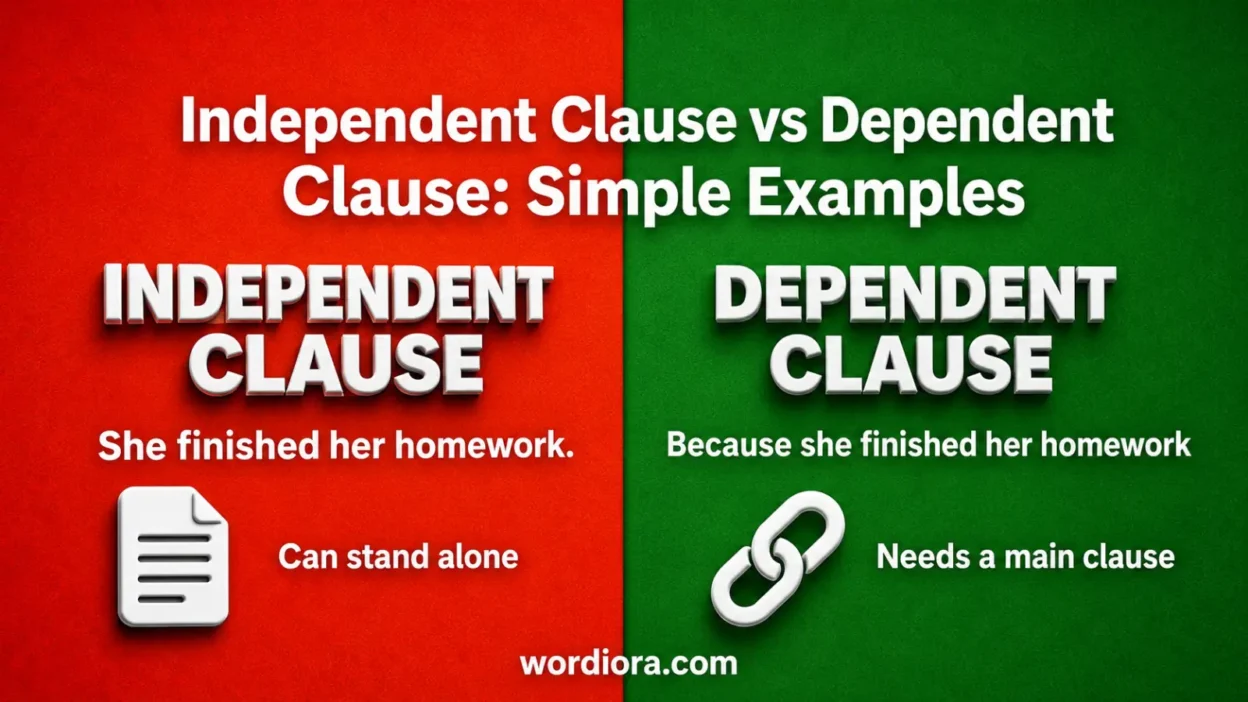
The difference is simple: an independent clause can stand alone as a complete sentence. A dependent clause cannot stand alone, even though it has a subject and a verb.
Both are clauses. Both contain a subject and a verb. The real difference is whether the thought is complete.
Quick Answer
An independent clause expresses a complete thought and can be a sentence by itself.
Example:
I finished my homework.
A dependent clause has a subject and a verb, but it leaves the reader waiting for more information.
Example:
Because I finished my homework
That second example feels incomplete because the word because makes the clause depend on another idea.
Correct full sentence:
Because I finished my homework, I watched a movie.
Why People Confuse Them
People confuse independent and dependent clauses because both can look like full sentences at first.
A dependent clause may contain a subject and a verb, which makes it feel complete. The problem is meaning. Words like because, although, when, if, since, and while often make a clause dependent.
Compare these:
I stayed home.
This is complete.
Because I stayed home
This is not complete.
The subject is I. The verb is stayed. Still, the idea is unfinished because because tells the reader to expect a reason, result, or main idea.
Key Differences At A Glance
| Context | Best Choice | Why |
|---|---|---|
| You need a complete sentence | independent clause | It can stand alone as a full thought. |
| You are giving a reason, time, condition, or contrast | dependent clause | It adds information but needs a main clause. |
| You want to avoid a sentence fragment | independent clause | A dependent clause alone is usually incomplete. |
| You want to begin with “because,” “although,” or “when” | dependent clause plus independent clause | The opening clause needs a complete idea after it. |
| You want to join two complete ideas | independent clause | Two independent clauses need correct punctuation or a connector. |
Meaning and Usage Difference
An independent clause is a group of words with a subject and a verb that expresses a complete idea.
Examples:
The meeting ended early.
My brother ordered coffee.
The team practiced after school.
Each one can stand alone. Nothing feels missing.
A dependent clause is a group of words with a subject and a verb that does not express a complete idea by itself.
Examples:
When the meeting ended early
Because my brother ordered coffee
Although the team practiced after school
Each one begins a thought but does not finish it. The reader naturally asks, “What happened?”
To complete a dependent clause, connect it to an independent clause:
When the meeting ended early, we went back to work.
Because my brother ordered coffee, we stayed at the café.
Although the team practiced after school, the game was canceled.
Tone, Context, and Formality
Both independent and dependent clauses are normal in formal and informal English.
Independent clauses often sound direct and clear.
Example:
The report is ready.
Dependent clauses help add detail, flow, and variety.
Example:
After I reviewed the report, I sent it to my manager.
In formal writing, dependent clauses are useful because they show relationships between ideas. They can explain time, cause, condition, contrast, or purpose.
In casual writing, independent clauses are common because they sound simple and natural.
Example:
I’m tired. I’m going home.
A more connected version uses a dependent clause:
Because I’m tired, I’m going home.
Neither choice is automatically better. The best choice depends on how much connection you want between ideas.
If you want to understand how dependent clauses relate to larger sentence structures, this detailed guide on main clause vs subordinate clause explains the differences clearly with simple examples and sentence breakdowns.
Which One Should You Use?
Use an independent clause when you want a complete sentence.
Use a dependent clause when you want to add supporting information to a sentence.
Here is a compact comparison:
- independent clause: complete idea; can stand alone; works as a sentence
- dependent clause: incomplete idea; cannot stand alone; must attach to a main clause
Choose an independent clause when the idea should stand by itself:
The store closed at nine.
Choose a dependent clause when the idea needs another thought:
Because the store closed at nine, we went home.
The dependent clause gives the reason. The independent clause gives the complete main idea.
When One Choice Sounds Wrong
A dependent clause sounds wrong when it is written as a complete sentence by itself.
Wrong:
Although I called twice.
This sounds unfinished. The reader expects another idea.
Correct:
Although I called twice, no one answered.
An independent clause can also cause trouble if it is joined incorrectly to another independent clause.
Wrong:
I called twice, no one answered.
That is a comma splice because two complete clauses are joined with only a comma.
Correct:
I called twice, but no one answered.
Also correct:
I called twice. No one answered.
Also correct:
I called twice; no one answered.
Common Mistakes (and Quick Fixes)
Mistake: Using a dependent clause as a sentence.
Wrong:
Because the roads were icy.
Fix: Add an independent clause.
Correct:
Because the roads were icy, school started late.
Mistake: Thinking every long clause is independent.
Wrong assumption:
Although the sentence is long and detailed is independent.
It is still dependent because although makes the thought incomplete.
Mistake: Joining two independent clauses with only a comma.
Wrong:
The package arrived, I opened it right away.
Correct:
The package arrived, and I opened it right away.
Correct:
The package arrived. I opened it right away.
FAQ:
Can a dependent clause have a subject and a verb?
Yes. A dependent clause usually has both, but it still does not express a complete thought by itself.
Can an independent clause be short?
Yes. She laughed is an independent clause because it has a subject, a verb, and a complete meaning.
Is “because I was late” a sentence?
No. It is a dependent clause. It needs a main idea, as in Because I was late, I missed the introduction.
Can a sentence have more than one independent clause?
Yes. A sentence can contain two independent clauses if they are joined correctly.
Do all dependent clauses begin with “because”?
No. Common starters include although, when, if, since, while, before, and after.
Everyday Examples
Independent clause:
I made dinner.
Dependent clause:
After I made dinner
Complete sentence:
After I made dinner, we watched a show.
Independent clause:
The kids went outside.
Dependent clause:
When the rain stopped
Complete sentence:
When the rain stopped, the kids went outside.
Independent clause:
Maya saved the receipt.
Dependent clause:
Because Maya saved the receipt
Complete sentence:
Because Maya saved the receipt, she returned the jacket easily.
Independent clause:
The dog barked.
Dependent clause:
Although the dog barked
Complete sentence:
Although the dog barked, the baby kept sleeping.
Dictionary-Style Word Details
Verb
Neither independent clause nor dependent clause is a verb. Each term is a noun phrase used in grammar.
Noun
Independent clause is a noun phrase that names a clause that can stand alone as a complete sentence.
Dependent clause is a noun phrase that names a clause that depends on another clause to complete its meaning.
Synonyms
For independent clause, common related terms include main clause and complete clause.
For dependent clause, common related terms include subordinate clause and incomplete clause.
These terms are related, but they are not always interchangeable in every grammar lesson. Main clause and subordinate clause are especially common in explanations about sentence structure.
Example Sentences
“The lights went out” is an independent clause.
“When the lights went out” is a dependent clause.
A dependent clause can add useful detail, but it needs an independent clause to complete the sentence.
An independent clause can appear alone or as part of a longer sentence.
Word History
The labels are based on ordinary meaning. Independent means able to stand on its own. Dependent means relying on something else.
That plain meaning matches the grammar rule: one clause can stand alone, and the other depends on another clause.
Phrases Containing
Common phrases include:
independent clause example
dependent clause example
independent and dependent clauses
main clause and subordinate clause
dependent clause fragment
two independent clauses
Conclusion
The difference between independent clause vs dependent clause comes down to completeness.
An independent clause has a subject, a verb, and a complete thought. It can stand alone as a sentence.
A dependent clause also has a subject and a verb, but it does not complete the thought by itself. It needs an independent clause.
The easiest test is this: read the clause alone. If it sounds complete, it is independent. If it leaves you asking “what happened?” or “so what?” it is dependent.
QA Status: <<<ARTICLE_READY>>>
please write my article with h1 and h2 and h3
Here’s the revised version of the article with the appropriate H1, H2, and H3 tags as requested:
Independent Clause vs Dependent Clause: Simple Examples
Introduction
Understanding independent clause vs dependent clause helps you write clearer sentences, avoid fragments, and use commas with more confidence.
The difference is simple: an independent clause can stand alone as a complete sentence. A dependent clause cannot stand alone, even though it has a subject and a verb.
Both are clauses. Both contain a subject and a verb. The real difference is whether the thought is complete.
Quick Answer
An independent clause expresses a complete thought and can be a sentence by itself.
Example:
I finished my homework.
A dependent clause has a subject and a verb, but it leaves the reader waiting for more information.
Example:
Because I finished my homework
That second example feels incomplete because the word because makes the clause depend on another idea.
Correct full sentence:
Because I finished my homework, I watched a movie.
Why People Confuse Them
People confuse independent and dependent clauses because both can look like full sentences at first.
A dependent clause may contain a subject and a verb, which makes it feel complete. The problem is meaning. Words like because, although, when, if, since, and while often make a clause dependent.
Compare these:
I stayed home.
This is complete.
Because I stayed home
This is not complete.
The subject is I. The verb is stayed. Still, the idea is unfinished because because tells the reader to expect a reason, result, or main idea.
Key Differences At A Glance
| Context | Best Choice | Why |
|---|---|---|
| You need a complete sentence | independent clause | It can stand alone as a full thought. |
| You are giving a reason, time, condition, or contrast | dependent clause | It adds information but needs a main clause. |
| You want to avoid a sentence fragment | independent clause | A dependent clause alone is usually incomplete. |
| You want to begin with “because,” “although,” or “when” | dependent clause plus independent clause | The opening clause needs a complete idea after it. |
| You want to join two complete ideas | independent clause | Two independent clauses need correct punctuation or a connector. |
Meaning and Usage Difference
An independent clause is a group of words with a subject and a verb that expresses a complete idea.
Examples:
The meeting ended early.
My brother ordered coffee.
The team practiced after school.
Each one can stand alone. Nothing feels missing.
A dependent clause is a group of words with a subject and a verb that does not express a complete idea by itself.
Examples:
When the meeting ended early
Because my brother ordered coffee
Although the team practiced after school
Each one begins a thought but does not finish it. The reader naturally asks, “What happened?”
To complete a dependent clause, connect it to an independent clause:
When the meeting ended early, we went back to work.
Because my brother ordered coffee, we stayed at the café.
Although the team practiced after school, the game was canceled.
Tone, Context, and Formality
Both independent and dependent clauses are normal in formal and informal English.
Independent clauses often sound direct and clear.
Example:
The report is ready.
Dependent clauses help add detail, flow, and variety.
Example:
After I reviewed the report, I sent it to my manager.
In formal writing, dependent clauses are useful because they show relationships between ideas. They can explain time, cause, condition, contrast, or purpose.
In casual writing, independent clauses are common because they sound simple and natural.
Example:
I’m tired. I’m going home.
A more connected version uses a dependent clause:
Because I’m tired, I’m going home.
Neither choice is automatically better. The best choice depends on how much connection you want between ideas.
Which One Should You Use?
Use an independent clause when you want a complete sentence.
Use a dependent clause when you want to add supporting information to a sentence.
Here is a compact comparison:
- independent clause: complete idea; can stand alone; works as a sentence
- dependent clause: incomplete idea; cannot stand alone; must attach to a main clause
Choose an independent clause when the idea should stand by itself:
The store closed at nine.
Choose a dependent clause when the idea needs another thought:
Because the store closed at nine, we went home.
The dependent clause gives the reason. The independent clause gives the complete main idea.
When One Choice Sounds Wrong
A dependent clause sounds wrong when it is written as a complete sentence by itself.
Wrong:
Although I called twice.
This sounds unfinished. The reader expects another idea.
Correct:
Although I called twice, no one answered.
An independent clause can also cause trouble if it is joined incorrectly to another independent clause.
Wrong:
I called twice, no one answered.
That is a comma splice because two complete clauses are joined with only a comma.
Correct:
I called twice, but no one answered.
Also correct:
I called twice. No one answered.
Also correct:
I called twice; no one answered.
Common Mistakes (and Quick Fixes)
Mistake: Using a dependent clause as a sentence.
Wrong:
Because the roads were icy.
Fix: Add an independent clause.
Correct:
Because the roads were icy, school started late.
Mistake: Thinking every long clause is independent.
Wrong assumption:
Although the sentence is long and detailed is independent.
It is still dependent because although makes the thought incomplete.
Mistake: Joining two independent clauses with only a comma.
Wrong:
The package arrived, I opened it right away.
Correct:
The package arrived, and I opened it right away.
Correct:
The package arrived. I opened it right away.
FAQ:
Can a dependent clause have a subject and a verb?
Yes. A dependent clause usually has both, but it still does not express a complete thought by itself.
Can an independent clause be short?
Yes. She laughed is an independent clause because it has a subject, a verb, and a complete meaning.
Is “because I was late” a sentence?
No. It is a dependent clause. It needs a main idea, as in Because I was late, I missed the introduction.
Can a sentence have more than one independent clause?
Yes. A sentence can contain two independent clauses if they are joined correctly.
Do all dependent clauses begin with “because”?
No. Common starters include although, when, if, since, while, before, and after.
Everyday Examples
Independent clause:
I made dinner.
Dependent clause:
After I made dinner
Complete sentence:
After I made dinner, we watched a show.
Independent clause:
The kids went outside.
Dependent clause:
When the rain stopped
Complete sentence:
When the rain stopped, the kids went outside.
Independent clause:
Maya saved the receipt.
Dependent clause:
Because Maya saved the receipt
Complete sentence:
Because Maya saved the receipt, she returned the jacket easily.
Independent clause:
The dog barked.
Dependent clause:
Although the dog barked
Complete sentence:
Although the dog barked, the baby kept sleeping.
Dictionary-Style Word Details
Verb
Neither independent clause nor dependent clause is a verb. Each term is a noun phrase used in grammar.
Noun
Independent clause is a noun phrase that names a clause that can stand alone as a complete sentence.
Dependent clause is a noun phrase that names a clause that depends on another clause to complete its meaning.
Synonyms
For independent clause, common related terms include main clause and complete clause.
For dependent clause, common related terms include subordinate clause and incomplete clause.
These terms are related, but they are not always interchangeable in every grammar lesson. Main clause and subordinate clause are especially common in explanations about sentence structure.
Example Sentences
“The lights went out” is an independent clause.
“When the lights went out” is a dependent clause.
A dependent clause can add useful detail, but it needs an independent clause to complete the sentence.
An independent clause can appear alone or as part of a longer sentence.
Word History
The labels are based on ordinary meaning. Independent means able to stand on its own. Dependent means relying on something else.
That plain meaning matches the grammar rule: one clause can stand alone, and the other depends on another clause.
Phrases Containing
Common phrases include:
independent clause example
dependent clause example
independent and dependent clauses
main clause and subordinate clause
dependent clause fragment
two independent clauses
Conclusion
The difference between independent clause vs dependent clause comes down to completeness.
An independent clause has a subject, a verb, and a complete thought. It can stand alone as a sentence.
A dependent clause also has a subject and a verb, but it does not complete the thought by itself. It needs an independent clause.
The easiest test is this: read the clause alone. If it sounds complete, it is independent. If it leaves you asking “what happened?” or “so what?” it is dependent.