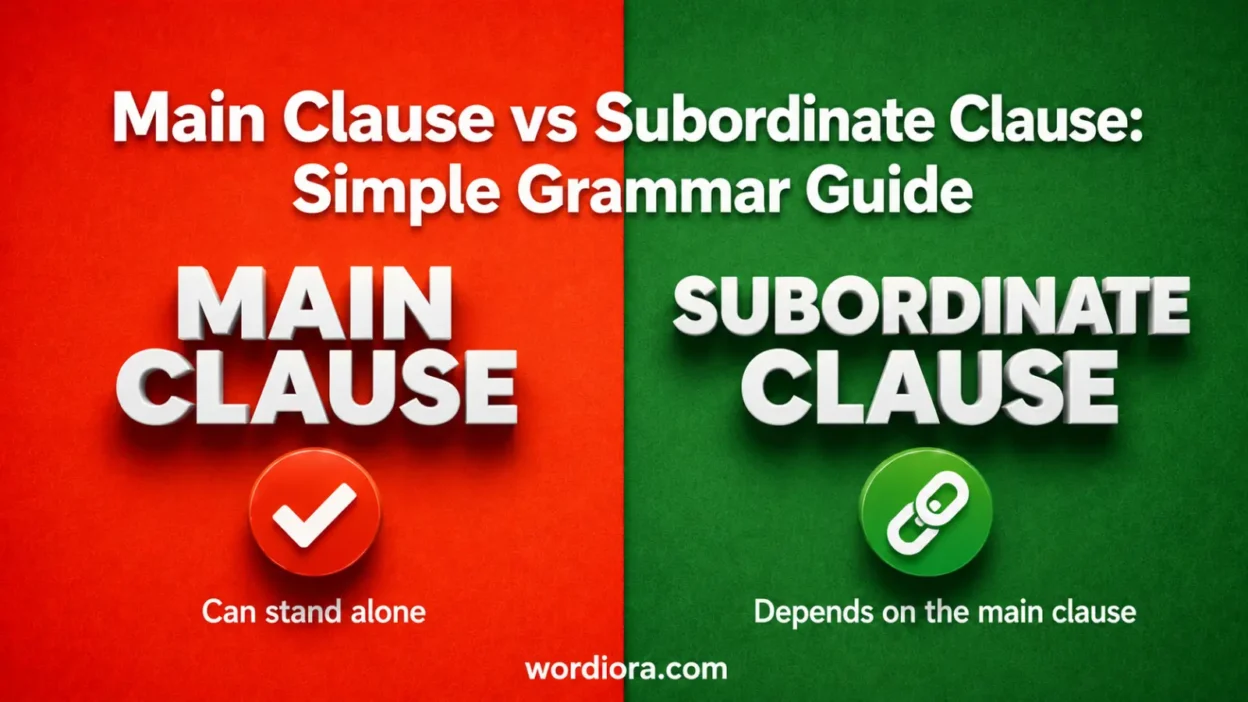
Main clause vs subordinate clause is a comparison between two types of clauses. Both contain a subject and a verb, but they do different jobs in a sentence.
A main clause can stand alone as a complete sentence. A subordinate clause cannot stand alone because it depends on another clause to complete the idea.
The easiest way to remember the difference is this: a main clause carries the central thought, while a subordinate clause adds extra information about time, reason, condition, contrast, place, or description.
Quick Answer
A main clause expresses a complete thought and can stand alone as a sentence.
A subordinate clause has a subject and verb, but it does not express a complete thought by itself.
Example:
Main clause:
She stayed home.
Subordinate clause:
because she felt sick
Combined sentence:
She stayed home because she felt sick.
In that sentence, “She stayed home” is the main clause. “Because she felt sick” is the subordinate clause.
Why People Confuse Them
People often confuse main clauses and subordinate clauses because both can look like full sentence parts. A subordinate clause still has a subject and a verb, so it may seem complete at first glance.
For example:
Because the meeting ended early.
This has a subject, “the meeting,” and a verb, “ended.” Still, it leaves the reader waiting for the main idea. What happened because the meeting ended early?
Now compare it with:
Because the meeting ended early, we went to lunch.
The sentence now feels complete because “we went to lunch” is the main clause.
Key Differences At A Glance
| Context | Best Choice | Why |
|---|---|---|
| You need a complete sentence | Main clause | It can stand alone and express a full idea. |
| You need to add reason, time, condition, or contrast | Subordinate clause | It depends on a main clause to complete the sentence. |
| You are fixing a sentence fragment | Main clause | A fragment often happens when a subordinate clause is used alone. |
| You are writing a complex sentence | Both | A complex sentence usually combines one main clause with one or more subordinate clauses. |
| You want the sentence’s central point | Main clause | It carries the main message. |
| You want supporting detail | Subordinate clause | It gives extra information about the main idea. |
Extra comparison:
- Main clause: complete, independent, central.
- Subordinate clause: incomplete alone, dependent, supporting.
- Main clause: can be a sentence by itself.
- Subordinate clause: must attach to another clause.
- Main clause: tells the main action or idea.
- Subordinate clause: explains when, why, how, where, or under what condition something happens.
Meaning and Usage Difference
A main clause is also called an independent clause. It has enough meaning to stand alone.
Examples:
- I finished the report.
- The kids played outside.
- Maria called her sister.
Each one has a subject, a verb, and a complete idea.
A subordinate clause is also called a dependent clause. It has a subject and verb, but it depends on a main clause.
Examples:
- after I finished the report
- while the kids played outside
- because Maria called her sister
These clauses are not complete sentences on their own. They need more information.
Complete versions:
- After I finished the report, I took a break.
- The dog slept while the kids played outside.
- Because Maria called her sister, the plans changed.
Tone, Context, and Formality
Main clauses and subordinate clauses are not formal or informal by themselves. The difference is grammatical, not based on tone.
Still, the way you combine them can affect style.
A sentence with only main clauses can sound direct:
- The storm passed. We drove home.
A sentence with a subordinate clause can sound smoother:
- After the storm passed, we drove home.
Both are correct. The better choice depends on what you want the sentence to do.
Use a main clause when you want a clear, direct statement. Use a subordinate clause when you want to connect ideas and show a relationship between them.
Which One Should You Use?
Use a main clause when the idea needs to stand on its own.
Example:
- The train arrived late.
Use a subordinate clause when the idea supports another idea.
Example:
- although the train arrived late
That clause needs a main clause:
- Although the train arrived late, we made it to the interview on time.
FAQ: Can a sentence have more than one main clause?
Yes. A compound sentence can have two or more main clauses.
Example:
- The train arrived late, but we still made it on time.
FAQ: Is a subordinate clause the same as a dependent clause?
Yes. In most grammar lessons, subordinate clause and dependent clause refer to the same idea: a clause that cannot stand alone as a complete sentence.
FAQ: Can a subordinate clause come first?
Yes. When it comes first, it is often followed by a comma.
Example:
- When the movie ended, everyone clapped.
When One Choice Sounds Wrong
A main clause sounds wrong when it is treated like a supporting detail but has no clear connection to the rest of the sentence.
Awkward:
- I stayed inside. Because it was raining.
Better:
- I stayed inside because it was raining.
A subordinate clause sounds wrong when it is written as a complete sentence.
Incorrect:
- Although I wanted to go.
Correct:
- Although I wanted to go, I stayed home.
Correct:
- I stayed home although I wanted to go.
The problem is not the subordinate clause itself. The problem is using it without a main clause.
Common Mistakes (and Quick Fixes)
One common mistake is writing a subordinate clause as a full sentence.
Mistake:
- When the alarm rang.
Fix:
- When the alarm rang, I woke up.
Another mistake is assuming every long clause is subordinate. Length does not decide the clause type.
Main clause:
- The teacher who helped me last semester wrote a recommendation letter.
This is a main clause because the full idea can stand alone.
Another mistake is placing a comma automatically before every subordinate clause.
Usually, when the subordinate clause comes first, use a comma:
- Before we left, I checked the lights.
When the main clause comes first, a comma is often unnecessary:
- I checked the lights before we left.
Everyday Examples
Main clause:
- I packed my suitcase.
Subordinate clause:
- before the taxi arrived
Complete sentence:
- I packed my suitcase before the taxi arrived.
Main clause:
- The team celebrated.
Subordinate clause:
- after they won the final game
Complete sentence:
- The team celebrated after they won the final game.
Main clause:
- We canceled the picnic.
Subordinate clause:
- because the weather changed
Complete sentence:
- We canceled the picnic because the weather changed.
Main clause:
- The dog barked.
Subordinate clause:
- when the doorbell rang
Complete sentence:
- The dog barked when the doorbell rang.
Main clause:
- You can borrow my notes.
Subordinate clause:
- if you return them tomorrow
Complete sentence:
- You can borrow my notes if you return them tomorrow.
Dictionary-Style Word Details
Verb
“Main clause” and “subordinate clause” are noun phrases, not verbs. They name grammatical units in a sentence.
Noun
A main clause is a clause that can stand alone as a complete sentence.
A subordinate clause is a clause that depends on a main clause and cannot stand alone as a complete sentence.
Synonyms
For main clause:
- independent clause
- principal clause
For subordinate clause:
- dependent clause
- embedded clause
Use “independent clause” and “dependent clause” when you want the most common classroom-friendly terms. Use “main clause” and “subordinate clause” when discussing sentence structure more directly.
Example Sentences
The clause “we left early” is a main clause because it expresses a complete thought.
The clause “because the roads were icy” is subordinate because it needs another clause to complete the idea.
In “We left early because the roads were icy,” the main clause is “We left early.”
In “When the guests arrived, the music started,” the subordinate clause comes first.
Word History
These terms come from traditional grammar labels. “Main” points to the central clause in a sentence, while “subordinate” points to a clause that works under or depends on another clause.
In modern grammar teaching, “main clause” is often paired with “independent clause,” and “subordinate clause” is often paired with “dependent clause.”
Phrases Containing
Common phrases include:
- main clause
- subordinate clause
- independent clause
- dependent clause
- relative subordinate clause
- adverbial subordinate clause
- noun subordinate clause
- clause structure
- complex sentence
Conclusion
Main clause vs subordinate clause is mostly about independence.
A main clause can stand alone because it expresses a complete thought. A subordinate clause cannot stand alone because it depends on a main clause.
Use main clauses for complete ideas. Use subordinate clauses to add details, reasons, time, conditions, contrast, or description. Once you can spot which clause carries the main idea and which clause depends on it, sentence structure becomes much easier to understand.