Both relative clause and noun clause are correct grammar terms. They are not interchangeable, though. They name two different kinds of dependent clauses.
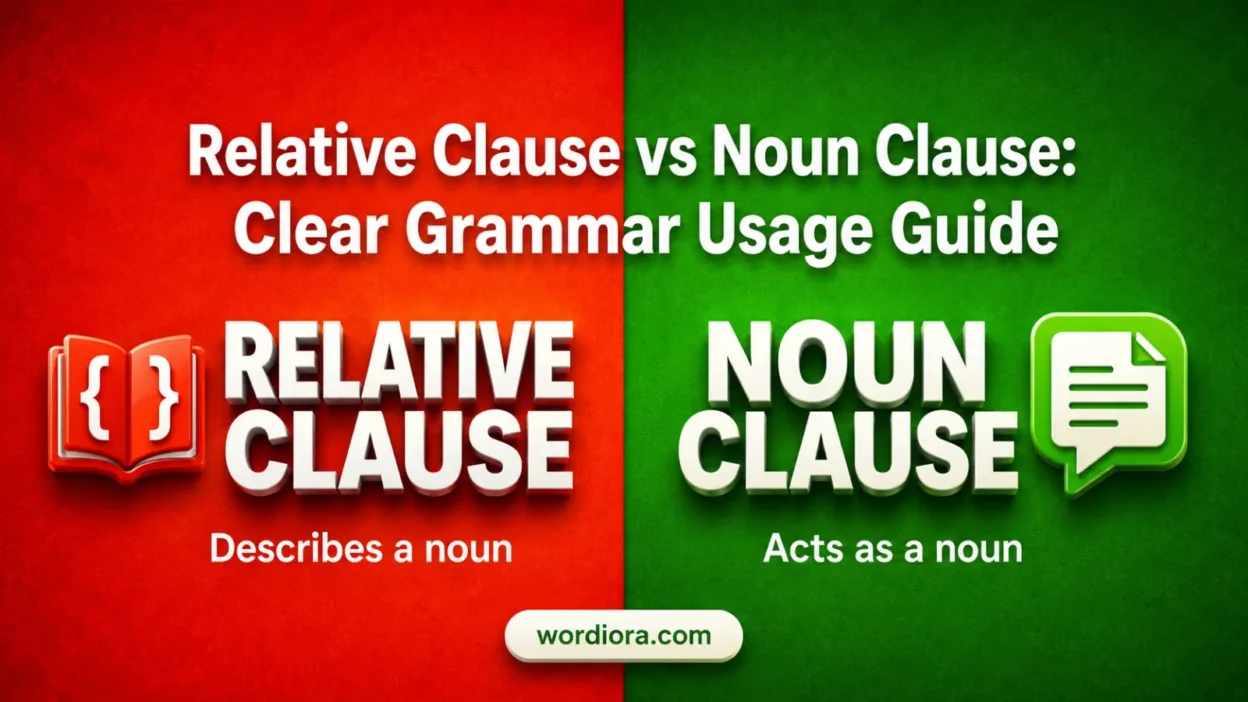
The main difference is simple: a relative clause describes a noun, while a noun clause acts like a noun.
That means the choice depends on what the clause does in the sentence, not just which word it starts with.
Quick Answer
Use relative clause when the clause gives more information about a noun already in the sentence.
Example:
The laptop that I ordered arrived today.
Use noun clause when the whole clause works as a noun, such as a subject, object, or complement.
Example:
I know what I ordered.
In the first sentence, the clause describes “laptop.” In the second, the clause is the thing known.
Why People Confuse Them
People confuse these terms because both can begin with words like who, what, which, or that.
That first word is not enough. You have to ask what the clause is doing.
In the student who emailed me, the clause who emailed me describes “student.” That makes it a relative clause.
In I know who emailed me, the clause who emailed me is the object of “know.” That makes it a noun clause.
Key Differences At A Glance
| Feature | relative clause | noun clause |
|---|---|---|
| Main job | Describes a noun or pronoun | Acts as a noun |
| Common role | Modifier | Subject, object, or complement |
| Needs a noun before it? | Usually yes | No |
| Example | The person who called left a message. | I know who called. |
| Quick test | “Which person or thing?” | “What?” or “who?” as a sentence part |
Meaning and Usage Difference
A relative clause adds information about a noun. It usually comes right after the noun it describes.
Example:
The teacher who runs the debate club is retiring.
The clause tells us which teacher.
A noun clause fills a noun position in the sentence. It can be the subject, object, or complement.
Examples:
What she decided surprised everyone.
He explained why the meeting changed.
The issue is whether we have enough time.
The safest question is: Does the clause describe a noun, or does it work as the noun itself?
Tone, Context, and Formality
Both terms are standard and neutral in US English grammar writing. Neither one is more casual or more formal by itself.
You will see relative clause in grammar lessons, writing centers, editing guides, and school materials. Some teachers also call it an adjective clause because it works like an adjective.
You will see noun clause in lessons about sentence structure, reported speech, and complex sentences. It is useful when a whole clause takes the place of a noun.
Pronunciation does not usually cause confusion here. The real issue is sentence function, not sound.
Which One Should You Use?
Use the term that matches the clause’s job.
| Context | Best Choice | Why |
|---|---|---|
| The clause describes a noun | relative clause | It modifies a noun already present |
| The clause is the subject | noun clause | It fills the subject position |
| The clause is the object of a verb | noun clause | It receives the action or completes the verb |
| The clause follows a noun and identifies it | relative clause | It tells which noun you mean |
| The clause follows a linking verb like is | noun clause | It can work as a subject complement |
When One Choice Sounds Wrong
Calling a clause a noun clause sounds wrong when the clause is only describing a noun.
Wrong label:
The car that needs repairs is outside.
Here, that needs repairs is not the subject or object. It describes “car,” so it is a relative clause.
Calling a clause a relative clause sounds wrong when there is no noun for it to describe.
Wrong label:
I heard that the store closed early.
Here, that the store closed early is what I heard. It acts as the object, so it is a noun clause.
Common Mistakes (and Quick Fixes)
Mistake 1: Judging only by the first word.
Fix: Look at the clause’s job in the sentence.
Mistake 2: Calling every who clause a relative clause.
Fix: Compare these two sentences:
The woman who called is my neighbor.
I know who called.
The first clause describes “woman.” The second clause is the object of “know.”
Mistake 3: Adding an extra pronoun in a relative clause.
Wrong: The client who I helped him sent a thank-you note.
Correct: The client who I helped sent a thank-you note.
Mistake 4: Treating a noun clause as extra information.
Wrong idea: She asked whether we were ready just adds detail.
Better: The clause is the object of “asked.”
Everyday Examples
Relative clause:
The restaurant that opened near campus is already packed.
Noun clause:
I heard that the restaurant opened near campus.
Relative clause:
The coworker who fixed the printer deserves coffee.
Noun clause:
We all know who fixed the printer.
Relative clause:
The reason why she left early was personal.
Noun clause:
I understand why she left early.
Dictionary-Style Word Details
Verb
• relative clause: Not commonly used as a verb in standard US English. It is a noun phrase naming a grammar category.
• noun clause: Not commonly used as a verb in standard US English. It is also a noun phrase naming a grammar category.
Noun
• relative clause: A grammar term for a dependent clause that modifies a noun or pronoun.
• noun clause: A grammar term for a dependent clause that functions as a noun.
Synonyms
• relative clause: Closest plain alternatives include adjective clause and clause that describes a noun. These are helpful, but the exact label depends on the grammar system being used.
• noun clause: Closest plain alternatives include nominal clause and clause that acts as a noun.
Clear antonyms do not fit neatly here because these terms classify sentence functions rather than opposite meanings.
Example Sentences
• relative clause: The book that you recommended is on my desk.
• relative clause: My cousin, who lives in Denver, is visiting next week.
• noun clause: What you recommended helped me choose a book.
• noun clause: The question is whether we should leave now.
Word History
• relative clause: The term is built from relative, meaning connected to something else, and clause, a group of words with a subject and verb. The name fits because the clause relates back to a noun or pronoun.
• noun clause: The term is built from noun and clause. The name fits because the whole clause does the job of a noun.
Reliable grammar sources use both as standard labels. Exact first-use history is not needed to understand the difference.
Phrases Containing
• relative clause: defining relative clause, nondefining relative clause, restrictive relative clause, nonrestrictive relative clause.
• noun clause: noun clause as subject, noun clause as object, noun clause as complement, noun clause as object of a preposition.
Want to understand how commas and essential information change sentence meaning? Read our detailed guide on restrictive clause vs nonrestrictive clause to master clause punctuation and clarity in English grammar.
FAQs
Is a relative clause the same as a noun clause?
No. A relative clause describes a noun, while a noun clause acts as a noun. They can look similar, but they do different jobs in a sentence.
How can I tell if a clause is relative or noun?
Ask what the clause does. If it describes a noun right before it, it is usually a relative clause. If the whole clause works as a subject, object, or complement, it is a noun clause.
Can both clauses start with “who”?
Yes. That is one reason people confuse them.
Relative clause:
The woman who called me is my aunt.
Noun clause:
I know who called me.
In the first sentence, the clause describes “woman.” In the second, the clause is the object of “know.”
Can both clauses start with “that”?
Yes, but the function changes.
Relative clause:
The phone that I bought works well.
Noun clause:
I heard that the phone works well.
The first clause describes “phone.” The second clause tells what I heard.
Is a relative clause an adjective clause?
Often, yes. Many grammar lessons call a relative clause an adjective clause because it describes a noun, like an adjective does.
What is the easiest way to identify a noun clause?
Try replacing the clause with a simple noun like something or the answer.
Example:
I understand why she left.
I understand the reason.
Because the clause can fill a noun spot, it is a noun clause.
What is the easiest way to identify a relative clause?
Look for a noun before the clause. Then ask whether the clause tells which one or what kind.
Example:
The house that has the blue door is for sale.
The clause tells which house, so it is a relative clause.
Which is correct: relative clause or noun clause?
Both are correct terms. Use relative clause when the clause describes a noun. Use noun clause when the whole clause acts as a noun.
Conclusion
The difference between relative clause vs noun clause comes down to function.
A relative clause describes a noun:
The team that won the finals celebrated downtown.
A noun clause acts as a noun:
Everyone knows that the team won the finals.
When you are unsure, do not focus only on the first word. Ask what the clause does. If it points back to a noun, call it a relative clause. If it fills a noun spot, call it a noun clause.