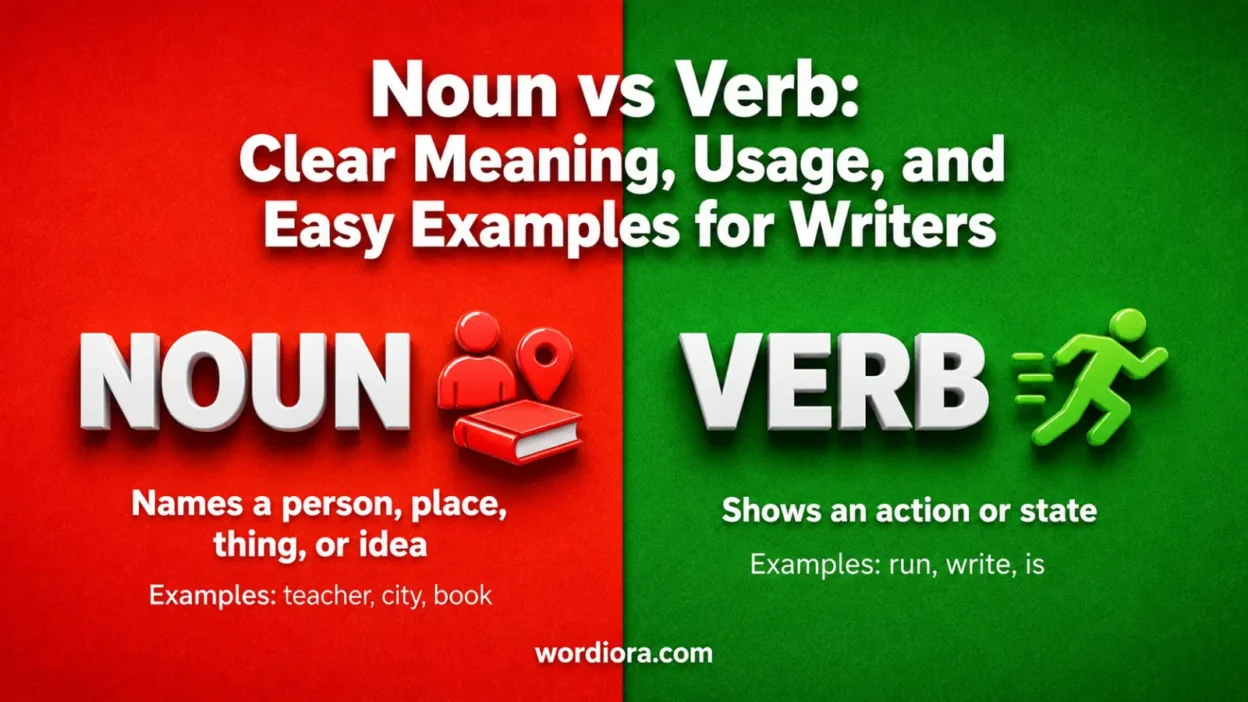
Noun vs verb is a basic grammar comparison, but it still confuses many writers. The short answer is this: a noun names someone or something, while a verb tells what happens, what someone does, or what state something is in.
The tricky part is that some words can be both. For example, play can be a noun in “We saw a play” and a verb in “The kids play outside.” The spelling did not change. The job in the sentence changed.
Quick Answer
Use noun when the word names a person, place, thing, idea, quality, event, or action.
Use verb when the word shows an action, occurrence, or state of being.
In simple terms:
- Noun: names who or what
- Verb: tells what happens or what is true about the subject
Example:
“The dog barked.”
Here, dog is a noun because it names the animal. Barked is a verb because it tells what the dog did.
Why People Confuse Them
People confuse nouns and verbs because English lets many words do more than one job.
Look at this pair:
“She sent a text.”
“She will text me later.”
In the first sentence, text is a noun. It names the message. In the second sentence, text is a verb. It shows the action of sending a message.
This is why memorizing one word list is not enough. You have to look at the sentence. Ask what the word is doing.
Key Differences At A Glance
Here is the clearest way to compare them:
- Noun: names a person, place, thing, idea, quality, event, or action.
- Verb: expresses an action, occurrence, or state.
- Noun clue: often works with words like a, an, the, my, this, or two.
- Verb clue: often changes for tense, as in walk, walked, or will walk.
- Main sentence role: a noun can be the subject or object; a verb is usually the core of the predicate.
Meaning and Usage Difference
A noun gives the sentence something to talk about. It may name a person, such as teacher; a place, such as school; a thing, such as phone; or an idea, such as freedom.
A verb gives the sentence movement, time, or state. It may show a clear action, such as run. It may show an event, such as happen. It may also show a state, such as is, seems, or exists.
Do not rely only on the idea that verbs are “action words.” That helps at first, but it is not complete. In “Maya is tired,” is is a verb even though it does not show a physical action.
Tone, Context, and Formality
The words noun and verb are standard grammar terms. They are neutral in tone and work in school, editing, writing, and everyday grammar talk.
The difference is not about formal versus informal English. It is about sentence function.
For example:
“Please email the file.”
“I received your email.”
Both sentences are normal in modern US English. In the first sentence, email is a verb. In the second, email is a noun.
Context decides the role.
Which One Should You Use?
Use the term noun when you are talking about a naming word. Use verb when you are talking about a doing, happening, or being word.
| Context | Best Choice | Why |
|---|---|---|
| Naming a person | Noun | It identifies who the sentence is about. |
| Naming a place | Noun | It labels a location. |
| Naming a thing | Noun | It identifies an object or item. |
| Naming an idea | Noun | It labels something you can think about. |
| Showing an action | Verb | It tells what someone or something does. |
| Showing a state | Verb | It tells what the subject is, has, feels, or seems. |
| Checking a sentence | Both | A complete sentence usually needs a subject and a verb. |
A fast test helps: ask, “Is this word naming something, or is it telling what happens?”
When One Choice Sounds Wrong
A noun sounds wrong when the sentence needs an action.
Wrong: “She decision quickly.”
Right: “She decided quickly.”
Here, decision is a noun, but the sentence needs a verb.
A verb sounds wrong when the sentence needs a name for a thing, idea, or action.
Wrong: “Her decide surprised us.”
Right: “Her decision surprised us.”
Here, decide is a verb, but the sentence needs the noun decision.
Sometimes both forms are possible, but the sentence structure changes:
“Let’s plan the event.”
“The plan looks solid.”
In the first sentence, plan is a verb. In the second, plan is a noun.
Common Mistakes (and Quick Fixes)
One common mistake is choosing a noun when a sentence needs a verb.
Wrong: “They approval the request.”
Right: “They approved the request.”
Another common mistake is choosing a verb when a noun is needed.
Wrong: “The approve came late.”
Right: “The approval came late.”
A third mistake is thinking every action word must be a verb. Words like swimming, reading, and running can name activities, so they can work like nouns in some sentences.
Example:
“Running helps me clear my head.”
Here, running names the activity. It acts like a noun.
Everyday Examples
Here are simple examples that show the difference clearly:
“Jordan called his mom.”
Jordan and mom are nouns. Called is a verb.
“The meeting starts at nine.”
Meeting is a noun. Starts is a verb.
“I need a drink.”
Drink is a noun because it names something.
“I drink coffee every morning.”
Drink is a verb because it shows an action.
“She gave a clear answer.”
Answer is a noun.
“Please answer the question.”
Answer is a verb.
These examples show why the sentence matters more than the spelling.
Dictionary-Style Word Details
Verb
Noun: Not commonly used as a verb in standard US English when referring to the grammar term. Say “use as a noun” or “make into a noun” instead.
Verb: Usually used as a noun when naming the part of speech. In casual grammar talk, people may say “verb a word” to mean “use a word as a verb,” but that is not the main grammar use.
Noun
Noun: A word that names a person, place, thing, idea, quality, event, or action. Examples include nurse, Chicago, laptop, honesty, and celebration.
Verb: A word that expresses an action, occurrence, or state. Examples include write, fall, happen, seem, and be.
Synonyms
Noun: Closest plain alternatives include naming word and name word. These are helpful for beginners, but noun is the correct grammar term.
Verb: Closest plain alternatives include action word and doing word. These are helpful, but they are not complete because verbs can also show states and events.
Clear antonyms do not really fit here. Noun and verb are different parts of speech, not true opposites.
Example Sentences
Noun: “A noun can name a person, place, thing, or idea.”
Noun: “In the sentence ‘The phone rang,’ phone is a noun.”
Verb: “A verb tells what happens or what the subject does.”
Verb: “In the sentence ‘The phone rang,’ rang is a verb.”
Word History
Noun: The history of the word is not needed to choose it correctly in a sentence. In modern grammar, it is the standard name for a word that names something.
Verb: The history of the word is not needed to choose it correctly in a sentence. In modern grammar, it is the standard name for a word that shows action, occurrence, or state.
Phrases Containing
Noun: Common grammar phrases include proper noun, common noun, compound noun, count noun, noncount noun, and noun phrase.
Verb: Common grammar phrases include action verb, linking verb, helping verb, main verb, phrasal verb, transitive verb, and intransitive verb.
FAQs
Is “noun” or “verb” the correct choice?
Both are correct, but they mean different things. Use noun for a word that names a person, place, thing, idea, quality, event, or action. Use verb for a word that shows action, occurrence, or state.
What is the easiest way to tell a noun from a verb?
Ask what the word is doing in the sentence. If it names something, it is acting as a noun. If it tells what happens or what the subject does or is, it is acting as a verb.
Can the same word be both a noun and a verb?
Yes. Many English words can work as both. In “I sent a text,” text is a noun. In “I will text you,” text is a verb.
Is a verb always an action word?
No. Many verbs show action, but not all of them do. Verbs can also show a state or condition, as in “She is ready” or “He seems tired.”
Is a noun always a person, place, or thing?
No. That beginner rule is helpful, but nouns can also name ideas, qualities, events, and actions. Words like freedom, honesty, meeting, and running can all be nouns.
How do nouns and verbs work together in a sentence?
A noun often acts as the subject, and the verb tells what the subject does or what is true about it. In “The dog barked,” dog is the noun and barked is the verb.
Why do some noun and verb forms look different?
Some words change form depending on their role. For example, decision is a noun, while decide is a verb. The sentence tells you which form you need.
Why do some noun and verb forms look the same?
English often uses the same spelling for different parts of speech. Words like plan, email, text, call, and answer can be nouns or verbs depending on the sentence.
What is a common noun vs verb mistake?
A common mistake is using a noun when the sentence needs a verb. For example, “They approval the request” is wrong. The correct sentence is “They approved the request.”
What should I remember about noun vs verb?
Remember this simple rule: a noun names, and a verb tells what happens. Then check the sentence to see how the word is being used.
Conclusion
The difference between noun and verb is about function. A noun names someone or something. A verb tells what happens, what someone does, or what state something is in.
When you are unsure, do not judge by spelling alone. Look at the sentence. If the word names a person, place, thing, idea, quality, event, or action, it is working as a noun. If it shows action, occurrence, or state, it is working as a verb.
That simple sentence check will solve most noun vs verb confusion.