The correct choice depends on what the clause does in the sentence.
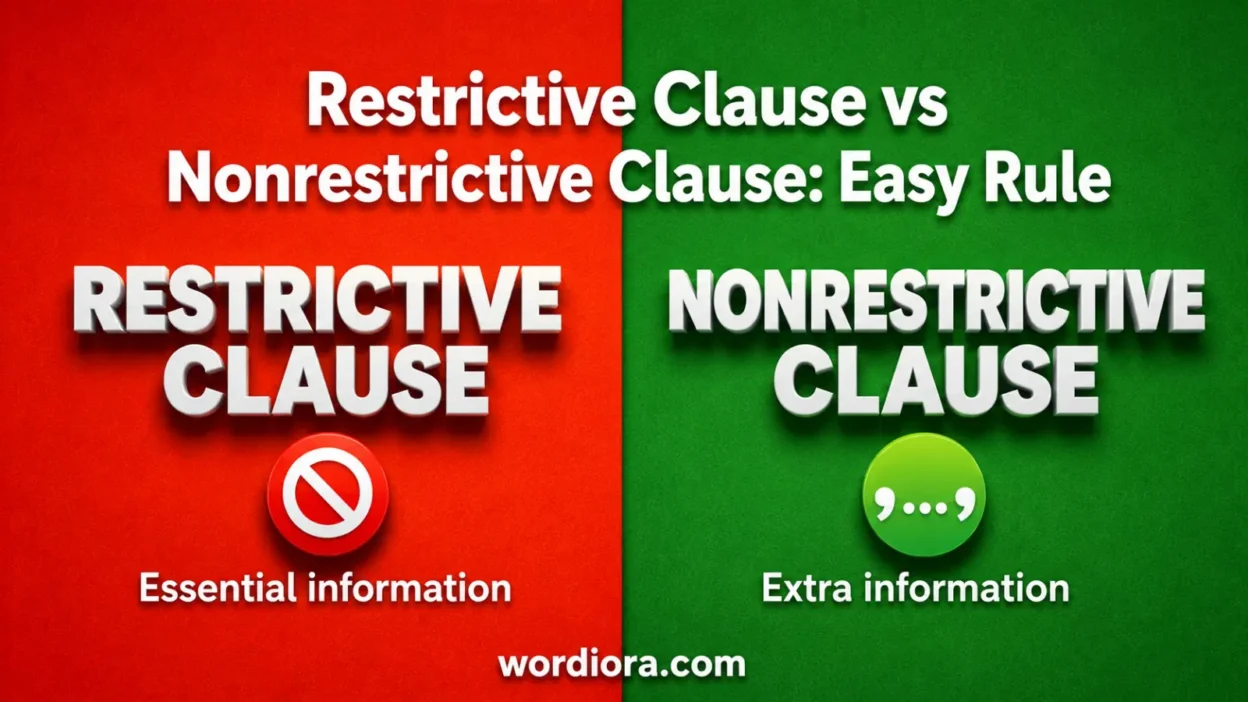
A restrictive clause is needed to identify the noun or limit its meaning. A nonrestrictive clause adds extra information about a noun that is already clear.
The main test is simple: if removing the clause changes who or what you mean, it is restrictive. If removing it only removes extra detail, it is nonrestrictive.
Quick Answer
Use a restrictive clause when the information is essential.
Example:
The employees who work remotely will join by video.
This means only the remote employees will join by video.
Use a nonrestrictive clause when the information is extra.
Example:
The employees, who work remotely, will join by video.
This suggests all the employees work remotely, and they will join by video.
The comma is not decoration. It changes the meaning.
Why People Confuse Them
People confuse these terms because both clauses often begin with words like who, which, whose, or that.
They also look similar. The real difference is not the length of the clause. It is whether the clause is needed to identify the noun.
Commas cause most of the trouble. A restrictive clause normally does not use commas. A nonrestrictive clause normally does.
Another common issue is that and which. In polished US writing, that is often used for restrictive clauses, and which is often used for nonrestrictive clauses. Still, the deeper issue is meaning: essential or extra?
Key Differences At A Glance
| Feature | restrictive clause | nonrestrictive clause |
|---|---|---|
| Main job | Identifies or limits a noun | Adds extra detail |
| Needed for meaning? | Yes | No |
| Commas? | Usually no commas | Usually set off with commas |
| Common starters | that, who, which, whose | who, which, whose |
| Meaning if removed | Changes or weakens the sentence | Main meaning stays clear |
Meaning and Usage Difference
A restrictive clause narrows the noun. It tells the reader exactly which person, place, thing, or idea you mean.
Example:
The laptop that has the cracked screen needs repair.
Without the clause, “the laptop” may be too vague. The clause identifies the specific laptop.
A nonrestrictive clause adds detail about a noun that is already identified.
Example:
Maya’s laptop, which has a cracked screen, needs repair.
The reader already knows which laptop: Maya’s laptop. The clause gives extra information.
Both terms are noun phrases used in grammar. They name types of clauses. They are not verbs, adjectives, or casual style choices.
Tone, Context, and Formality
This comparison is mostly about grammar and meaning, not tone.
A restrictive clause does not sound more casual. A nonrestrictive clause does not sound more formal. The better choice depends on what the sentence needs to say.
In emails, school papers, reports, resumes, and business writing, the same basic distinction applies. Use restrictive wording when you need to narrow the noun. Use nonrestrictive wording when the noun is already clear and the clause only adds detail.
Nonrestrictive clauses can feel a little more polished because they often add side information smoothly. But that is a sentence-style effect, not a separate meaning of the term.
Which One Should You Use?
| Context | Best Choice | Why |
|---|---|---|
| You need to say which person or thing you mean | restrictive clause | It identifies the noun |
| The noun is already clear | nonrestrictive clause | It adds extra detail |
| Removing the clause changes the meaning | restrictive clause | The clause is essential |
| Removing the clause leaves the main point clear | nonrestrictive clause | The clause is extra |
| You are using commas around the clause | nonrestrictive clause | Commas mark added information |
| You are using no commas before the clause | restrictive clause | No commas usually signal needed information |
When One Choice Sounds Wrong
The wrong choice can change the message.
Wrong for the likely meaning:
My sister who lives in Denver is visiting.
This says you may have more than one sister, and the Denver sister is visiting.
Better if you have one sister:
My sister, who lives in Denver, is visiting.
Now “who lives in Denver” is extra information.
Wrong for the likely meaning:
The students, who submitted the form, got a confirmation email.
This suggests all students submitted the form.
Better if only some students did:
The students who submitted the form got a confirmation email.
Now the clause identifies which students got the email.
Common Mistakes (and Quick Fixes)
Mistake 1: Adding commas to an essential clause.
Incorrect: The car, that is parked outside, is mine.
Correct: The car that is parked outside is mine.
Mistake 2: Leaving out commas around extra information.
Incorrect: Our office which opened last year is expanding.
Correct: Our office, which opened last year, is expanding.
Mistake 3: Thinking every clause with which must be nonrestrictive.
Better thinking: Ask whether the clause is essential. In many US style settings, that is the cleaner choice for a restrictive clause.
Mistake 4: Using the comma test without checking meaning.
A comma often signals a nonrestrictive clause, but the writer’s intended meaning still matters.
Everyday Examples
Restrictive:
The sneakers that I bought for running are already worn out.
Meaning: not all my sneakers, only the running pair.
Nonrestrictive:
My new sneakers, which I bought for running, are already worn out.
Meaning: the sneakers are already identified as my new sneakers.
Restrictive:
The coworker who handles payroll is out today.
Meaning: this identifies the coworker.
Nonrestrictive:
Jordan, who handles payroll, is out today.
Meaning: Jordan is already identified; the job detail is extra.
Restrictive:
The apartment that faces the park costs more.
Meaning: only the park-facing apartment costs more.
Nonrestrictive:
Apartment 4B, which faces the park, costs more.
Meaning: Apartment 4B is already specific.
Dictionary-Style Word Details
Verb
• restrictive clause: Not used as a verb in standard US English. It is a grammar term used as a noun phrase.
• nonrestrictive clause: Not used as a verb in standard US English. It is also a grammar term used as a noun phrase.
Noun
• restrictive clause: A noun phrase meaning a clause that is needed to identify or limit the noun it modifies.
Example: In “The phone that keeps freezing needs service,” “that keeps freezing” is a restrictive clause.
• nonrestrictive clause: A noun phrase meaning a clause that adds extra information about a noun already identified.
Example: In “My phone, which keeps freezing, needs service,” “which keeps freezing” is a nonrestrictive clause.
Synonyms
• restrictive clause: Closest plain alternatives include essential clause, defining clause, and identifying clause.
• nonrestrictive clause: Closest plain alternatives include nonessential clause, nondefining clause, and parenthetical clause.
Clear opposites:
• restrictive clause ↔ nonrestrictive clause
• essential clause ↔ nonessential clause
• defining clause ↔ nondefining clause
Example Sentences
• restrictive clause: The package that arrived this morning is for you.
• restrictive clause: Students who miss the deadline must contact the office.
• restrictive clause: The route that avoids downtown is faster today.
• nonrestrictive clause: The package, which arrived this morning, is for you.
• nonrestrictive clause: Ava, who missed the deadline, contacted the office.
• nonrestrictive clause: Route 18, which avoids downtown, is faster today.
Word History
• restrictive clause: The term comes from grammar use of restrictive, meaning that the clause restricts or narrows what the noun refers to.
• nonrestrictive clause: The term is built from nonrestrictive, meaning the clause does not restrict or narrow the noun in the same essential way.
The broad formation is clear from the parts of the words. Precise origin details vary by reference, so it is safest not to overstate a single history claim.
Phrases Containing
• restrictive clause: restrictive relative clause; restrictive adjective clause; restrictive element; restrictive modifier.
• nonrestrictive clause: nonrestrictive relative clause; nonrestrictive adjective clause; nonrestrictive element; nonrestrictive modifier.
FAQs
What is the main difference between a restrictive clause and a nonrestrictive clause?
A restrictive clause is essential because it identifies or limits the noun. A nonrestrictive clause adds extra information about a noun that is already clear.
Do restrictive clauses need commas?
No. A restrictive clause usually does not use commas because the information is needed for the sentence to make sense.
Example:
The book that has the blue cover is mine.
Do nonrestrictive clauses need commas?
Yes. A nonrestrictive clause is usually set off with commas because the information is extra.
Example:
My biology book, which has a blue cover, is mine.
How can I tell if a clause is restrictive?
Remove the clause from the sentence. If the meaning becomes unclear or changes, the clause is restrictive.
Example:
The students who finished the test early may leave.
Without the clause, we do not know which students may leave.
How can I tell if a clause is nonrestrictive?
Remove the clause from the sentence. If the main meaning still stays clear, the clause is nonrestrictive.
Example:
My brother, who lives in Austin, is visiting this weekend.
The main point is still clear: my brother is visiting.
Is “that” used with restrictive clauses?
Yes. In polished US writing, that is commonly used to introduce restrictive clauses.
Example:
The phone that keeps freezing needs to be replaced.
Is “which” used with nonrestrictive clauses?
Yes. Which is commonly used with nonrestrictive clauses and is usually set off with commas.
Example:
My phone, which keeps freezing, needs to be replaced.
Can “who” be used in both restrictive and nonrestrictive clauses?
Yes. Who can be used in both types when referring to people.
Restrictive:
The employee who handles billing is out today.
Nonrestrictive:
Maria, who handles billing, is out today.
Why do commas matter so much?
Commas show whether the clause is essential or extra. A missing or added comma can change the meaning of the sentence.
Example:
My cousins who live in Chicago are visiting.
This means only the Chicago cousins are visiting.
My cousins, who live in Chicago, are visiting.
This suggests all my cousins live in Chicago.
Which one should I use in formal writing?
Use the one that matches your meaning. A restrictive clause is correct when the detail is essential. A nonrestrictive clause is correct when the detail is extra. Both are acceptable in formal writing when used correctly.
Conclusion
The difference between a restrictive clause and a nonrestrictive clause comes down to meaning.
Use a restrictive clause when the clause is needed to identify the noun. Do not set it off with commas.
Use a nonrestrictive clause when the clause only adds extra information. Set it off with commas.
When in doubt, remove the clause and read the sentence again. If the main meaning changes, the clause is restrictive. If the main meaning stays clear, it is nonrestrictive.