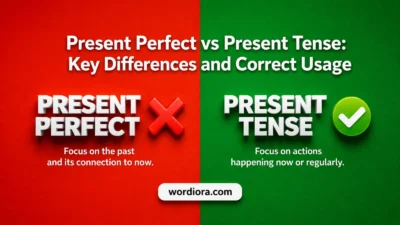

The comparison between simple present vs present perfect is one of the most common areas of confusion in English grammar. Both tenses can talk about actions, facts, experiences, and situations that relate to the present. However, they do not mean the same thing, and choosing the wrong one can change the meaning of a sentence.
The simple present focuses on facts, routines, habits, schedules, and situations that are generally true. The present perfect connects a past action or event to the present moment. It often shows experience, change, completion, or a result that matters now.
Consider these examples:
- I work in Chicago.
- I have worked in Chicago.
Both sentences are grammatically correct, but they communicate different ideas. The first describes a current fact. The second highlights work experience connected to the present.
Understanding when to use each tense helps you communicate more clearly in everyday conversations, emails, school assignments, workplace communication, and professional writing.
Quick Answer
If you need a fast answer, use this rule:
- Simple Present = facts, habits, routines, schedules, and general truths.
- Present Perfect = actions or experiences that happened in the past but still matter now.
Examples:
Simple Present
- She drives to work every day.
- The store opens at 9 a.m.
- Water boils at 212°F.
Present Perfect
- She has driven across the country three times.
- The store has opened a new location.
- Scientists have discovered a new species.
A helpful shortcut is this:
If the sentence answers the question “What is generally true?”, the simple present is usually the best choice.
If the sentence answers the question “What has happened up to now?”, the present perfect is usually the better choice.
Why People Confuse Them
People often confuse these tenses because both can relate to the present.
For example:
- I live in Dallas.
- I have lived in Dallas for ten years.
Both sentences describe a current situation. The difference is that the first simply states a fact. The second emphasizes duration from the past until now.
Another reason for confusion is that present perfect contains a past participle, which makes some learners think it is a past tense. It is not. The present perfect always has a connection to the present.
Compare:
- I finished the project yesterday.
- I have finished the project.
The first sentence focuses on a completed action in the past. The second focuses on the current result: the project is now complete.
Many writers also struggle because both tenses may appear in discussions about work experience, relationships, travel, and personal history.
For example:
- I work for a software company.
- I have worked for this company since 2021.
The first describes a present fact.
The second describes an action that began in the past and continues today.
The overlap in context makes the distinction seem difficult, but once you focus on the purpose of each tense, the choice becomes much clearer.
Key Differences At A Glance
| Context | Best Choice | Why |
|---|---|---|
| Daily habits | Simple Present | Describes routines and repeated actions |
| General truths | Simple Present | States facts that are generally true |
| Scheduled events | Simple Present | Shows fixed schedules and timetables |
| Life experiences | Present Perfect | Connects past experiences to now |
| Recent achievements | Present Perfect | Emphasizes current relevance |
| Ongoing situations | Present Perfect | Shows something started in the past and continues now |
| Completed actions with present results | Present Perfect | Focuses on the outcome today |
| Instructions and rules | Simple Present | States permanent or regular information |
Quick Comparison
| Feature | Simple Present | Present Perfect |
|---|---|---|
| Time focus | Present and general time | Past connected to present |
| Common use | Habits, facts, routines | Experiences, results, duration |
| Signal words | always, usually, often, every day | already, yet, ever, never, since, for |
| Main question answered | What is generally true? | What has happened up to now? |
| Structure | Base verb | have/has + past participle |
Meaning and Usage Difference
The biggest difference between simple present and present perfect is how they treat time.
Simple Present Meaning
The simple present describes things that are generally true or regularly happen.
Common uses include:
- Habits
- Routines
- Facts
- Instructions
- Schedules
- Permanent situations
Examples:
- I drink coffee every morning.
- My brother lives in Texas.
- The train leaves at 6 p.m.
- Dogs need exercise.
- She teaches math.
These statements are not focused on a specific moment in the past. They describe regular or ongoing realities.
Present Perfect Meaning
The present perfect connects a past action with the present.
Structure:
- Have + past participle
- Has + past participle
Examples:
- I have visited New York five times.
- She has completed the report.
- They have lived here for years.
- We have never seen that movie.
- He has already left.
The action occurred in the past, but the result, experience, or duration matters now.
Experience
One of the most common uses of present perfect is describing experiences.
Examples:
- I have traveled to California.
- She has eaten sushi before.
- They have visited several national parks.
The exact time is not important.
Duration
Present perfect often describes something that started in the past and continues into the present.
Examples:
- I have worked here for six years.
- She has studied English since middle school.
- We have known each other for a long time.
Results
Present perfect can emphasize a result that exists now.
Examples:
- I have lost my keys.
- He has broken his phone.
- They have finished the project.
The focus is the current situation.
Important Time Difference
Simple present does not usually focus on past events.
Present perfect does.
Compare:
- I play tennis.
- I have played tennis since childhood.
The first describes a habit.
The second describes an activity that began in the past and continues today.
Tone, Context, and Formality
Both tenses are common in everyday American English and neither is inherently more formal than the other.
However, they create different impressions.
Simple Present Tone
Simple present often sounds direct, factual, and straightforward.
Examples:
- I manage a sales team.
- She lives downtown.
- We meet every Friday.
These sentences simply state information.
Present Perfect Tone
Present perfect often sounds more connected to experience, progress, or achievement.
Examples:
- I have managed teams for ten years.
- She has lived downtown since 2020.
- We have met several times before.
These sentences provide background and context.
Workplace Communication
Simple Present:
- I supervise the marketing department.
- I handle client accounts.
Present Perfect:
- I have supervised teams across multiple offices.
- I have handled hundreds of client projects.
The present perfect often highlights accomplishments or accumulated experience.
Academic Writing
Simple present frequently appears when discussing established facts.
Examples:
- The study shows a clear pattern.
- The article explains the findings.
Present perfect often appears when discussing developments up to the present.
Examples:
- Researchers have identified new trends.
- Scientists have discovered additional evidence.
Conversation
In casual conversation, both tenses appear constantly.
Simple Present:
- I work from home.
- I exercise every morning.
Present Perfect:
- I have worked remotely for years.
- I have already exercised today.
The difference is not formality. It is meaning.
Which One Should You Use?
Choosing between these tenses becomes easier when you ask a few simple questions.
Use Simple Present When:
The statement is generally true.
Examples:
- The Earth revolves around the sun.
- My office closes at five.
The action is a routine.
Examples:
- I walk my dog every morning.
- She checks her email before breakfast.
The sentence describes a schedule.
Examples:
- The flight departs at noon.
- School starts next week.
The statement expresses a fact.
Examples:
- He lives in Seattle.
- They own a restaurant.
Use Present Perfect When:
You are talking about experience.
Examples:
- I have visited Boston.
- She has traveled abroad.
You are describing a result that matters now.
Examples:
- I have completed the application.
- They have fixed the problem.
You are showing duration.
Examples:
- We have lived here for years.
- He has worked here since 2022.
You are discussing recent developments.
Examples:
- The company has announced new policies.
- Scientists have made progress.
Simple Decision Rule
Ask yourself:
“Am I describing a general fact or routine?”
If yes, use simple present.
“Am I connecting a past action to the present?”
If yes, use present perfect.
When One Choice Sounds Wrong
Sometimes both tenses are grammatically possible but create different meanings.
Other times, one tense simply sounds wrong.
Incorrect
- I have go to work every day.
Correct:
- I go to work every day.
The sentence describes a routine, so simple present is required.
Incorrect
- I live here since 2018.
Correct:
- I have lived here since 2018.
The action began in the past and continues now.
Incorrect
- She has usually drives to work.
Correct:
- She usually drives to work.
Habits generally use simple present.
Incorrect
- I have known him yesterday.
Correct:
- I met him yesterday.
Or:
- I have known him for years.
Present perfect does not normally work with finished past time expressions such as “yesterday.”
Incorrect
- We have finished the project last week.
Correct:
- We finished the project last week.
Or:
- We have finished the project.
Present perfect usually does not pair with specific completed past times.
Why This Happens
The most common problem occurs when writers mix a completed past time reference with present perfect.
Examples of completed past times:
- yesterday
- last year
- last week
- in 2024
- two days ago
These typically require a past tense, not present perfect.
Common Mistakes and Quick Fixes
Mistake 1: Using Present Perfect for Habits
Incorrect:
- I have watched the news every morning.
Better:
- I watch the news every morning.
Quick Fix
For repeated routines, choose simple present.
Mistake 2: Using Simple Present for Ongoing Duration
Incorrect:
- I live here for ten years.
Correct:
- I have lived here for ten years.
Quick Fix
Use present perfect when something started in the past and continues today.
Mistake 3: Forgetting Have or Has
Incorrect:
- She finished the report already.
Possible in conversation, but if using present perfect:
- She has finished the report already.
Quick Fix
Remember the structure:
have/has + past participle
Mistake 4: Mixing Time References
Incorrect:
- I have visited Chicago last summer.
Correct:
- I visited Chicago last summer.
Quick Fix
Specific finished times generally require past tense.
Mistake 5: Using Present Perfect for Universal Facts
Incorrect:
- Water has boiled at 212°F.
Correct:
- Water boils at 212°F.
Quick Fix
Facts and scientific truths use simple present.
Mistake 6: Confusing Experience with Routine
Incorrect:
- I have driven to work every day.
Better:
- I drive to work every day.
Quick Fix
Daily patterns usually belong in simple present.
Everyday Examples
The best way to understand simple present and present perfect is to see them in realistic situations.
At Work
Simple Present:
- I manage customer accounts.
- Our team meets every Monday.
- The office opens at 8 a.m.
Present Perfect:
- I have managed large projects.
- Our team has completed the launch.
- The company has expanded nationwide.
At School
Simple Present:
- She studies biology.
- The class starts at nine.
- Students submit assignments online.
Present Perfect:
- She has improved her grades.
- The class has completed the unit.
- Students have finished the project.
Family Life
Simple Present:
- We eat dinner together.
- My parents live nearby.
- My brother drives a truck.
Present Perfect:
- We have lived here for years.
- My parents have visited often.
- My brother has changed jobs twice.
Travel
Simple Present:
- I travel for work.
- She flies frequently.
- They stay at hotels.
Present Perfect:
- I have traveled across the country.
- She has flown internationally.
- They have stayed in many hotels.
Health and Fitness
Simple Present:
- I exercise every morning.
- He runs three miles daily.
- They eat healthy meals.
Present Perfect:
- I have lost ten pounds.
- He has improved his endurance.
- They have changed their diet.
Technology
Simple Present:
- I use a laptop for work.
- She checks social media daily.
- We stream movies online.
Present Perfect:
- I have upgraded my laptop.
- She has deleted the app.
- We have switched providers.
Shopping
Simple Present:
- I shop online regularly.
- She buys groceries every Friday.
- They compare prices.
Present Perfect:
- I have ordered a new phone.
- She has purchased a new car.
- They have found a better deal.
Dictionary-Style Word Details
Verb
Simple Present:
A verb form used to express habits, routines, facts, general truths, schedules, and ongoing states.
Examples:
- work
- live
- drive
- study
- teach
Present Perfect:
A verb form created with have/has + past participle. It connects past actions or experiences to the present.
Examples:
- have worked
- has lived
- have driven
- has studied
- have taught
Noun
Simple Present:
Not commonly used as a noun in standard American English. It is primarily a tense name used in grammar discussions.
Example:
- The simple present is often taught early in English classes.
Present Perfect:
Not commonly used as a noun outside grammar discussions. It is primarily the name of a verb tense.
Example:
- The present perfect can express experience and duration.
Synonyms
Because these are grammar terms rather than ordinary vocabulary words, exact synonyms do not truly exist.
Simple Present — Closest Plain Alternatives
- Present tense (in limited contexts)
- Habit tense (informal description)
- General present (informal description)
Present Perfect — Closest Plain Alternatives
- Perfect present (rare wording)
- Have/has form (informal description)
- Present-result tense (informal explanation)
There are no true antonyms that perfectly oppose either term because they are grammatical categories rather than ordinary words.
Example Sentences
Simple Present
- I work downtown.
- She exercises every morning.
- They watch baseball on weekends.
- The store closes at nine.
- He enjoys cooking.
Present Perfect
- I have worked downtown before.
- She has exercised already today.
- They have watched that series twice.
- The store has opened a new location.
- He has enjoyed the experience.
Word History
Simple Present:
The term comes from traditional grammar terminology used to describe the basic present-tense form of a verb. It has long been used in English grammar instruction.
Present Perfect:
The term comes from grammatical traditions that use the word “perfect” to describe actions viewed as completed or connected to a resulting state. In modern English grammar, it refers to the have/has + past participle construction.
Specific historical details vary across grammar traditions, so broad claims about exact origins are best avoided.
Phrases Containing
Simple Present
- simple present tense
- simple present form
- simple present verb
- simple present sentence
- simple present structure
Present Perfect
- present perfect tense
- present perfect form
- present perfect verb
- present perfect sentence
- present perfect structure
FAQs
Is simple present the same as present perfect?
No. Simple present describes facts, habits, routines, and general truths. Present perfect connects past actions or experiences to the present.
Which tense is more common in everyday conversation?
Both are extremely common. Simple present appears often when discussing routines and facts, while present perfect appears frequently when discussing experiences, results, and ongoing situations.
Can I use present perfect with “yesterday”?
Generally no. “Yesterday” refers to a completed past time, which usually requires a past tense form instead.
Why do I say “I have lived here for ten years” instead of “I live here for ten years”?
Because the action started in the past and continues into the present. Present perfect is the standard choice for that meaning.
Can present perfect describe experience?
Yes. This is one of its most common uses.
Examples:
- I have visited New York.
- She has tried sushi.
- They have traveled abroad.
Can simple present describe the future?
Sometimes. It is often used for schedules and timetables.
Examples:
- The train leaves at 7 p.m.
- School starts Monday.
What words commonly appear with present perfect?
Common words include:
- already
- yet
- ever
- never
- since
- for
- recently
What words commonly appear with simple present?
Common words include:
- always
- usually
- often
- sometimes
- every day
- every week
- regularly
Which tense should I use on a résumé or professional profile?
Use simple present for your current responsibilities and present perfect when emphasizing accomplishments or accumulated experience.
Can both tenses appear in the same paragraph?
Absolutely. Native speakers often use both together.
Example:
- I work in finance. I have worked in the industry for more than ten years.
Conclusion
The difference between simple present vs present perfect comes down to purpose and time connection.
Use simple present when talking about facts, routines, habits, schedules, and general truths. It explains what is generally true or regularly happens.
Use present perfect when talking about experiences, achievements, ongoing situations, or past actions that still matter now. It creates a bridge between the past and the present.
A practical way to remember the difference is this:
- Simple Present: What is true now or usually?
- Present Perfect: What has happened up to now?
Once you focus on that distinction, choosing between the two becomes much easier, and your English will sound clearer, more natural, and more accurate in everyday communication.