
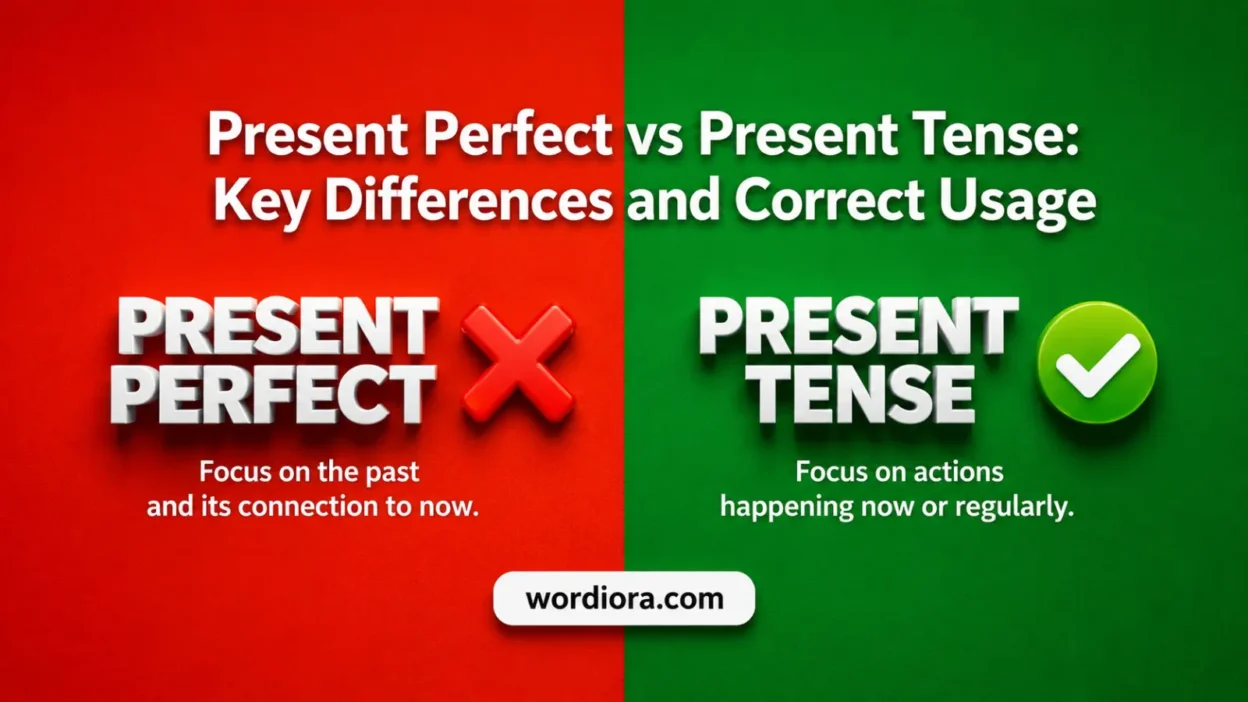
Many English learners and even native speakers occasionally hesitate when choosing between the present perfect and the present tense. Both forms talk about actions, situations, and states connected to the present, which is why they are often confused.
The challenge is that these two grammar forms do not serve the same purpose. One describes what is generally true or happening now, while the other connects a past action or experience to the present moment.
Understanding the difference can make your speaking and writing clearer, more natural, and more accurate. Whether you are writing emails, having conversations, completing school assignments, or preparing for exams, knowing when to use each form matters.
This guide explains the distinction in plain American English with practical examples and easy-to-follow rules.
Quick Answer
The short answer is simple:
- Use present tense when talking about facts, habits, routines, general truths, or actions happening now.
- Use present perfect when talking about a past action that has a connection to the present.
Examples:
Present Tense
- I work in Chicago.
- She drinks coffee every morning.
- They play basketball on weekends.
Present Perfect
- I have worked in Chicago for five years.
- She has finished her coffee.
- They have played basketball together many times.
The key difference is that the present perfect links the past to the present, while the present tense focuses on what is true, regular, or happening now.
Why People Confuse Them
The confusion usually comes from the word present appearing in both names.
Many people assume that if both forms contain the word “present,” they should be used in the same situations. However, they focus on different time relationships.
The present tense often describes:
- Current facts
- Daily habits
- Permanent situations
- Scheduled events
- Actions occurring now
The present perfect often describes:
- Past actions with present results
- Life experiences
- Unfinished periods of time
- Actions continuing into the present
- Recent events affecting the current situation
Consider these examples:
- I live in Dallas.
- I have lived in Dallas for ten years.
The first sentence simply states where the person lives.
The second sentence emphasizes the duration and tells us the person started living there in the past and still lives there now.
Both sentences are correct, but they communicate different ideas.
Another reason for confusion is that many languages use different tense systems. Speakers often try to apply rules from their native language directly to English, which can lead to mistakes.
Key Differences At A Glance
| Context | Best Choice | Why |
| General facts | Present Tense | States something generally true |
| Daily routines | Present Tense | Describes habits and repeated actions |
| Current situations | Present Tense | Focuses on the present state |
| Past action with present result | Present Perfect | Connects the past to now |
| Life experiences | Present Perfect | Shows something happened at an unspecified time |
| Duration from past until now | Present Perfect | Action began earlier and continues today |
| Recent events | Present Perfect | Highlights current relevance |
| Instructions or descriptions | Present Tense | Presents information directly |
Quick Feature Comparison
| Feature | Present Perfect | Present Tense |
| Time focus | Past connected to present | Present time |
| Common structure | Have/has + past participle | Base verb or verb + s |
| Talks about habits | No | Yes |
| Talks about experiences | Yes | Usually no |
| Talks about general truths | No | Yes |
| Emphasizes current results | Yes | Usually no |
Meaning and Usage Difference
The clearest distinction is the relationship to time.
Present Tense
The present tense describes:
- Facts
- Habits
- Routines
- Permanent conditions
- Current actions
Examples:
- The Earth revolves around the sun.
- My brother works downtown.
- I exercise every morning.
- She teaches science.
- We live near the beach.
These statements are true now or regularly true.
Present Perfect
The present perfect describes:
- Actions completed at an unspecified time before now
- Experiences
- Changes over time
- Continuing situations
- Past actions with present consequences
Structure:
have/has + past participle
Examples:
- I have visited New York many times.
- She has finished her homework.
- We have lived here since 2018.
- They have improved their performance.
- He has already eaten lunch.
Notice that the exact time is either unknown, unimportant, or unnecessary.
Present Tense Examples
- She drives to work.
- They study every evening.
- The store opens at 9 a.m.
- Water boils at 212°F.
- My friend enjoys hiking.
Present Perfect Examples
- She has driven across the country.
- They have studied for three hours.
- The store has changed its hours.
- Scientists have discovered new evidence.
- My friend has enjoyed the trip so far.
The Time Connection
Compare:
- I work here.
- I have worked here for five years.
The first sentence simply states employment.
The second sentence highlights a period that began in the past and continues today.
Compare:
- She writes articles.
- She has written dozens of articles.
The first describes a regular activity.
The second focuses on completed accomplishments connected to the present.
Common Signal Words
Present tense often appears with:
- always
- usually
- often
- sometimes
- every day
- every week
- generally
Examples:
- I usually wake up early.
- She often visits her parents.
Present perfect often appears with:
- already
- yet
- ever
- never
- since
- for
- recently
- lately
Examples:
- I have already finished.
- Have you ever visited Seattle?
- We have lived here for years.
These signal words are not strict rules, but they often help identify the correct tense.
Tone, Context, and Formality
Neither form is inherently more formal than the other.
Both appear in:
- Business writing
- Academic writing
- Everyday conversation
- Journalism
- Professional communication
The difference is meaning, not formality.
In Everyday Conversation
Present tense:
- I work from home.
- My son plays baseball.
Present perfect:
- I have worked from home since last year.
- My son has played baseball for six years.
In Business Communication
Present tense:
- The company provides support.
- We offer free shipping.
Present perfect:
- The company has expanded its services.
- We have launched a new program.
In Academic Writing
Present tense:
- The study shows a relationship.
- The report explains the results.
Present perfect:
- Researchers have identified several patterns.
- Scientists have conducted numerous experiments.
Context Matters
Sometimes both forms can be correct, but they emphasize different ideas.
Example:
- I know Sarah.
- I have known Sarah for ten years.
The first focuses on the relationship.
The second focuses on its duration.
Another example:
- They work together.
- They have worked together since college.
Again, both are correct, but the message changes.
Which One Should You Use?
A simple decision process can help.
Ask yourself:
Are you describing a fact, routine, or general truth?
Use present tense.
Examples:
- I drive to work.
- She teaches math.
- The restaurant serves breakfast.
Are you describing something that happened before now but still matters now?
Use present perfect.
Examples:
- I have driven that route many times.
- She has taught math for twenty years.
- The restaurant has improved its menu.
Are you talking about an experience?
Use present perfect.
Examples:
- I have visited California.
- We have seen that movie.
- He has traveled abroad.
Are you talking about a habit?
Use present tense.
Examples:
- I visit California every summer.
- We watch movies on Fridays.
- He travels for work.
Are you emphasizing duration?
Use present perfect.
Examples:
- I have lived here for six years.
- She has worked remotely since 2020.
- They have owned the house for a decade.
When duration stretches from the past into the present, present perfect is usually the best choice.
When One Choice Sounds Wrong
Certain situations strongly favor one tense.
Wrong: I have go to school every day.
Correct:
- I go to school every day.
The sentence describes a routine, so present tense is required.
Wrong: I live here since 2019.
Correct:
- I have lived here since 2019.
The action started in the past and continues now.
Wrong: She has knows the answer.
Correct:
- She knows the answer.
The verb “know” describes a current state.
Wrong: We are friends for ten years.
Correct:
- We have been friends for ten years.
The friendship began in the past and continues today.
Wrong: He has eaten lunch every day at noon.
Correct:
- He eats lunch every day at noon.
This describes a repeated habit.
When Present Tense Sounds Unnatural
Example:
- I work here since January.
Native speakers generally consider this incorrect.
Better:
- I have worked here since January.
When Present Perfect Sounds Unnatural
Example:
- I have play basketball every Saturday.
Better:
- I play basketball every Saturday.
The sentence describes a routine, not an experience or continuing duration.
Common Mistakes and Quick Fixes
Mistake 1: Using Present Tense With “Since”
Incorrect:
- I live here since 2022.
Correct:
- I have lived here since 2022.
Quick Fix:
If “since” shows a starting point that continues today, use present perfect.
Mistake 2: Using Present Perfect For Habits
Incorrect:
- I have watched TV every night.
Correct:
- I watch TV every night.
Quick Fix:
Regular habits usually require present tense.
Mistake 3: Adding Exact Past Times To Present Perfect
Incorrect:
- I have visited Denver last year.
Correct:
- I visited Denver last year.
Quick Fix:
Specific finished times often use past tense instead.
Mistake 4: Forgetting The Past Participle
Incorrect:
- She has write the report.
Correct:
- She has written the report.
Quick Fix:
Present perfect requires:
have/has + past participle
Mistake 5: Ignoring The Present Connection
Incorrect choice:
- I work here for ten years.
Correct:
- I have worked here for ten years.
Quick Fix:
If the action began earlier and still continues, use present perfect.
Mistake 6: Using Present Perfect For Permanent Facts
Incorrect:
- The Earth has revolved around the sun.
Correct:
- The Earth revolves around the sun.
Quick Fix:
Scientific facts and general truths normally use present tense.
Everyday Examples
Below are practical examples showing how the two forms differ.
At Work
Present Tense:
- I manage the sales team.
- We hold meetings every Monday.
Present Perfect:
- I have managed the sales team for three years.
- We have held more meetings this month.
At School
Present Tense:
- She studies biology.
- The professor teaches chemistry.
Present Perfect:
- She has studied biology for four years.
- The professor has taught chemistry since 2015.
At Home
Present Tense:
- We cook dinner together.
- My dad watches the news.
Present Perfect:
- We have cooked dinner together many times.
- My dad has watched that program for years.
Travel
Present Tense:
- I travel often.
- They visit Florida every winter.
Present Perfect:
- I have traveled across the country.
- They have visited Florida many times.
Technology
Present Tense:
- I use a laptop for work.
- She checks her email every morning.
Present Perfect:
- I have used this laptop for five years.
- She has already checked her email.
Health And Fitness
Present Tense:
- I run every morning.
- He exercises regularly.
Present Perfect:
- I have run three races this year.
- He has exercised consistently for months.
Shopping
Present Tense:
- I shop online frequently.
- She buys groceries on Saturdays.
Present Perfect:
- I have purchased several items today.
- She has bought a new jacket.
Family
Present Tense:
- We visit our grandparents often.
- My sister lives in Arizona.
Present Perfect:
- We have visited our grandparents many times this year.
- My sister has lived in Arizona since college.
These examples show that the difference is not about correctness versus incorrectness. It is about choosing the tense that best matches the meaning you want to express.
Dictionary-Style Word Details
Verb
Present Perfect:
A verb construction formed with have or has plus a past participle. It expresses a past action, experience, or condition connected to the present.
Examples:
- have finished
- has worked
- have lived
Present Tense:
A verb form used for current facts, habits, states, routines, and general truths.
Examples:
- work
- works
- live
- lives
Noun
Present Perfect:
A grammatical tense name used in English grammar.
Example:
- The teacher explained the present perfect.
Present Tense:
A grammatical tense category referring to present-time situations.
Example:
- The lesson focused on the present tense.
Synonyms
These are grammar terms rather than ordinary vocabulary words, so exact synonyms do not truly exist.
Present Perfect:
Closest plain alternatives:
- present perfect tense
- perfect aspect connected to the present
Present Tense:
Closest plain alternatives:
- simple present (in many common discussions)
- present-time verb form
There are no true antonyms that directly oppose either term in every grammatical context.
Example Sentences
Present Perfect
- I have completed the training.
- She has visited Boston several times.
- We have known each other for years.
- They have improved their results.
- He has already submitted the application.
Present Tense
- I complete my assignments on time.
- She visits Boston every summer.
- We know each other well.
- They improve with practice.
- He submits reports every Friday.
Word History
Present Perfect:
The term comes from traditional grammar descriptions used to identify a verb form that combines present relevance with a completed or continuing action.
Present Tense:
The term comes from longstanding grammatical classifications used to describe actions, states, and facts expressed in present time.
Neither label is a recently created grammar term, and both have been used in English grammar instruction for a long time.
Phrases Containing
Present Perfect
- present perfect tense
- present perfect construction
- present perfect form
- present perfect verb phrase
Present Tense
- simple present tense
- present tense verb
- present tense sentence
- present tense narration
FAQS
Is present perfect a type of present tense?
It is usually treated as a separate tense or tense-aspect form in English grammar. Although it contains the word “present,” it connects past actions to the present rather than describing only what is happening now.
Can I use present perfect for daily habits?
Usually no.
For habits and routines, present tense is generally the better choice.
- I go to the gym every day.
Not:
- I have gone to the gym every day.
unless a special context is intended.
Why do we use “have” and “has” in present perfect?
They help create the structure:
- have/has + past participle
Examples:
- have finished
- has completed
- have traveled
This structure signals the present perfect form.
Which tense is more common in conversation?
Both are extremely common. Present tense appears constantly because people talk about routines, facts, and current situations. Present perfect is also common when discussing experiences, recent events, and ongoing situations.
Can both forms be correct in the same situation?
Sometimes yes.
Example:
- I work here.
- I have worked here for five years.
Both are grammatically correct, but each emphasizes a different idea.
Do native speakers confuse these forms?
Native speakers usually use them naturally, but learners often struggle because the distinction does not always exist in the same way in other languages.
What is the easiest rule to remember?
Use present tense for what is generally true now.
Use present perfect for something that started before now or happened before now but still matters today.
Does present perfect always refer to the past?
It refers to the past, but only when that past action has a meaningful connection to the present.
That present connection is what makes the form unique
Conclusion
The difference between present perfect and present tense comes down to time and connection.
The present tense focuses on facts, routines, habits, states, and situations that are true now. It answers questions about what someone does, what exists, or what regularly happens.
The present perfect connects the past with the present. It is used for experiences, recent events, ongoing situations, and actions that began earlier but still affect the current moment.
A helpful way to remember the distinction is this:
- Present tense = now, usually, regularly, generally true
- Present perfect = before now, but still relevant now
Once you focus on that connection to the present, choosing between the two forms becomes much easier. Instead of memorizing long grammar rules, think about the message you want to communicate. If the action simply describes current reality, use the present tense. If the past action still matters today, use the present perfect.
You have not enough Humanizer words left. Upgrade your Surfer plan.