
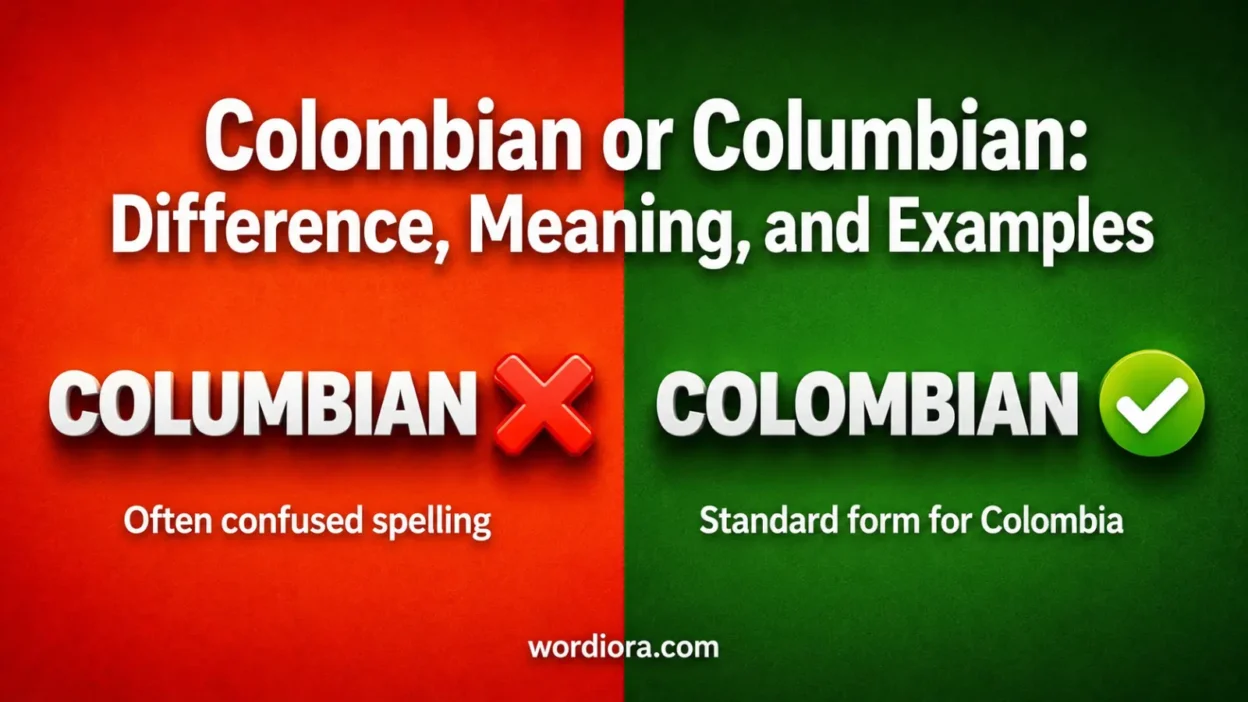
Colombian and Columbian look almost the same, so the mistake is easy to make. One letter changes the whole meaning. In clear American English, Colombian usually points to Colombia, the South American country. Columbian points to Columbia, Christopher Columbus, the Columbia River, or places and institutions named Columbia.
The safest rule is simple: use Colombian for people, culture, food, music, coffee, sports, or anything connected to Colombia. Use Columbian only when the context truly involves Columbia or Columbus. This guide explains the difference with examples, tables, mistakes, and quick fixes.
Quick Answer
Use Colombian when you mean something or someone from Colombia. Write Colombian coffee, Colombian culture, Colombian singer, and Colombian restaurant. Use Columbian when you mean something connected to Columbia, Christopher Columbus, the Columbia River, or a place named Columbia. The two words are not interchangeable.
Why People Confuse Them
People confuse Colombian and Columbian because both words come from names that look and sound very similar. Colombia is the country. Columbia is a different name used for many places, schools, rivers, and historical references.
The sound also creates confusion. In fast American speech, Colombian and Columbian may sound close. A listener may not notice the difference, but readers will. In writing, the wrong letter can make a sentence look careless.
Another reason is the common phrase District of Columbia. Many people know Columbia from Washington, D.C., Columbia University, British Columbia, or the Columbia River. Because those names are familiar, some writers accidentally use Columbian when they mean Colombian.
That mistake is most noticeable when talking about people. Calling a person from Colombia “Columbian” is not the standard choice. The correct word is Colombian.
Key Differences At A Glance
| Context | Best Choice | Why |
|---|---|---|
| A person from Colombia | Colombian | It refers to nationality or origin from Colombia. |
| Food from Colombia | Colombian | It describes the country, culture, or cuisine. |
| Coffee grown in Colombia | Colombian | The product comes from Colombia. |
| Music from Colombia | Colombian | It connects to Colombian culture. |
| Columbia University | Columbian | It relates to an institution named Columbia. |
| Columbia River | Columbian | It relates to the river named Columbia. |
| Christopher Columbus | Columbian | It connects to Columbus or historical references based on his name. |
| Before Columbus reached the Americas | pre-Columbian | This fixed historical term uses Columbian. |
The key is not style or formality. The key is the thing you mean. Colombia takes Colombian. Columbia or Columbus takes Columbian.
Meaning and Usage Difference
Colombian is an adjective and a noun. As an adjective, it means related to Colombia, its people, or its culture. As a noun, it means a person from Colombia or a person of Colombian origin.
Examples:
• She ordered Colombian coffee.
• They opened a Colombian restaurant in Miami.
• He is a Colombian artist.
• Several Colombians attended the event.
Columbian is also an adjective and a noun, but its meaning is different. As an adjective, it can mean related to Columbia, the Columbia River, the United States in certain older or poetic uses, or Christopher Columbus. As a noun, it can mean a person from a place named Columbia, though this is less common in everyday writing.
Examples:
• The museum has a pre-Columbian art exhibit.
• The paper discussed the Columbian Exchange.
• The Columbian white-tailed deer lives in parts of the Pacific Northwest.
• She studied at a Columbian institution only when the name Columbia was part of the context.
Do not use Columbian as a fancy spelling of Colombian. It does not make the word more formal. It changes the reference.
Tone, Context, and Formality
Colombian is the normal word in modern American English when the subject is Colombia. It works in casual writing, school essays, news writing, travel content, restaurant descriptions, business copy, and academic writing.
Examples:
• Colombian food is popular in many US cities.
• The team interviewed a Colombian journalist.
• We listened to Colombian music during the party.
Columbian has a narrower use. It often appears in historical, geographic, scientific, or institutional contexts. You may see it in phrases such as Columbian Exchange, pre-Columbian art, Columbia River, or Columbia University.
Examples:
• The class studied pre-Columbian civilizations.
• The article explained the Columbian Exchange.
• The report focused on the Columbian Basin.
The tone difference comes from context, not from politeness. Colombian is not casual or less correct. Columbian is not more elegant. Each word belongs to a different name family.
Pronunciation may not help much because the words can sound close. In careful speech, Colombian is often said as “kuh-LOM-bee-un,” while Columbian is often said as “kuh-LUM-bee-un.” Still, spelling is the better guide.
Which One Should You Use?
Use Colombian when the sentence answers “from Colombia?” This includes people, food, music, products, sports teams, travel, accents, traditions, and national identity.
Correct:
• Colombian coffee
• Colombian Spanish
• Colombian culture
• Colombian singer
• Colombian soccer player
• Colombian restaurant
• Colombian passport
• Colombian family
Use Columbian when the sentence answers “related to Columbia or Columbus?” This includes certain place names, historical terms, river references, and fixed expressions.
Correct:
• Columbian Exchange
• pre-Columbian art
• Columbian mammoth
• Columbian River context, when referring to the Columbia River
• Columbian institution, only when tied to a Columbia-named institution
When in doubt, ask what proper name is behind the word. If the base word is Colombia, choose Colombian. If the base word is Columbia or Columbus, choose Columbian.
When One Choice Sounds Wrong
Columbian sounds wrong when the sentence clearly talks about Colombia. This is the most common error.
Wrong: I love Columbian coffee.
Right: I love Colombian coffee.
Wrong: She is a Columbian writer from Bogotá.
Right: She is a Colombian writer from Bogotá.
Wrong: We tried a Columbian restaurant downtown.
Right: We tried a Colombian restaurant downtown.
Colombian sounds wrong when the sentence talks about Columbia or Columbus.
Wrong: The class discussed the Colombian Exchange.
Right: The class discussed the Columbian Exchange.
Wrong: The museum displayed Colombian artifacts from before Columbus.
Better: The museum displayed pre-Columbian artifacts.
Wrong: He studied Colombian history at Columbia University.
Possible but different meaning: He studied the history of Colombia at Columbia University.
Correct for the institution: He studied at a Columbian institution only if the context means related to Columbia.
The wrong word may confuse readers because both forms are real words. Spell-check may not catch the error. You must check meaning.
Common Mistakes (and Quick Fixes)
Mistake 1: Using Columbian for Colombia
Wrong: Columbian food is delicious.
Right: Colombian food is delicious.
Fix: If you mean the country Colombia, use the “o” form: Colombian.
Mistake 2: Thinking Columbia is the English spelling of Colombia
Wrong: He traveled to Columbia last summer.
Right: He traveled to Colombia last summer.
Fix: Colombia is the country name in English. Columbia is not the country.
Mistake 3: Using Colombian in fixed historical phrases
Wrong: The Colombian Exchange changed world history.
Right: The Columbian Exchange changed world history.
Fix: The phrase refers to Columbus, so use Columbian.
Mistake 4: Forgetting capitalization
Wrong: colombian coffee
Right: Colombian coffee
Wrong: pre-columbian art
Right: pre-Columbian art
Fix: Capitalize Colombian and Columbian because they come from proper names.
Mistake 5: Relying only on sound
Wrong: She is a Columbian athlete from Medellín.
Right: She is a Colombian athlete from Medellín.
Fix: Sound can mislead you. Check the meaning behind the word.
Everyday Examples
Here are natural examples that show how each word works in real sentences.
Colombian:
• My neighbor runs a Colombian bakery.
• We bought Colombian coffee for the office.
• She teaches Colombian history at the college.
• The documentary follows a Colombian family in Queens.
• He learned Colombian Spanish while living in Bogotá.
• The festival featured Colombian dancers and musicians.
• A Colombian chef opened a new restaurant in Chicago.
• My friend is Colombian, but she grew up in Texas.
• The article covered Colombian politics and culture.
• They served Colombian arepas at the party.
Columbian:
• The students learned about the Columbian Exchange.
• The exhibit included pre-Columbian pottery.
• The book explored Columbian-era maps.
• The scientist studied the Columbian mammoth.
• The article mentioned wildlife near the Columbia River.
• The phrase pre-Columbian means before Columbus’s arrival in the Americas.
• The historian explained why Columbian is used in that fixed term.
• The term Columbian can appear in names tied to Columbia.
• The museum label used Columbian in a historical sense.
• The class compared pre-Columbian art with later colonial art.
Compact comparison:
| Feature | Colombian | Columbian |
| Main reference | Colombia | Columbia or Columbus |
| Common use | Nationality, culture, food, products | History, geography, named places |
| Example | Colombian coffee | Columbian Exchange |
| Person word | A Colombian | A Columbian, only in a Columbia-related context |
| Common mistake | Spelling it Columbian | Using it for Colombia |
Dictionary-Style Word Details
Verb
• Colombian: Not commonly used as a verb in standard American English. You would not normally say “to Colombian” something.
• Columbian: Not commonly used as a verb in standard American English. It is mainly an adjective and sometimes a noun.
Noun
• Colombian: A Colombian is a person from Colombia or a person of Colombian origin. Example: Several Colombians joined the community event.
• Columbian: A Columbian can mean a person connected with a place named Columbia, but this noun use is much less common in everyday speech. Most writers use it only when the Columbia connection is clear.
Synonyms
• Colombian: There is no exact synonym for Colombian when it means “from Colombia.” Closest plain alternatives include “from Colombia,” “Colombia-based,” or “of Colombian origin,” depending on the sentence.
• Columbian: There is no exact synonym that fits every use. Closest plain alternatives include “related to Columbia,” “related to Columbus,” or “pre-Columbus” in limited historical contexts.
Clear antonyms do not fit well for either word because both words name origin or connection, not opposite qualities.
Example Sentences
• Colombian: The café serves Colombian coffee every morning.
• Colombian: She is a Colombian filmmaker living in Los Angeles.
• Colombian: We watched a movie about Colombian culture.
• Columbian: The class studied the Columbian Exchange.
• Columbian: The museum has a pre-Columbian collection.
• Columbian: The report mentioned species connected to the Columbia River region.
Word History
• Colombian: Colombian comes from Colombia, the name of the South American country. In modern English, it is the standard adjective and noun for people and things connected to Colombia.
• Columbian: Columbian comes from Columbia or Columbus-related naming. It appears in historical phrases, geographic references, and names connected to places or institutions called Columbia.
The important point is practical: the two forms are not just alternate spellings. They point to different names.
Phrases Containing
• Colombian: Colombian coffee, Colombian food, Colombian music, Colombian culture, Colombian Spanish, Colombian citizen, Colombian restaurant, Colombian artist.
• Columbian: Columbian Exchange, pre-Columbian art, pre-Columbian civilization, Columbian mammoth, Columbian white-tailed deer, Columbia River-related uses.
FAQs
Is Colombian or Columbian correct?
Both words are correct, but they mean different things. Use Colombian for Colombia, the South American country. Use Columbian for Columbia, Columbus, the Columbia River, or fixed terms such as Columbian Exchange.
Is a person from Colombia Colombian or Columbian?
A person from Colombia is Colombian. You can say “She is Colombian” or “He is a Colombian.” Do not use Columbian for Colombian nationality.
Is Colombian coffee or Columbian coffee correct?
Colombian coffee is the correct standard phrase when the coffee comes from Colombia. Columbian coffee is usually a mistake unless it is part of a specific brand or name.
Why is it the Columbian Exchange, not the Colombian Exchange?
The Columbian Exchange is named from Columbus, not Colombia. That is why the phrase uses Columbian.
Is Columbia the English spelling of Colombia?
No. Colombia is the correct English spelling for the country. Columbia is used in other names, such as District of Columbia, British Columbia, Columbia University, and the Columbia River.
Should Colombian and Columbian be capitalized?
Yes. Capitalize both words because they come from proper names. Write Colombian coffee, Colombian culture, Columbian Exchange, and pre-Columbian art.
Conclusion
Colombian and Columbian are easy to mix up, but the difference is clear once you connect each word to its base name. Colombian means related to Colombia, its people, or its culture. Use it for Colombian coffee, Colombian food, Colombian music, Colombian athletes, and Colombian citizens.
Columbian means related to Columbia or Columbus. Use it in phrases such as Columbian Exchange, pre-Columbian art, and other Columbia-based references. The best quick test is this: if you mean the country Colombia, choose Colombian. If you mean Columbia or Columbus, choose Columbian.