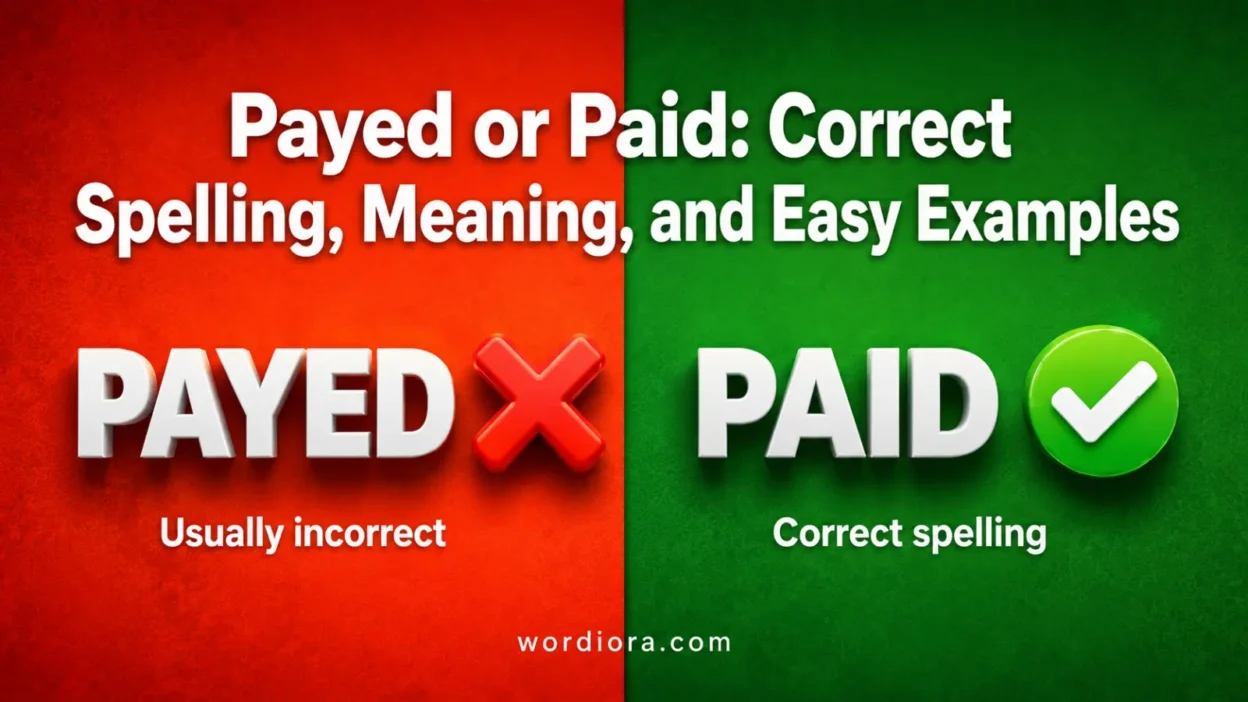
Many writers pause at payed or paid because both spellings look possible. Since many English verbs form the past tense with -ed, payed can feel natural. However, the everyday past tense of pay is paid, not payed.
The short rule is simple: use paid for money, work, bills, debts, attention, visits, respect, and results. Use payed only in rare technical contexts, mainly when talking about letting out rope or coating part of a boat.
Quick Answer
Paid is the correct choice in almost all modern US English. Write I paid the bill, she paid attention, and the job is paid. Payed is a real word, but it is rare. It is mainly used when someone lets out rope, cable, or chain, especially in sailing or similar technical contexts.
Why People Confuse Them
People confuse payed and paid because pay is an irregular verb in everyday use. A regular verb usually adds -ed in the past tense: walk becomes walked, call becomes called, and clean becomes cleaned.
So, many writers assume pay should become payed. That spelling follows a familiar pattern, but it is not the normal form for paying money or giving attention.
Another reason is that payed is not completely fake. It appears in dictionaries, so a spell checker may not always mark it wrong. That can make the mistake harder to catch.
The real issue is not spelling alone. It is meaning. Paid belongs to common uses of pay. Payed belongs to a narrow technical use.
Key Differences At A Glance
| Context | Best Choice | Why |
|---|---|---|
| Money, bills, rent, salary, or debt | paid | This is the standard past tense of pay. |
| Attention, respect, a visit, or a compliment | paid | These are common figurative uses of pay. |
| A job, ad, vacation, or position that gives money | paid | Paid can work as an adjective. |
| Letting out rope, cable, or chain | payed | This is the rare technical use. |
| Coating a boat surface with tar or similar material | payed | This is another rare nautical use. |
| Everyday school, business, or email writing | paid | Payed will usually look like an error. |
Meaning and Usage Difference
Paid means that someone gave money, settled a cost, received wages, or completed another common action connected to pay.
Examples:
- I paid the invoice yesterday.
- She paid for lunch with a debit card.
- The company paid its employees on Friday.
- He paid attention during the safety meeting.
- Their hard work paid off.
In these sentences, payed would be wrong because the meaning is not technical.
Payed is the past tense of rare senses of pay. It can mean letting out rope, cable, or chain in a controlled way. It can also mean coating part of a boat with tar, pitch, or another waterproof material.
Examples:
- The deckhand payed out the rope slowly.
- The crew payed the seam before the boat returned to the water.
These examples sound technical because the word itself is technical. Most readers will rarely need payed unless they are writing about boating, sailing, rope handling, or a similar setting.
Both words are pronounced the same: payd. Because they sound alike, the mistake happens mostly in writing, not speech.
Tone, Context, and Formality
Paid is neutral, standard, and accepted in everyday US English. It fits casual messages, school papers, business emails, job posts, invoices, news writing, and formal documents.
You can use it without sounding too casual or too formal:
- We paid the deposit.
- This is a paid internship.
- She paid close attention to the instructions.
Payed sounds specialized. In most everyday writing, it will look wrong. A reader may think the writer meant paid but typed the wrong spelling.
However, payed is not slang. It is not informal. It is simply rare and technical. It works only when the meaning truly involves rope, cable, chain, or boat coating.
So, the tone difference is really a context difference. Paid fits normal life. Payed fits narrow technical writing.
Which One Should You Use?
Use paid unless you are certain the sentence needs the rare technical meaning of payed.
For most writers, this rule will solve nearly every case:
- Money? Use paid.
- A bill? Use paid.
- A salary? Use paid.
- Attention? Use paid.
- A visit? Use paid.
- A debt? Use paid.
- A result from effort? Use paid.
- A paid job or paid ad? Use paid.
- Rope or chain being let out? Payed may be correct.
- Boat seams being coated? Payed may be correct.
In modern business, school, and online writing, paid is the safe and natural choice.
When One Choice Sounds Wrong
Payed sounds wrong when the sentence is about money.
Wrong: I payed the bill online.
Right: I paid the bill online.
Wrong: She payed me for the design work.
Right: She paid me for the design work.
Wrong: We payed rent on the first of the month.
Right: We paid rent on the first of the month.
It also sounds wrong in common phrases.
Wrong: He payed attention in class.
Right: He paid attention in class.
Wrong: The plan finally payed off.
Right: The plan finally paid off.
Wrong: They payed their respects.
Right: They paid their respects.
Paid may sound less technical if you are writing a specialized sentence about rope. Still, many readers will understand paid out the rope, and some references accept paid in certain nautical uses. But if you want the technical form, payed out the rope is the clearer choice.
Common Mistakes and Quick Fixes
Mistake 1: Using payed for money
Wrong: I payed $40 for the ticket.
Right: I paid $40 for the ticket.
Fix: Money almost always needs paid.
Mistake 2: Using payed with attention
Wrong: She payed attention to every detail.
Right: She paid attention to every detail.
Fix: The phrase is always paid attention.
Mistake 3: Using payed off for success
Wrong: His training payed off.
Right: His training paid off.
Fix: When effort brings a good result, use paid off.
Mistake 4: Using payed as an adjective
Wrong: This is a payed position.
Right: This is a paid position.
Fix: Before a noun, the standard adjective is paid.
Mistake 5: Thinking payed is always fake
Wrong idea: Payed is never a word.
Better idea: Payed is a real but rare technical word.
Fix: Use it only for rope, cable, chain, or boat-coating contexts.
Everyday Examples
Here are natural examples with paid:
- I paid the electric bill this morning.
- She paid for the coffee before I arrived.
- The company paid everyone before the holiday.
- We paid the parking fee at the exit.
- He paid off his credit card last month.
- The manager paid close attention to the customer complaint.
- They paid their respects at the memorial.
- This is a paid training program.
- The invoice is marked paid.
- My brother finally paid me back.
Here are rare technical examples with payed:
- The sailor payed out the line as the boat moved away.
- The crew payed the anchor chain carefully.
- The worker payed the seam with a waterproof coating.
- During the rescue, she payed out the rope slowly.
- The old boat had been payed before the trip.
Compact comparison:
| Feature | Payed | Paid |
| Common in everyday English | No | Yes |
| Used for money | No | Yes |
| Used as an adjective | Rarely, if ever | Yes |
| Used for rope or boat work | Yes | Sometimes, but payed is more technical |
| Best choice for most writers | No | Yes |
Dictionary-Style Word Details
Verb
Payed: A rare past tense and past participle form of pay in technical senses. It can mean let out rope, cable, or chain. It can also mean coat part of a boat with waterproof material.
Example: The sailor payed out the rope.
Paid: The normal past tense and past participle of pay in common meanings. It means gave money, settled a bill, gave attention, offered respect, or received a result.
Example: She paid the bill before leaving.
Noun
Payed: Not commonly used as a noun in standard US English.
Paid: Not commonly used as a noun. It is usually a verb form or an adjective. The related noun is pay, as in weekly pay or equal pay.
Example: His pay increased after the promotion.
Synonyms
Payed: Exact synonyms depend on the technical meaning. Closest plain alternatives include let out, released, fed out, coated, and waterproofed.
Paid: Closest plain alternatives include settled, covered, compensated, reimbursed, remunerated, and repaid.
For adjective use, paid can sometimes contrast with unpaid, as in paid work and unpaid work. For a bill, useful opposites include unpaid, owed, or outstanding.
Example Sentences
Payed:
- The crew payed out the rope as the boat drifted from the dock.
- He payed the cable slowly to avoid a sudden drop.
- The repair team payed the boat seam before sealing the hull.
Paid:
- I paid the rent before the due date.
- She paid for the tickets online.
- We paid attention during the training.
- The company offers paid vacation after six months.
- His patience paid off in the final interview.
Word History
Payed: This form follows the regular -ed pattern, but it survived mainly in rare technical senses of pay. It should not be treated as the normal past tense for money or attention.
Paid: This is the standard irregular past tense and past participle of pay in modern English. English kept paid for the common meanings of pay, even though many other verbs simply add -ed.
The history is useful, but the modern rule matters more: everyday writers almost always need paid.
Phrases Containing
Payed:
- payed out the rope
- payed out the line
- payed the seam
- payed the cable
These phrases are rare and technical.
Paid:
- paid for
- paid back
- paid off
- paid attention
- paid respect
- paid a visit
- paid in full
- paid vacation
- paid job
- paid advertisement
- paid leave
- paid invoice
These phrases are common in everyday English.
FAQs
Is it I paid or I payed?
Write I paid in almost every normal sentence.
Correct: I paid for dinner.
Wrong: I payed for dinner.
Use I payed only if you mean you let out rope, cable, or chain, or handled a rare boat-related action.
Is payed a real word?
Yes, payed is a real word. However, it is not the normal past tense of pay when money is involved. It is rare and mostly technical.
That is why payed can be both real and wrong, depending on the sentence.
Is it paid attention or payed attention?
The correct phrase is paid attention.
Correct: She paid attention to the instructions.
Wrong: She payed attention to the instructions.
Attention is a common figurative use of pay, so the past tense is paid.
Is it paid off or payed off?
Use paid off.
Correct: The loan is paid off.
Correct: Her hard work paid off.
Wrong: Her hard work payed off.
Whether the meaning is debt or success, paid off is the standard form.
Can I use payed for salary, bills, or rent?
No. Use paid for salary, bills, rent, invoices, fees, taxes, and debts.
Correct: The company paid my salary.
Correct: We paid the rent.
Correct: The bill has been paid.
Payed does not fit these money meanings.
Conclusion
The choice between payed or paid is easy once you connect each word to its meaning. Paid is the correct word for almost all modern writing. Use it for money, bills, work, attention, respect, visits, debt, and results.
Payed is a real word, but it belongs to rare technical contexts, mostly rope, cable, chain, or boat work. When in doubt, choose paid. It is the standard form your readers will expect.