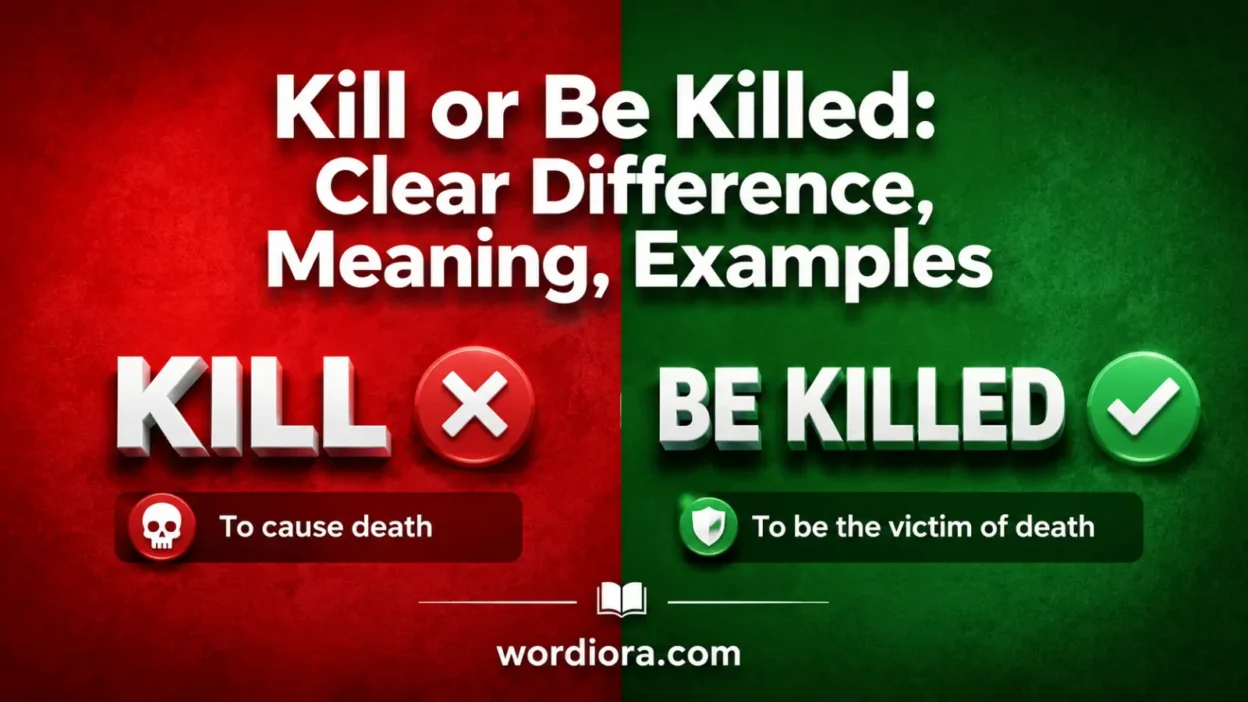
Kill or be killed compares two grammar roles. Kill shows action. The subject does something. Be killed shows result. The subject receives the action.
Both forms work in standard English, but they do not work the same way. In the full phrase kill or be killed, the meaning becomes stronger. It describes an extreme situation where someone must act first or face serious harm. Writers also use it for harsh competition, but the tone stays intense.
Quick Answer
Use kill when the subject causes death, ends something, stops something, or ruins something. Use be killed when the subject receives that action. In kill or be killed, the contrast is active versus passive: act first, or have the action happen to you.
Why People Confuse Them
People confuse kill and be killed because the words appear together in the fixed expression kill or be killed. The phrase sounds like one complete idea, so readers may miss the grammar difference.
Tone also causes confusion. The phrase sounds dramatic, so people often focus on the feeling instead of the structure. However, the structure matters. Kill points to the actor, while be killed points to the receiver.
This difference also matters in figurative writing. A sentence like “The market is kill or be killed” does not usually refer to real death. It means the market feels ruthless, urgent, or unforgiving.
Key Differences At A Glance
| Context | Best Choice | Why |
|---|---|---|
| The subject does the action | kill | It sounds active and direct. |
| The subject receives the action | be killed | It focuses on the result. |
| A strong survival phrase | kill or be killed | It shows an extreme either-or situation. |
| A calm business report | highly competitive | It sounds less dramatic. |
| A modifier before a noun | kill-or-be-killed | Hyphens join the words before a noun. |
Meaning and Usage Difference
Kill usually works as a verb. Its main meaning is to cause someone or something to die. It can also mean to end, stop, cancel, ruin, or remove something. For example, a company can kill a project, bad weather can kill a plan, and a writer can kill a weak sentence.
Be killed works as a passive verb phrase. It uses a form of be plus killed. The subject does not perform the action. Instead, the subject receives it.
Compare these two sentences:
The disease can kill plants.
The disease performs the action.
Disease can kill the plants.
This active version sounds clearer.
You may also write: The plants can be killed by disease.
That version shifts attention to the plants instead of the disease.
In the phrase kill or be killed, both sides work together. The phrase means “act first or become the victim.” Because that meaning sounds harsh, use it carefully.
Tone, Context, and Formality
Kill can sound neutral, serious, casual, or figurative. Context controls the tone. “Smoking can kill” sounds serious. “Kill the lights” sounds casual. “Kill the plan” sounds direct but not violent.
Be killed sounds more formal, serious, or report-like because it focuses on what happened to the subject. Writers may use it when the actor is unknown, unclear, or less important.
Kill or be killed sounds stronger than either form alone. It suggests danger, survival pressure, or ruthless competition. In everyday writing, it may feel too dramatic. For example, “Final exams are kill or be killed” sounds exaggerated. “Final exams are stressful” sounds more natural.
Which One Should You Use?
Use kill when you want a direct sentence with a clear actor. This choice usually sounds shorter and stronger.
Choose be killed when the receiver matters more than the actor. You can also use it when you do not know who or what caused the action.
Reserve kill or be killed for intense situations. It works in stories, commentary, sports writing, games, history, and dramatic descriptions of competition. Still, it can sound too harsh in school, workplace, or polite everyday contexts.
| Feature | Kill | Be killed |
|---|---|---|
| Grammar role | Active verb | Passive verb phrase |
| Focus | The actor | The receiver |
| Tone | Direct | More result-focused |
| Example | Frost can kill crops. | Crops can die from frost. |
When One Choice Sounds Wrong
Kill sounds wrong when the subject does not perform the action.
Wrong: The crops killed by frost.
Correct: Frost killed the crops.
Be killed sounds wrong when you need a clear active actor.
Awkward: The storm was killed the power.
Correct: The storm killed the power.
The full phrase can also sound wrong when the situation feels too mild.
Too dramatic: The lunch line was kill or be killed.
Better: The lunch line was chaotic.
Use the stronger phrase only when the situation truly feels extreme or when the dramatic tone is intentional.
Common Mistakes and Quick Fixes
One common mistake is dropping the verb be before killed.
Wrong: He killed by the villain in the movie.
Correct: The villain killed him in the movie.
Another mistake comes from using kill or be killed for small problems.
Weak: Choosing a parking spot was kill or be killed.
Better: Choosing a parking spot felt stressful.
Writers also forget hyphens before a noun.
Less clear: a kill or be killed mindset
Better: a kill-or-be-killed mindset
Finally, some readers take the phrase too literally. In business, sports, and fiction reviews, it often means fierce pressure, not actual killing.
Everyday Examples
Kill examples:
The cold snap could kill the young plants.
My editor told me to cut the last paragraph.
A long delay can kill the energy in a meeting.
This bug might crash the app before launch.
One mistake should not kill the team’s confidence.
Be killed examples:
Frost could kill the plants overnight.
The committee may kill the proposal.
The awkward silence killed the mood.
The director cut several scenes during editing.
One missing signature could kill the deal.
Kill or be killed examples:
The novel presents war as kill or be killed.
The final round felt like kill or be killed.
Some traders describe the market as kill or be killed.
The movie shows a kill-or-be-killed world.
That team played with a kill-or-be-killed mindset.
Dictionary-Style Word Details
Verb
Kill: This word commonly works as a verb. It can mean to cause death, end something, stop something, cancel something, or destroy the effect of something.
Be killed: This phrase uses passive grammar. It combines a form of be with killed. Common forms include is killed, was killed, were killed, could be killed, and has been killed.
Noun
Kill: This word can work as a noun in limited contexts. A hunter, gamer, or sports writer may refer to “a kill.” This use depends on context.
Be killed: Standard US English does not use be killed as a noun. It works as a verb phrase.
Synonyms
Kill: Closest plain alternatives include destroy, stop, end, cancel, ruin, defeat, or cause death, depending on context. These words do not all mean the same thing in every sentence.
Be killed: Closest plain alternatives include die, fall victim, get destroyed, come to an end, or lose all chance of success, depending on the sentence.
For the full phrase kill or be killed, close alternatives include do or die, sink or swim, survive or perish, and all or nothing. These phrases carry a similar high-stakes feeling, but they do not fit every context.
Example Sentences
Kill: The freeze may kill the flowers overnight.
Kill: A confusing opening can kill reader interest.
Kill: The board voted to kill the proposal.
Be killed: The flowers may die in the freeze.
Be killed: A confusing opening can hurt reader interest.
Be killed: The board may reject the proposal after debate.
Word History
Kill: The word has a long history in English, but modern readers do not need that history to use it correctly. Today, context decides whether it means literal death, stopping something, canceling something, or ruining an effect.
Be killed: This phrase comes from normal passive grammar. It joins a form of be with the past participle killed.
The exact first use of kill or be killed does not matter for everyday usage. Modern speakers understand it as a fixed expression about survival, danger, or ruthless pressure.
Phrases Containing
Kill: kill time, kill the mood, kill the lights, kill a plan, kill a project, kill two birds with one stone.
Be killed: be killed by frost, be killed in an accident, be killed off in a story, be killed by delay, be killed by poor planning.
Kill or be killed: kill-or-be-killed mindset, kill-or-be-killed culture, kill-or-be-killed competition, kill-or-be-killed world.
FAQs
Is “kill or be killed” correct?
Yes. Kill or be killed works as a fixed phrase. It compares an active action with a passive result. The phrase means someone must act first or face serious harm.
Is “be killed” passive voice?
Yes. Be killed uses passive voice. It places the receiver of the action in the subject position.
Can “kill” mean something other than death?
Yes. In everyday English, kill can mean stop, cancel, ruin, or remove something. You can kill a plan, kill time, kill the mood, or kill a weak sentence.
Is “kill or be killed” too strong?
Often, yes. It sounds intense and dramatic. Use it for extreme pressure, survival, competition, or fiction. For normal problems, choose softer wording.
Should I write “kill-or-be-killed” with hyphens?
Use hyphens when the phrase comes before a noun. Write a kill-or-be-killed attitude. Without a following noun, write It felt like kill or be killed.
Conclusion
Kill and be killed both work, but they do different jobs. Kill shows action. The subject performs the action. Be killed shows result. The subject receives the action.
The phrase kill or be killed combines both forms into one strong expression. It works best when a situation feels dangerous, ruthless, or extremely competitive. For calm everyday writing, choose a softer phrase. Clear context always makes the right choice easier.