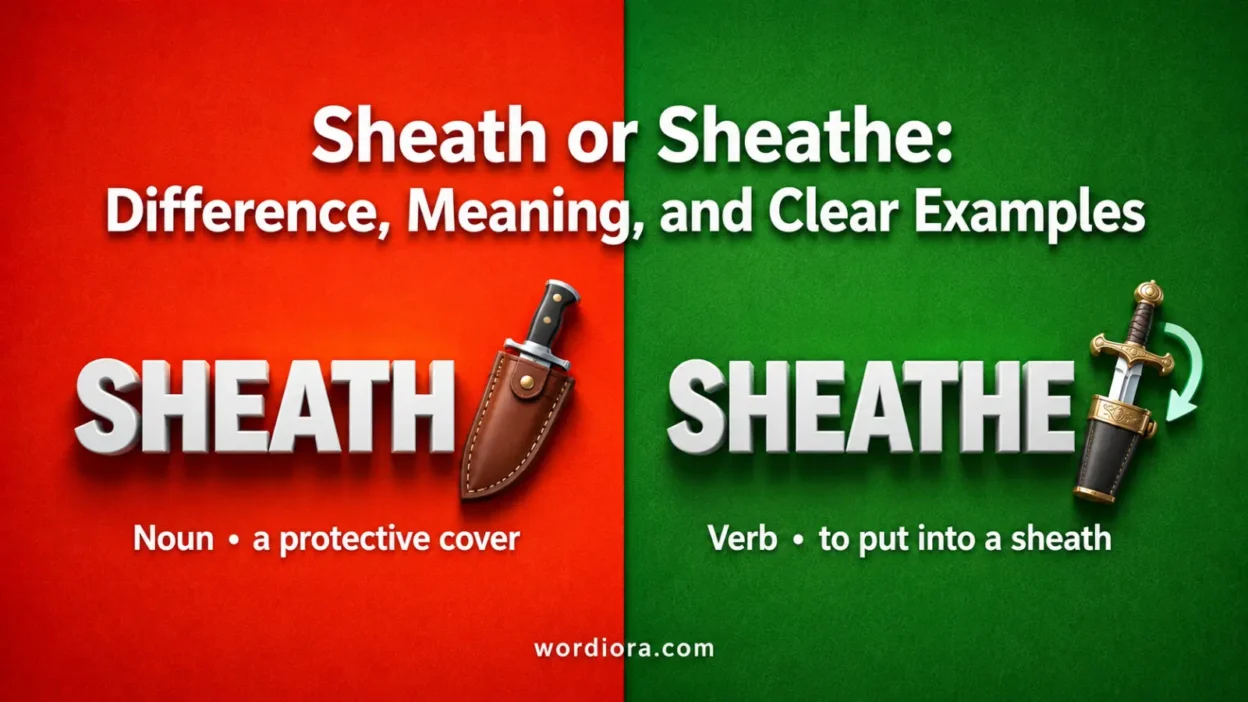
Sheath and sheathe are both correct English words, but they do not usually do the same job in a sentence. The main difference is grammatical: sheath is the thing, and sheathe is the action.
Use sheath when you mean a close-fitting cover, especially one for a knife, sword, cable, or body part. Use sheathe when you mean to put something into a sheath or cover something with a protective layer. Once you know the noun-and-verb pattern, the choice becomes much easier.
Quick Answer
Use sheath as a noun. It means a close-fitting cover or case.
Use sheathe as a verb. It means to put something into a sheath, cover something, or encase it for protection.
Correct: The knife was in its sheath.
Correct: Please sheathe the knife before you put it away.
Why People Confuse Them
People confuse sheath and sheathe because they look almost the same. The only spelling difference is the final e, but that small letter changes the usual role of the word.
They also sound close. Sheath ends with an unvoiced th sound, like the sound at the end of teeth. Sheathe ends with a voiced th sound, closer to the sound in breathe. In fast speech, many listeners may not notice the difference.
Another reason is that both words belong to the same idea. A sheath is a cover. To sheathe something is to put it into that cover or cover it in a similar way. Since the meanings are linked, writers sometimes use the noun when they need the verb.
Key Differences At A Glance
| Context | Best Choice | Why |
|---|---|---|
| A cover for a knife or sword | sheath | You mean the object, not the action. |
| Putting a blade away | sheathe | You mean the action of placing it in a cover. |
| A cable covering | sheath | You mean a protective outer layer. |
| Covering a roof, wall, or cable | sheathe | You mean applying a protective layer. |
| A close-fitting dress | sheath | The word names a dress style. |
| A cat pulling in its claws | sheathe | The word describes the action of retracting claws. |
Meaning and Usage Difference
Sheath is mainly a noun. It names something that covers, holds, or protects. The most common image is a knife or sword cover. For example, you can say, “The chef kept the knife in a leather sheath.” You can also use sheath for a layer around a cable, a nerve, a plant part, or another long, narrow thing.
Sheathe is a verb. It names an action. When you sheathe a blade, you put it into its sheath. When builders sheathe a wall, they cover it with a protective layer. When a cat sheathes its claws, the claws retract into a protected position.
The easiest test is this: ask whether the word means a thing or an action. If it is a thing, choose sheath. If it is an action, choose sheathe.
Compact comparison:
- Sheath = a cover, case, layer, or close-fitting dress.
- Sheathe = to put into a sheath, cover, encase, or retract.
- Sheath usually follows words like a, the, this, leather, plastic, or outer.
- Sheathe often follows a subject and can change form: sheathe, sheathes, sheathed, sheathing.
Tone, Context, and Formality
Sheath is a normal word in practical, technical, medical, fashion, and outdoor contexts. You may see it in knife safety, cable descriptions, anatomy, plant science, and clothing descriptions. It is not slang.
Sheathe is also standard, but it can sound more formal or literary when used with swords, daggers, or dramatic scenes. In everyday writing, it is still correct when the action is literal: “Sheathe the knife before walking away.” In building or repair contexts, it can sound technical: “The crew will sheathe the exterior wall.”
For plain daily writing, you may often choose simpler verbs like cover, put away, encase, or protect. Still, sheathe is the exact word when you want the action connected to a sheath.
Which One Should You Use?
Use sheath when the word sits where a noun belongs. It may come after an article, adjective, or possessive word.
Examples:
The sheath is cracked.
His sheath was made of leather.
The cable has a plastic sheath.
Use sheathe when the word sits where a verb belongs. It may follow a subject, pair with to, or change tense.
Examples:
She will sheathe the blade.
The workers sheathed the wall.
The cat sheathed its claws.
Do not choose based only on sound. Choose based on the job in the sentence. If you can replace the word with cover or case as a noun, sheath is probably right. If you can replace it with cover, encase, or put away as a verb, sheathe is usually right.
When One Choice Sounds Wrong
Sheath sounds wrong when the sentence clearly needs an action.
Wrong: Please sheath the hunting knife before you pack it.
Better: Please sheathe the hunting knife before you pack it.
Some dictionaries record sheath as a less common verb, but modern readers usually expect sheathe for the verb. For clean, standard writing, use sheathe when you mean “put into a cover.”
Sheathe sounds wrong when the sentence clearly needs a thing.
Wrong: The blade slid into the sheathe.
Better: The blade slid into the sheath.
The word after into usually names the place or object receiving something. Since the cover is a thing, sheath is the natural choice.
Common Mistakes (and Quick Fixes)
Mistake 1: Using sheathe as a noun.
Wrong: The knife came with a black sheathe.
Correct: The knife came with a black sheath.
Mistake 2: Using sheath as the main verb.
Wrong: The ranger told us to sheath our knives.
Better: The ranger told us to sheathe our knives.
Mistake 3: Forgetting the verb forms.
Wrong: He sheath the dagger before entering.
Correct: He sheathed the dagger before entering.
Mistake 4: Using the wrong word in technical writing.
Wrong: The cable has a rubber sheathe.
Correct: The cable has a rubber sheath.
Mistake 5: Treating the words as fully interchangeable.
Better: Use sheath for the protective cover. Use sheathe for the act of covering or placing something inside that cover.
Everyday Examples
The camper slid the knife back into its sheath.
The old sword still had a worn leather sheath.
Please sheathe the blade before you hand it to me.
The electrician checked the cable’s outer sheath.
The contractor said the wall would be sheathed before the siding went on.
The cat relaxed and sheathed its claws.
Her black sheath dress looked simple and elegant.
A cracked sheath can expose a sharp edge.
The museum label said the dagger’s sheath was made of decorated leather.
The crew sheathed the roof with protective panels.
A protective sheath helps keep the cable from damage.
The instructor paused until everyone had sheathed their knives.
Dictionary-Style Word Details
Verb
Sheath: Not commonly used as a verb in standard modern US English. Some dictionaries list it as a less common verb form, but sheathe is the safer choice for the action.
Sheathe: A verb meaning to put into a sheath, cover with a protective layer, encase, or retract. Its forms are sheathe, sheathes, sheathed, and sheathing.
Noun
Sheath: A noun meaning a close-fitting cover, case, or protective layer. It can refer to a blade cover, cable covering, body covering, plant part, or a close-fitting dress.
Sheathe: Not used as a noun in standard English. If you mean the cover itself, use sheath.
Synonyms
Sheath: Closest plain alternatives include cover, case, casing, sleeve, jacket, housing, and protective layer. For a sword, scabbard can also fit.
Sheathe: Closest plain alternatives include cover, encase, enclose, clad, wrap, put away, and retract. The best choice depends on the sentence.
Clear opposite for sheathe: unsheathe, when the meaning is to draw a blade out of its sheath. For sheath, there is no single everyday opposite that works in every context.
Example Sentences
Sheath: The knife slipped out of its sheath during the hike.
Sheath: The cable’s plastic sheath cracked near the plug.
Sheath: She wore a navy sheath dress to the dinner.
Sheathe: Always sheathe a blade before storing it.
Sheathe: The builders sheathed the frame before adding the siding.
Sheathe: The cat sheathed its claws and settled on the couch.
Word History
Sheath is the older noun form connected with the idea of a cover or case, especially for a blade. Sheathe developed as the verb form from that noun.
The exact history can get technical, so the safest practical point is simple: modern writers normally use sheath for the cover and sheathe for the action.
Phrases Containing
Sheath: sheath knife, plastic sheath, leather sheath, cable sheath, myelin sheath, outer sheath, sheath dress.
Sheathe: sheathe a sword, sheathe a knife, sheathe a blade, sheathed in metal, sheathed in ice, sheathing a wall.
FAQs
Is sheath or sheathe correct?
Both are correct, but they are used differently. Sheath is usually the noun, and sheathe is the verb. Write “the knife is in its sheath” and “please sheathe the knife.”
What is the main difference between sheath and sheathe?
The main difference is part of speech. A sheath is a cover or case. To sheathe something is to put it into a sheath or cover it with a protective layer.
Is sheathe a real word?
Yes. Sheathe is a real verb. It means to place something into a sheath, cover something, encase it, or retract something like claws.
Can sheath be used as a verb?
Some dictionaries record sheath as a less common verb variant. However, sheathe is the better choice in regular modern writing when you need a verb.
How do you pronounce sheath and sheathe?
Sheath sounds like sheeth, with the final sound in teeth. Sheathe sounds like sheedh, with the final sound in breathe. The difference is small but real.
Which word should I use for a knife cover?
Use sheath. A knife cover is a sheath. If you mean putting the knife into that cover, use sheathe.
Conclusion
Sheath and sheathe are easy to mix up because they look alike and share the same basic idea. Still, the normal difference is clear.
Use sheath when you mean the cover, case, layer, or dress. Use sheathe when you mean the action of putting something into a sheath, covering it, encasing it, or retracting it. For most modern US writing, that noun-versus-verb rule will keep your sentence correct and natural.