Many English learners and writers confuse interrogative sentences and exclamatory sentences because both can express strong emotions. However, they serve different purposes and follow different sentence structures.
Understanding the difference helps you write more clearly, choose the correct punctuation, and communicate exactly what you mean.
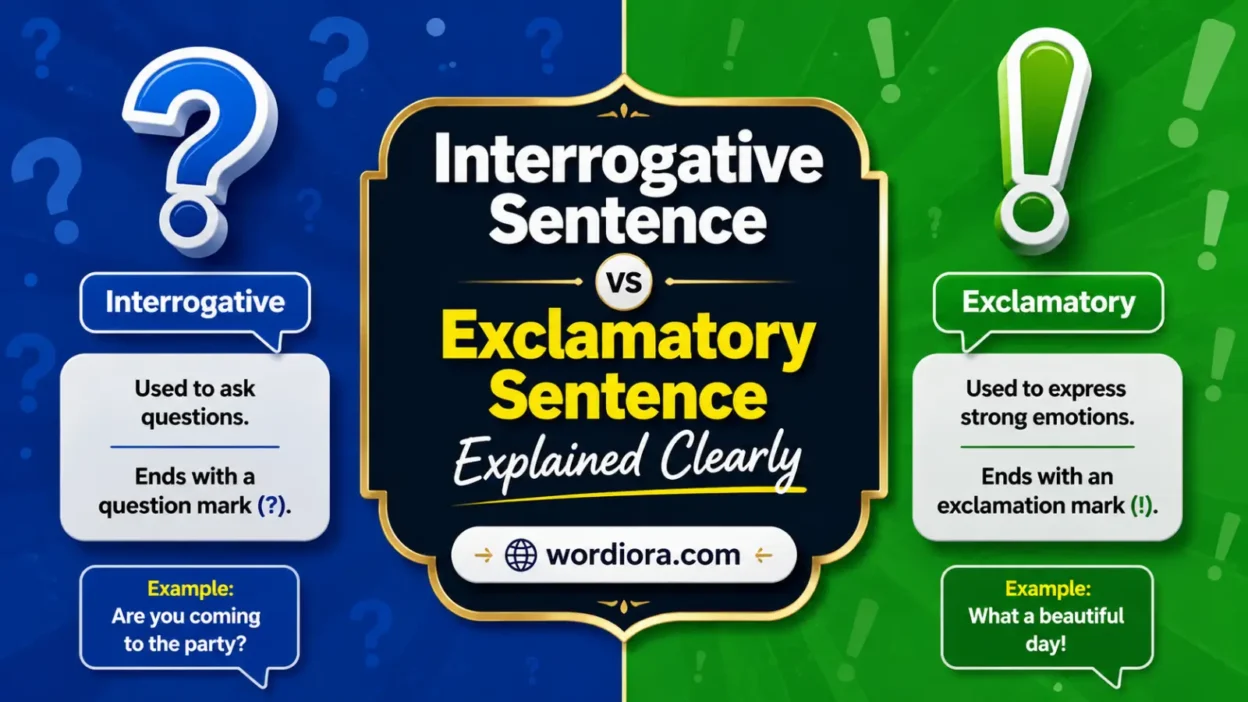
An interrogative sentence asks a question and expects information, clarification, or a response. An exclamatory sentence expresses strong emotion, surprise, excitement, anger, joy, or emphasis.
Knowing when to use each type makes your writing more effective and easier to understand.
Quick Answer
The main difference is simple:
- Interrogative sentence: asks a question.
- Exclamatory sentence: expresses strong emotion or excitement.
Examples:
Interrogative Sentence
- Where are you going?
- Did you finish the report?
- What time does the movie start?
Exclamatory Sentence
- What a beautiful sunset!
- I can’t believe we won!
- That was an incredible performance!
If you need an answer, use an interrogative sentence.
If you want to show emotion or emphasis, use an exclamatory sentence.
Why People Confuse Them
People often confuse these sentence types because both may begin with words such as “what” and “how.”
Consider these examples:
Interrogative:
- What are you doing?
Exclamatory:
- What a wonderful job you did!
The first asks for information.
The second expresses admiration.
Another reason for confusion is that both sentence types can sound emotional when spoken aloud. Tone of voice sometimes makes the distinction less obvious, but punctuation and sentence purpose reveal the correct category.
Key Differences At A Glance
| Feature | Interrogative Sentence | Exclamatory Sentence |
|---|---|---|
| Main Purpose | Ask a question | Express emotion |
| Expected Response | Usually yes | Not required |
| Ending Punctuation | Question mark (?) | Exclamation mark (!) |
| Tone | Curious or seeking information | Excited, surprised, emotional |
| Common Starters | Who, What, Where, When, Why, How | What, How, Wow, Amazing |
| Information Request | Yes | No |
Context Comparison Table
| Context | Best Choice | Why |
|---|---|---|
| Asking directions | Interrogative Sentence | You need information |
| Showing excitement | Exclamatory Sentence | You express emotion |
| Conducting an interview | Interrogative Sentence | Questions are required |
| Celebrating success | Exclamatory Sentence | Strong feelings are being shared |
| Requesting clarification | Interrogative Sentence | An answer is expected |
| Reacting to good news | Exclamatory Sentence | Emotion is the focus |
Meaning and Usage Difference
What Is an Interrogative Sentence?
An interrogative sentence is a sentence used to ask a question.
Its purpose is to obtain information.
Examples:
- Who called you yesterday?
- Where is the nearest gas station?
- Why did the meeting start late?
- How does this software work?
Interrogative sentences generally end with a question mark.
They encourage the listener or reader to respond.
What Is an Exclamatory Sentence?
An exclamatory sentence expresses strong feelings or emotions.
It communicates excitement, surprise, happiness, frustration, fear, admiration, or other emotions.
Examples:
- What an amazing concert!
- How quickly time flies!
- That’s fantastic!
- I can’t believe it!
Exclamatory sentences typically end with an exclamation mark.
Unlike interrogative sentences, they do not seek information.
Purpose Comparison
Interrogative sentences focus on obtaining knowledge.
Exclamatory sentences focus on expressing feelings.
This difference is the easiest way to identify which type you are using.
Tone, Context, and Formality
The tone of an interrogative sentence is usually curious, neutral, or investigative.
Examples:
- Can you help me?
- When does the store open?
- Have you seen my keys?
The tone of an exclamatory sentence is emotional and expressive.
Examples:
- This pizza is amazing!
- What a wonderful surprise!
- That’s unbelievable!
Formal Writing
Interrogative sentences commonly appear in:
- Academic writing
- Research papers
- Surveys
- Interviews
- Business communication
Exclamatory sentences appear less frequently in formal writing because excessive emotional language may reduce professionalism.
Informal Writing
Exclamatory sentences are common in:
- Text messages
- Social media posts
- Personal emails
- Casual conversations
Interrogative sentences remain common because people constantly ask questions.
Which One Should You Use?
Choose an interrogative sentence when:
- You need information.
- You want clarification.
- You are conducting research.
- You expect an answer.
Examples:
- What caused the delay?
- Can you explain this process?
- Where should we meet?
Choose an exclamatory sentence when:
- You want to express excitement.
- You are showing surprise.
- You are emphasizing a feeling.
- You are reacting emotionally.
Examples:
- That’s incredible!
- What a great idea!
- I finally passed the exam!
Always ask yourself:
Am I requesting information or expressing emotion?
The answer determines which sentence type fits best.
When One Choice Sounds Wrong
Sometimes using the wrong sentence type creates confusion.
Incorrect Use
- What time is the meeting!
This appears emotional instead of questioning.
Correct Use
- What time is the meeting?
Another example:
Incorrect Use
- What an amazing game?
The question mark suggests information is needed.
Correct Use
- What an amazing game!
The exclamation mark properly communicates excitement.
Matching punctuation to sentence purpose is essential.
Common Mistakes (and Quick Fixes)
Mistake 1: Using the Wrong Punctuation
Incorrect:
- Where are you going!
Correct:
- Where are you going?
Mistake 2: Treating Every Sentence With “What” as a Question
Incorrect assumption:
- What a beautiful day!
This is not a question.
Correct understanding:
It is an exclamatory sentence expressing admiration.
Mistake 3: Overusing Exclamation Marks
Poor:
- We completed the report!!!
- The meeting starts at 10!!!
Better:
- We completed the report!
- The meeting starts at 10.
Use exclamation marks carefully to maintain credibility and clarity.
Mistake 4: Forgetting the Purpose
Before writing, determine whether you need information or want to express emotion.
That simple check prevents most mistakes.
Everyday Examples
At School
Interrogative:
- When is the assignment due?
Exclamatory:
- This project is so interesting!
At Work
Interrogative:
- Can you send me the updated file?
Exclamatory:
- We landed the client!
At Home
Interrogative:
- Did you feed the dog?
Exclamatory:
- Dinner smells amazing!
During Travel
Interrogative:
- Which gate is boarding now?
Exclamatory:
- This view is breathtaking!
Online Communication
Interrogative:
- Have you watched the new episode?
Exclamatory:
- That ending was shocking!
Dictionary-Style Word Details
Verb
Interrogative Sentence:
Not commonly used as a verb in standard US English. The term refers to a sentence type that asks a question.
Exclamatory Sentence:
Not commonly used as a verb in standard US English. The term refers to a sentence type that expresses strong emotion.
Noun
Interrogative Sentence:
A sentence that asks a direct question and usually ends with a question mark.
Example:
- “Where are you going?” is an interrogative sentence.
Exclamatory Sentence:
A sentence that expresses strong emotion and usually ends with an exclamation mark.
Example:
- “What a wonderful day!” is an exclamatory sentence.
Synonyms
Interrogative Sentence
Closest plain alternatives:
- Question sentence
- Direct question
- Inquiry sentence
Exclamatory Sentence
Closest plain alternatives:
- Emotional statement
- Exclamation
- Expressive sentence
These alternatives are helpful descriptions but are not always exact grammatical replacements.
Example Sentences
Interrogative Sentence Examples
- Who won the game?
- Why are the lights off?
- When does class begin?
- Can you help me?
Exclamatory Sentence Examples
- What a fantastic performance!
- That’s unbelievable!
- How exciting this trip is!
- We finally made it!
Word History
Interrogative Sentence
The word “interrogative” comes from a Latin root associated with questioning and asking.
Exclamatory Sentence
The word “exclamatory” comes from a Latin root related to calling out or expressing emotion.
The modern grammatical meanings have remained generally consistent in English usage.
Phrases Containing
Interrogative Sentence
Common related phrases:
- Direct interrogative sentence
- Interrogative form
- Interrogative structure
- Interrogative question
Exclamatory Sentence
Common related phrases:
- Exclamatory statement
- Exclamatory form
- Exclamatory expression
- Exclamatory structure
FAQs
What is the main difference between an interrogative sentence and an exclamatory sentence?
An interrogative sentence asks a question and expects information, while an exclamatory sentence expresses strong emotion or excitement.
Do interrogative sentences always end with a question mark?
Yes. Standard interrogative sentences typically end with a question mark (?) because they ask a direct question.
Do exclamatory sentences always end with an exclamation mark?
Most exclamatory sentences end with an exclamation mark (!) because they express strong emotion or emphasis.
Can a sentence start with “what” and still be exclamatory?
Yes. For example, “What a beautiful sunset!” is exclamatory because it expresses admiration rather than asks a question.
Which sentence type is more common in formal writing?
Interrogative sentences are generally more common in formal writing because they help ask questions and gather information. Exclamatory sentences are used more sparingly.
Can an interrogative sentence express emotion?
Yes, but its primary purpose remains asking a question. The need for information is what makes it interrogative.
Why do students confuse interrogative and exclamatory sentences?
Students often confuse them because both can begin with words like “what” and “how,” and both may sound emotional when spoken.
Is punctuation the easiest way to identify the sentence type?
Punctuation helps, but the most reliable method is identifying the sentence’s purpose. Questions are interrogative, while emotional expressions are exclamatory.
Can exclamatory sentences ask questions?
No. Once a sentence genuinely asks for information, it functions as an interrogative sentence.
How can I quickly identify the correct sentence type?
Ask yourself whether the sentence seeks an answer or expresses a feeling. The answer will immediately reveal whether it is interrogative or exclamatory.
Conclusion
The difference between an interrogative sentence and an exclamatory sentence comes down to purpose.
An interrogative sentence asks a question and seeks information. It normally ends with a question mark.
An exclamatory sentence expresses strong feelings, excitement, surprise, or emphasis. It usually ends with an exclamation mark.
Whenever you’re unsure, ask yourself one simple question:
Am I asking for information or expressing emotion?
If you’re seeking an answer, use an interrogative sentence.
If you’re sharing a strong feeling, use an exclamatory sentence.
That distinction makes choosing the correct sentence type easy.