Compound sentences and complex sentences are often confused because both combine ideas into one sentence. The difference comes down to how the clauses connect.
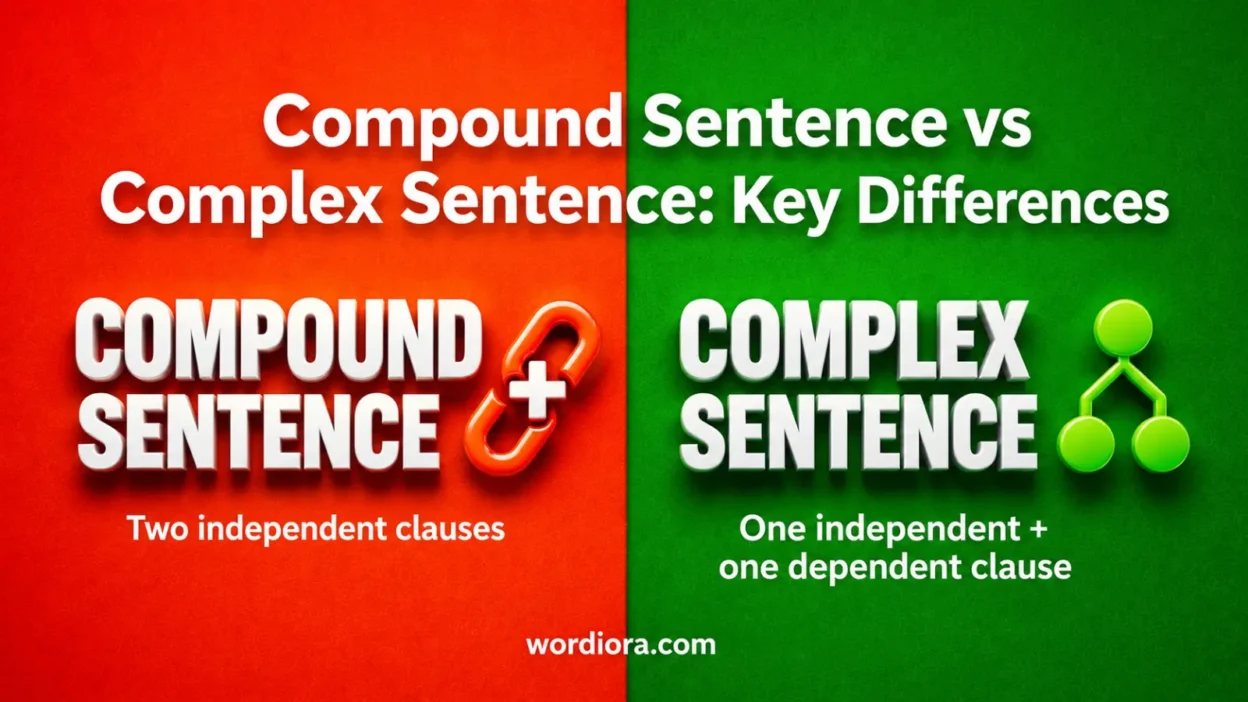
A compound sentence joins two independent clauses that could each stand alone as complete sentences. A complex sentence combines one independent clause with at least one dependent clause that cannot stand alone.
Understanding the difference helps you write clearer, more natural sentences and avoid common grammar mistakes.
Quick Answer
A compound sentence connects two complete thoughts using a coordinating conjunction like and, but, or so.
A complex sentence combines one complete thought with a dependent clause that adds extra meaning, timing, reason, or condition.
Examples:
- Compound sentence: I finished my homework, and I watched a movie.
- Complex sentence: After I finished my homework, I watched a movie.
Why People Confuse Them
Both sentence types contain more than one clause, so they can look similar at first glance.
Writers also confuse them because conjunctions appear in both forms:
- Compound sentences use coordinating conjunctions.
- Complex sentences use subordinating conjunctions.
Compare these:
- She called me, but I missed the call.
- She called me because she needed help.
The first sentence joins two equal ideas. The second sentence makes one idea dependent on the other.
Another reason for confusion is that many school grammar lessons oversimplify the difference by focusing only on conjunction words instead of clause structure.
Key Differences At A Glance
| Context | Best Choice | Why |
|---|---|---|
| Joining two equal ideas | Compound sentence | Both clauses can stand alone |
| Showing cause, time, or condition | Complex sentence | One clause depends on another |
| Creating balanced rhythm | Compound sentence | The ideas carry equal weight |
| Adding background detail | Complex sentence | The dependent clause supports the main idea |
| Writing short, direct arguments | Compound sentence | The structure feels more straightforward |
| Showing relationships between ideas | Complex sentence | The sentence sounds more layered and connected |
Quick Structural Comparison
| Feature | Compound Sentence | Complex Sentence |
|---|---|---|
| Main structure | Two independent clauses | One independent + one dependent clause |
| Common connectors | and, but, so, yet | because, although, while, since |
| Clause equality | Equal | Unequal |
| Can each clause stand alone? | Yes | Only the independent clause can |
| Typical effect | Balanced ideas | Layered meaning |
Meaning and Usage Difference
A compound sentence treats both ideas as equally important.
Example:
- The store was closing, so we hurried inside.
Both parts could work independently:
- The store was closing.
- We hurried inside.
A complex sentence creates a relationship where one idea supports the other.
Example:
- Because the store was closing, we hurried inside.
The clause because the store was closing cannot stand alone. It depends on the main clause.
This difference changes the sentence’s tone and flow.
Compound sentences often sound more direct and balanced. Complex sentences usually sound more connected and explanatory.
Tone, Context, and Formality
Compound sentences often create a smoother conversational rhythm.
Examples:
- I wanted coffee, but the café was closed.
- He studied hard, and he passed the exam.
Complex sentences often sound more detailed or analytical.
Examples:
- Although the café was closed, I still wanted coffee.
- Because he studied hard, he passed the exam.
Neither type is automatically more formal. Strong writing usually mixes both styles naturally.
Too many compound sentences can sound repetitive. Too many complex sentences can feel heavy or overly dense.
Which One Should You Use?
Use a compound sentence when:
- both ideas deserve equal emphasis
- the relationship is simple and direct
- you want smoother readability
Use a complex sentence when:
- one idea explains another
- timing or cause matters
- you want more sentence variety
For example:
- Compound: The game ended, and the crowd left quickly.
- Complex: After the game ended, the crowd left quickly.
The first version feels balanced. The second emphasizes sequence and timing.
When One Choice Sounds Wrong
Sometimes choosing the wrong structure makes a sentence feel awkward or unclear.
Weak example:
- Because I was tired, and I went home early.
This mixes complex and compound structures incorrectly.
Better versions:
- Because I was tired, I went home early.
- I was tired, so I went home early.
Another awkward example:
- The meeting ended although everyone stayed.
The logical relationship sounds incomplete.
Better:
- Although the meeting ended, everyone stayed.
- The meeting ended, but everyone stayed.
The sentence structure should match the relationship between the ideas.
Common Mistakes and Quick Fixes
Mistake: Using a comma without a conjunction in a compound sentence.
Incorrect:
- I was hungry, I made lunch.
Correct:
- I was hungry, so I made lunch.
Mistake: Treating a dependent clause as a full sentence.
Incorrect:
- Because the weather changed.
Correct:
- Because the weather changed, we canceled the picnic.
Mistake: Confusing coordinating and subordinating conjunctions.
Incorrect:
- I stayed home, because it was raining.
Correct:
- I stayed home because it was raining.
- It was raining, so I stayed home.
Mistake: Overloading one sentence with too many clauses.
Weak:
- Although I was tired and the weather was bad, I went to the store, and I bought groceries because we had nothing left.
Cleaner:
- Although I was tired, I went to the store because we needed groceries.
Everyday Examples
Compound sentences:
- The traffic was terrible, but we arrived on time.
- She loves hiking, and her brother enjoys camping.
- I called twice, yet nobody answered.
- The movie ended, so everyone stood up.
Complex sentences:
- While the traffic was terrible, we stayed calm.
- Because her brother enjoys camping, they travel often.
- After I called twice, I gave up.
- Although the movie ended late, everyone stayed quiet.
Mixed comparison:
- Compound: He missed the train, so he took a taxi.
- Complex: Because he missed the train, he took a taxi.
Both are correct, but the emphasis changes.
Dictionary-Style Word Details
Verb
Neither compound sentence nor complex sentence functions as a verb. These are grammar terms used as noun phrases.
Noun
Compound sentence: a sentence containing two or more independent clauses connected by a coordinating conjunction or punctuation.
Complex sentence: a sentence containing one independent clause and at least one dependent clause.
Synonyms
Related grammar terms:
- coordinated sentence
- subordinate-clause sentence
- multi-clause sentence
- clause-based sentence structure
These are not perfect substitutes, but they are closely related concepts.
Example Sentences
- My laptop crashed, so I restarted it.
- Because my laptop crashed, I lost my work.
- She cooked dinner, and he washed the dishes.
- Although she cooked dinner, he still ordered takeout.
Word History
The grammar term compound sentence comes from the idea of combining equal parts together.
The term complex sentence developed from traditional grammar systems describing layered clause relationships within a sentence.
Both terms have been standard parts of English grammar instruction for generations.
Phrases Containing
Common related phrases include:
- compound-complex sentence
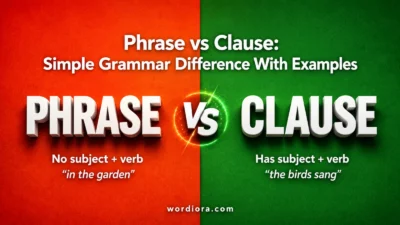
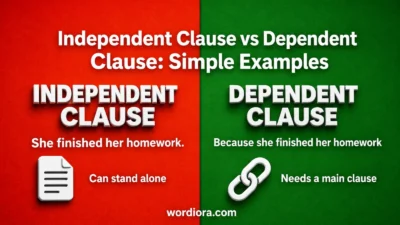
- independent clause
- dependent clause
- coordinating conjunction
- subordinating conjunction
- sentence structure
- clause relationship
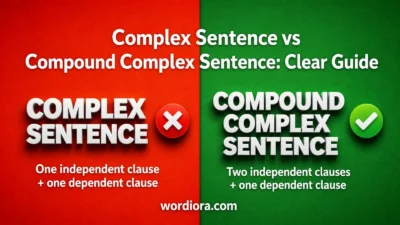
Still confused about advanced sentence structures? This simple guide on complex sentence vs compound-complex sentence explains the differences with clear examples.
FAQ
Can a sentence be both compound and complex?
Yes. A compound-complex sentence contains at least two independent clauses and at least one dependent clause.
Which is easier to read?
That depends on the context. Compound sentences often feel simpler and more direct, while complex sentences can explain relationships more clearly.
Do complex sentences always need commas?
No. Comma use depends on where the dependent clause appears in the sentence.
Are compound sentences always longer?
No. Some compound sentences are very short, while some complex sentences are quite long.
Can you start a sentence with “because”?
Yes. Starting with a dependent clause is completely correct when the sentence also includes an independent clause.
Conclusion
The difference between a compound sentence and a complex sentence comes down to clause relationships.
A compound sentence joins two equal independent clauses. A complex sentence combines one independent clause with a dependent clause that supports it.
If both parts can stand alone, you likely have a compound sentence. If one clause depends on the other for meaning, you likely have a complex sentence.
Strong writing uses both naturally. The key is choosing the structure that best matches the relationship between your ideas.