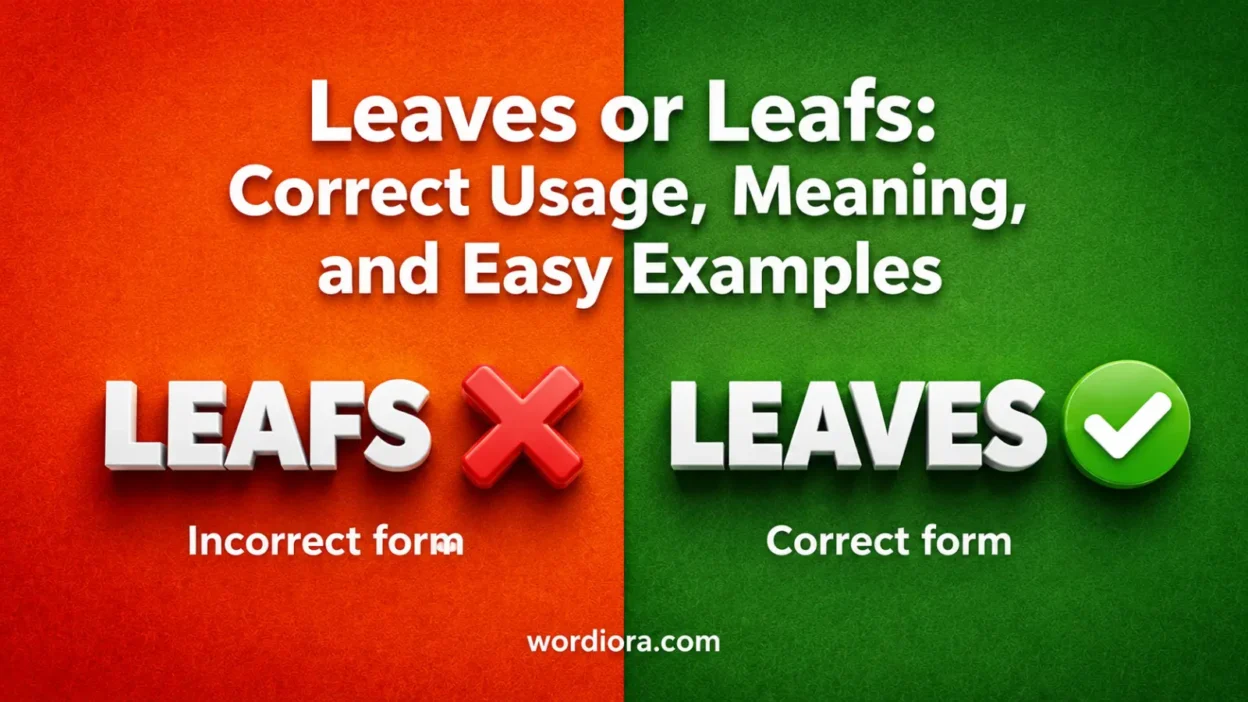
The choice between leaves or leafs can look simple, but it has one important twist. In most sentences, leaves is the correct plural of leaf. You should write “fallen leaves,” “maple leaves,” “table leaves,” and “book leaves.”
Leafs is not the normal plural noun in standard American English. Still, it can be correct in two main cases: as a verb form of leaf, as in “She leafs through the magazine,” and in proper names, such as “Toronto Maple Leafs.”
So the safest rule is this: use leaves when you mean more than one leaf. Use leafs only when it is part of a name or when it means “turns pages” or “puts out leaves.”
Quick Answer
Leaves is the correct choice when you mean more than one leaf. Say “The leaves fell from the tree,” not “The leafs fell from the tree.”
Leafs is correct as a verb: “He leafs through the report.” It also appears in proper names, such as “Maple Leafs.” Outside those cases, it usually looks wrong.
Why People Confuse Them
People confuse these words because many English nouns become plural by adding s. One dog becomes dogs. One cup becomes cups. So it feels natural to think one leaf becomes leafs.
But leaf follows a different pattern. The f changes to v, and the word becomes leaves. This same pattern appears in words like knife/knives, wolf/wolves, and shelf/shelves.
Another reason is that leafs is a real word in some contexts. A person can leaf through a book, and a plant can leaf out in spring. That makes the spelling look familiar, even though it is not the usual plural noun.
Key Differences At A Glance
| Context | Best Choice | Why |
|---|---|---|
| More than one tree leaf | leaves | Standard plural noun |
| Fall or autumn foliage | leaves | Refers to many leaves |
| Parts added to a table | leaves | Standard plural for table sections |
| Pages or sheets in a book | leaves | Traditional noun plural |
| Someone turns pages quickly | leafs | Verb form of “leaf” |
| A plant puts out leaves | leafs | Verb form of “leaf” |
| A sports team name | Leafs | Proper name spelling |
Compact comparison:
• Leaves = the normal plural noun
• Leafs = a verb form or part of a proper name
• Leaves sounds like “leevz”
• Leafs sounds like “leefs”
• In everyday writing, leaves is usually the word you need
Meaning and Usage Difference
Leaves usually means more than one leaf. A leaf can be part of a plant, a page-like sheet in a book, a removable section of a table, a hinged part of a door, or a thin sheet of metal such as gold leaf. In these noun uses, the plural is normally leaves.
Examples:
“The oak leaves turned red in October.”
“We added two leaves to the dining table.”
“The old book had several torn leaves.”
Leafs is different. It is usually the third-person singular form of the verb leaf. To leaf through something means to turn pages quickly. A plant can also leaf out, meaning it begins to grow leaves.
Examples:
“She leafs through the catalog before ordering.”
“The tree leafs out later than the others.”
Tone, Context, and Formality
Leaves is standard in casual, school, business, and formal writing. It works in everyday messages, nature writing, furniture descriptions, technical writing, and academic sentences.
Leafs sounds wrong if you use it as the plural of leaf. A sentence like “The leafs are falling” will look like a spelling mistake to most readers.
The exception is context. In “She leafs through the pages,” the word sounds natural because it is a verb. In “Toronto Maple Leafs,” the spelling is part of an official name, so you should not change it.
Pronunciation can help. Leaves is pronounced like “leevz.” Leafs is pronounced like “leefs.” The difference is small but useful.
Which One Should You Use?
Use leaves when you mean more than one leaf of almost any kind.
Choose leaves for:
tree leaves
fall leaves
maple leaves
tea leaves
table leaves
book leaves
door leaves
gold leaves
Use leafs when the word is acting as a verb.
Correct:
“She leafs through the folder every morning.”
“The young plant leafs out in warm weather.”
Use Leafs when it is part of a proper name.
Correct:
“The Toronto Maple Leafs play in the NHL.”
Do not use leafs just because the singular form is leaf. For the plural noun, leaves is the normal choice.
When One Choice Sounds Wrong
Leafs sounds wrong when you are talking about more than one plant leaf.
Wrong: “The leafs covered the sidewalk.”
Correct: “The leaves covered the sidewalk.”
It also sounds wrong for furniture.
Wrong: “Store the table leafs in the closet.”
Correct: “Store the table leaves in the closet.”
It sounds wrong for book pages or sheets.
Wrong: “The manuscript had missing leafs.”
Correct: “The manuscript had missing leaves.”
But leaves can sound wrong when you need the verb leafs.
Wrong: “She leaves through the magazine.”
Correct: “She leafs through the magazine.”
Here, leaves would make readers think of the verb leave, meaning “go away,” not the action of turning pages.
Common Mistakes and Quick Fixes
Mistake: Using leafs for tree parts.
Fix: Use leaves.
“The leaves are changing color.”
Mistake: Using leafs for table sections.
Fix: Use leaves.
“We need both table leaves for dinner.”
Mistake: Changing a proper name.
Fix: Keep the official spelling.
“Maple Leafs” stays “Maple Leafs.”
Mistake: Writing leaves through when you mean turning pages.
Fix: Use leafs through.
“She leafs through the book.”
Mistake: Thinking all words ending in f work the same way.
Fix: Learn each common plural.
Leaf becomes leaves, but roof becomes roofs.
Everyday Examples
“The leaves in our front yard are bright yellow.”
“Please rake the leaves before the rain starts.”
“She saved a few maple leaves in her journal.”
“The dining table has two removable leaves.”
“The designer used gold leaves on the frame.”
“The old Bible had thin, fragile leaves.”
“He leafs through the newspaper while drinking coffee.”
“My dad leafs through the manual before fixing anything.”
“The vine leafs out quickly once the weather warms.”
“The Toronto Maple Leafs were on TV last night.”
“Do not write ‘fall leafs’ in a school essay.”
“For most sentences, ‘leaves’ is the cleaner and safer choice.”
Dictionary-Style Word Details
Verb
• Leaves: Commonly used as the third-person singular form of the verb leave, meaning “go away” or “causes something to remain.” Example: “She leaves work at five.”
• Leafs: Used as the third-person singular form of the verb leaf. It can mean “turns pages quickly” or “puts out leaves.” Example: “He leafs through the notes.”
Noun
• Leaves: The standard plural noun form of leaf. It can refer to plant leaves, book leaves, table leaves, door leaves, or thin sheets of material.
• Leafs: Not the normal plural noun in standard American English. It may appear in proper names, such as “Maple Leafs,” where the spelling should stay unchanged.
Synonyms
• Leaves: Closest plain alternatives depend on context. For plant leaves, foliage can work when referring to leaves as a group. For some plant types, words like fronds or needles may fit, but they are not exact replacements for every leaf.
• Leafs: As a verb, closest plain alternatives include flips through, turns through, skims, or browses. These are not perfect in every sentence, but they are often close.
Clear antonyms do not fit well for the plural noun leaves. For the verb leafs through, a practical opposite might be reads carefully, but that is a context-based contrast, not a strict dictionary opposite.
Example Sentences
• Leaves: “The leaves were wet after the storm.”
• Leaves: “We added two leaves to the table before dinner.”
• Leaves: “The book’s leaves were thin and worn.”
• Leafs: “She leafs through the magazine at the checkout counter.”
• Leafs: “The plant leafs out after a few warm days.”
• Leafs: “He leafs through the contract before signing.”
Word History
• Leaves: The word comes from leaf, an old English word for a plant leaf and later also a sheet or page. The plural form leaves keeps an older English pattern where some words ending in f change to ves.
• Leafs: This form comes from adding s to the verb leaf for third-person singular present tense. It is also preserved in some proper names. Do not treat it as the regular plural noun in normal writing.
Phrases Containing
• Leaves: “fall leaves,” “autumn leaves,” “tea leaves,” “table leaves,” “book leaves,” “in full leaf,” “turn over a new leaf.”
• Leafs: “leafs through,” “leafs out,” “Toronto Maple Leafs.”
FAQs
Is it leaves or leafs?
Use leaves when you mean more than one leaf. For example, “The leaves are falling.” Use leafs only as a verb, such as “She leafs through the book,” or in a proper name like “Toronto Maple Leafs.”
What is the plural of leaf?
The plural of leaf is leaves. This is the standard form in American English. Write “tree leaves,” “fall leaves,” “tea leaves,” and “table leaves.”
Is leafs ever correct?
Yes, leafs can be correct, but not as the normal plural noun. It is correct as a verb: “He leafs through the magazine.” It also appears in proper names, such as “Maple Leafs.”
Why is the plural of leaf leaves?
In English, some nouns ending in f change to ves in the plural. That is why leaf becomes leaves, just like wolf becomes wolves and knife becomes knives.
Do you say fall leaves or fall leafs?
Say fall leaves. Since you are talking about more than one leaf, leaves is the correct plural noun. “Fall leafs” looks like a spelling mistake in standard writing.
Are table leaves or table leafs correct?
Table leaves is the correct form. A table leaf is a removable section added to make a table larger. More than one is called table leaves.
What does leafs mean?
Leafs is usually a verb form. It can mean “turns pages quickly,” as in “She leafs through the report.” It can also mean a plant begins to grow leaves, as in “The tree leafs out in spring.”
Is Toronto Maple Leafs grammatically wrong?
No. Toronto Maple Leafs is a proper name, so the spelling stays the same. Proper names do not always follow regular grammar patterns.
How do you pronounce leaves and leafs?
Leaves sounds like “leevz.” Leafs sounds like “leefs.” The sound difference can help you remember that they are not used the same way.
What is the easiest way to remember leaves vs leafs?
Use leaves for more than one leaf. Use leafs when someone turns pages or when the word is part of a name. In most everyday sentences, leaves is the correct choice.
Conclusion
The difference between leaves or leafs comes down to grammar and context. Leaves is the standard plural noun. Use it for trees, plants, tables, books, doors, and thin sheets.
Leafs is not the usual plural of leaf. Use it when it is a verb, as in “She leafs through the report,” or when it appears in a proper name, such as “Maple Leafs.”
For everyday writing, remember this simple guide: if you mean more than one leaf, write leaves. If you mean turns pages or grows leaves, write leafs.