Many English learners mix up subordinating conjunctions and relative pronouns because both connect clauses. Some words, especially “that,” can even work as both.
But they are not the same thing.
The biggest difference is simple:
- A subordinating conjunction only connects clauses.
- A relative pronoun connects clauses and also acts like a noun inside the clause.
Once you know that rule, the difference becomes much easier to spot.
Quick Answer
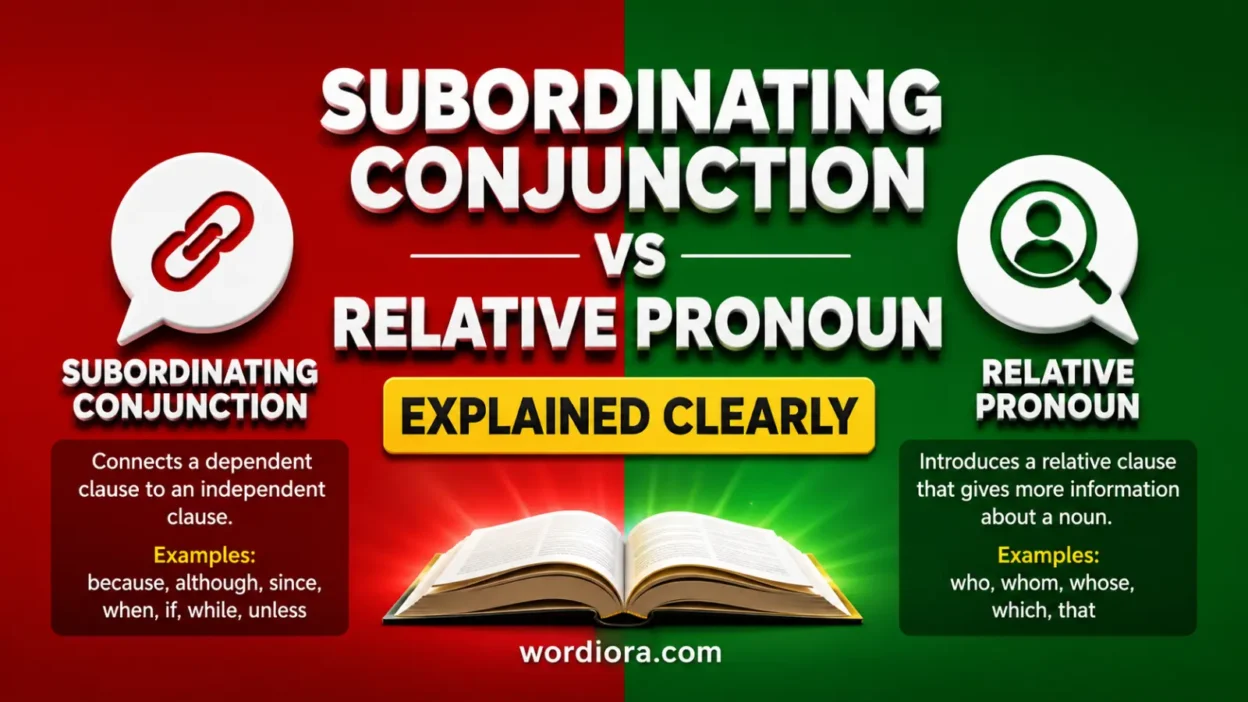
A subordinating conjunction introduces a dependent clause and shows a relationship such as time, reason, condition, or contrast.
Examples:
- because
- although
- if
- when
A relative pronoun introduces a relative clause and refers back to a noun already mentioned.
Examples:
- who
- which
- whom
- whose
- that
Compare these:
- I stayed home because it was raining.
- The movie that we watched was excellent.
In the first sentence, “because” only connects ideas.
In the second sentence, “that” connects the clause and stands for “the movie.”
Why People Confuse Them
Both terms deal with dependent clauses.
Both connect sentence parts.
And some words can belong to different grammar categories depending on the sentence.
The word “that” causes the most confusion.
Compare these:
- I know that she called.
- The phone that she bought is expensive.
In the first sentence, “that” is a subordinating conjunction. It simply introduces the clause “that she called.”
In the second sentence, “that” is a relative pronoun. It refers back to “the phone.”
That small difference changes the grammar completely.
Key Differences At A Glance
| Context | Best Choice | Why |
|---|---|---|
| Connecting a reason clause | Subordinating conjunction | Shows cause or relationship |
| Referring back to a noun | Relative pronoun | Replaces or refers to a noun |
| Introducing an adjective clause | Relative pronoun | Describes a noun |
| Showing time, condition, or contrast | Subordinating conjunction | Links ideas logically |
| Acting as subject or object in a clause | Relative pronoun | Functions inside the clause |
Quick Comparison
| Feature | subordinating conjunction | relative pronoun |
|---|---|---|
| Main job | Connect clauses | Connect clauses and refer to nouns |
| Refers to noun? | No | Yes |
| Functions inside clause? | No | Yes |
| Common examples | because, although, if | who, which, whose, that |
| Clause type | Subordinate clause | Relative clause |
Meaning and Usage Difference
A subordinating conjunction introduces a dependent clause and shows how it relates to the main clause.
Examples:
- We left early because traffic was getting worse.
- Call me if you need help.
- She smiled although she was tired.
These words explain relationships like:
- cause
- time
- condition
- contrast
A relative pronoun works differently.
It introduces a clause that describes a noun.
Examples:
- The teacher who helped me retired last year.
- I lost the jacket that I bought in Chicago.
- The restaurant which opened downtown is already popular.
Notice something important:
The relative pronoun stands for a noun inside the clause.
In:
- The teacher who helped me retired.
“Who” refers to “teacher” and acts as the subject of “helped.”
In:
- The jacket that I bought is missing.
“That” refers to “jacket” and acts as the object of “bought.”
Subordinating conjunctions do not do that.
Tone, Context, and Formality
Both forms appear in casual and formal American English.
The difference is grammatical, not really about tone.
Still, some patterns are more common in formal writing.
For example:
- The employee whom you interviewed accepted the offer.
“Whom” sounds more formal in modern US English.
In casual speech, many people would say:
- The employee who you interviewed accepted the offer.
Subordinating conjunctions usually do not change formality much.
These all sound natural in everyday English:
- because
- while
- although
- unless
One special case is “that.”
In informal speech, people often leave out “that” when it acts as a subordinating conjunction:
- I think she’s right.
Instead of:
- I think that she’s right.
But when “that” is a relative pronoun, removing it is not always possible.
Which One Should You Use?
Use a subordinating conjunction when you want to show a relationship between ideas.
Examples:
- We canceled the picnic because it started storming.
- I’ll text you after I land.
- You can go if your work is finished.
Use a relative pronoun when you want to describe a noun.
Examples:
- The woman who called earlier left a message.
- The laptop that I ordered arrived today.
- The house which sold last week needed repairs.
A useful test:
Ask yourself:
“Does this word stand for a noun?”
- If yes, it is probably a relative pronoun.
- If no, it is probably a subordinating conjunction.
When One Choice Sounds Wrong
These sentences sound wrong because the grammar role does not match.
Incorrect:
- The car because I bought is electric.
Correct:
- The car that I bought is electric.
Why? Because the clause describes “car,” so you need a relative pronoun.
Another example:
Incorrect:
- I stayed home who it was snowing.
Correct:
- I stayed home because it was snowing.
Here, the sentence needs a word showing cause, not a noun reference.
Common Mistakes and Quick Fixes
Mistake 1: Treating every connector as a conjunction
Incorrect:
- The friend which helped me moved away.
Better:
- The friend who helped me moved away.
“Who” refers to a person.
Mistake 2: Forgetting that relative pronouns have a job inside the clause
Incorrect:
- The movie because we watched was boring.
Correct:
- The movie that we watched was boring.
“That” acts as the object of “watched.”
Mistake 3: Confusing “that”
Subordinating conjunction:
- She said that she was busy.
Relative pronoun:
- The song that you played was amazing.
The first “that” only introduces a clause.
The second one refers to “song.”
Everyday Examples
- I stayed inside because the heat was unbearable.
- The neighbor who owns the blue truck moved away.
- We ordered pizza after the game ended.
- The phone that keeps freezing needs an update.
- She smiled although the meeting went badly.
- The actor whom they interviewed won an award.
- Call me when you get home.
- The dog which escaped was found two hours later.
Dictionary-Style Word Details
Verb
subordinating conjunction:
Not commonly used as a verb in standard US English.
relative pronoun:
Not commonly used as a verb in standard US English.
Noun
subordinating conjunction:
A grammatical word that introduces a dependent clause and connects it to a main clause.
relative pronoun:
A pronoun that introduces a relative clause and refers back to a noun or pronoun.
Synonyms
subordinating conjunction:
Closest plain alternatives:
- subordinator
- clause connector
No exact everyday synonym exists.
relative pronoun:
Closest plain alternatives:
- relativizer
- clause pronoun
No exact everyday synonym exists.
Example Sentences
subordinating conjunction:
- We stayed quiet because the baby was sleeping.
- I’ll go unless the weather changes.
- She called after the meeting ended.
relative pronoun:
- The student who won the contest gave a speech.
- The shoes that I ordered finally arrived.
- The artist whose mural went viral lives in Austin.
Word History
subordinating conjunction:
The term comes from traditional Latin-based grammar systems describing words that place one clause under another in importance.
relative pronoun:
The word “relative” refers to the pronoun’s relationship to a noun already mentioned in the sentence.
Phrases Containing
subordinating conjunction:
- subordinating conjunction list
- subordinate clause
- dependent clause
relative pronoun:
- relative clause
- restrictive clause
- nonrestrictive clause
FAQs
Is a relative pronoun the same as a subordinating conjunction?
No. A relative pronoun refers back to a noun and also connects a clause. A subordinating conjunction only connects clauses and shows relationships like cause, time, or condition.
Can “that” be both a subordinating conjunction and a relative pronoun?
Yes. Its role depends on the sentence.
- Subordinating conjunction: “I heard that the store closed.”
- Relative pronoun: “The store that closed was downtown.”
How can I tell whether a word is a relative pronoun?
Check whether the word refers to a noun in the sentence.
Example:
- “The teacher who helped me was kind.”
“Who” refers to “teacher,” so it is a relative pronoun.
Do subordinating conjunctions refer to nouns?
No. Subordinating conjunctions do not replace or refer to nouns. They only connect clauses.
What are common subordinating conjunctions?
Common examples include:
- because
- although
- if
- since
- while
- after
- unless
What are common relative pronouns?
Common relative pronouns include:
- who
- whom
- whose
- which
- that
Can a relative clause start with a subordinating conjunction?
Usually no. Relative clauses are normally introduced by relative pronouns such as “who,” “which,” or “that.”
Is every relative pronoun also a conjunction?
Not exactly. Relative pronouns connect clauses, but they also function as pronouns inside those clauses. That is why they are not classified as ordinary conjunctions.
Why do learners confuse subordinating conjunctions and relative pronouns?
They both introduce dependent clauses, and some words like “that” can belong to either category depending on the sentence.
Which is more common in everyday American English: “who” or “whom”?
“Who” is far more common in casual US English. “Whom” still appears in formal writing and after prepositions.
Conclusion
A subordinating conjunction and a relative pronoun may look similar, but they do different jobs.
A subordinating conjunction only connects clauses and shows relationships like cause, time, or condition.
A relative pronoun connects clauses while also referring back to a noun inside the sentence.
The easiest way to tell them apart is this:
If the word replaces or refers to a noun, it is a relative pronoun.
If it simply links ideas, it is a subordinating conjunction.
Once you start checking for that noun connection, the difference becomes much clearer.