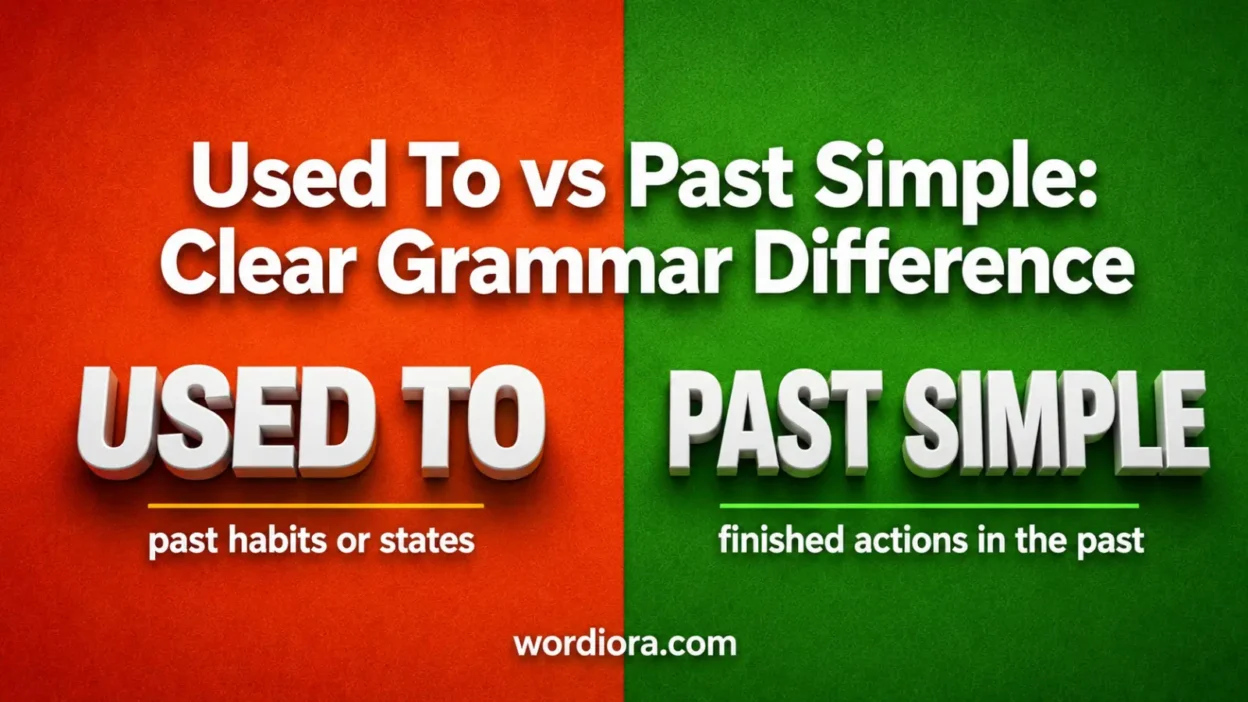
Both used to and past simple talk about the past, but they do not always do the same job. The main difference is this: used to shows a past habit or past state that is no longer true. Past simple shows a finished past action, event, or state.
So, both can be correct. The best choice depends on what you mean.
Say I used to walk to school when you mean it was a regular habit in the past and it does not happen now. Say I walked to school yesterday when you mean one finished action at a clear past time.
Quick Answer
Use used to for old habits, routines, or states that have changed.
Use past simple for completed past events, one-time actions, or a series of past actions.
Correct examples:
Used to:
I used to work nights, but now I work mornings.
Past simple:
I worked late last night.
The first sentence compares the past with now. The second sentence simply reports a finished action.
Why People Confuse Them
People confuse used to and past simple because both can describe something in the past.
For example, these two sentences are both possible:
I used to visit my grandparents every summer.
I visited my grandparents every summer.
The first sentence clearly tells us the summer visits were a past habit and probably do not happen now. The second sentence can also describe a repeated past action, but it does not strongly show that the habit has ended.
That is the key: used to carries a stronger “not now” feeling. Past simple depends more on time words and context.
Key Differences At A Glance
| Context | Best Choice | Why |
|---|---|---|
| A past habit that stopped | used to | It shows the action happened before but not now. |
| A past state that changed | used to | It shows something was true before but is not true now. |
| One finished event | past simple | It reports a completed action. |
| A story with several past actions | past simple | It moves the story forward. |
| A past routine with clear frequency words | either | Past simple can work if the repeated meaning is clear. |
| A specific past time like yesterday | past simple | Used to does not fit single completed events. |
Meaning and Usage Difference
Used to means something happened regularly in the past or was true in the past, but it is not true now.
Examples:
I used to drink soda every day.
She used to live in Denver.
There used to be a movie theater on this block.
In these sentences, the past is different from the present.
Past simple describes something that started and ended in the past. It can be one action, many actions, or a past state.
Examples:
I drank soda at lunch.
She lived in Denver for three years.
There was a movie theater on this block in 1998.
Past simple does not automatically tell us whether the situation is still true now. It simply places the action or state in the past.
Compact comparison:
- Used to: old habit or old state; usually not true now.
- Past simple: finished past action, event, story, or state.
- Used to: needs a base verb after it.
- Past simple: uses a past verb form.
- Used to: does not fit one-time events.
- Past simple: fits one-time events naturally.
Tone, Context, and Formality
Both used to and past simple are normal in everyday US English. Neither one is too formal or too casual.
Used to often sounds personal, reflective, or conversational because it compares the past with now.
Examples:
I used to hate coffee, but now I love it.
My dad used to coach my soccer team.
Past simple sounds direct and factual. It is common in stories, reports, school writing, workplace updates, and daily conversation.
Examples:
I sent the report this morning.
We moved to Austin in 2021.
She called me after dinner.
Pronunciation can matter a little in speech. In normal conversation, used to often sounds like “yoos-tuh.” In questions and negatives, the spelling usually changes after did:
Did you use to live here?
I didn’t use to like spicy food.
Which One Should You Use?
Choose used to when your sentence means “that was true before, but it is not true now.”
Use it for old habits:
I used to take the bus to work.
We used to eat dinner at 6.
Use it for old states:
He used to be shy.
This neighborhood used to be quiet.
Choose past simple when your sentence tells what happened at a finished time.
Use it for one event:
I took the bus yesterday.
We ate dinner at 6 last night.
Use it for a story:
I woke up, checked my phone, and made coffee.
Use it with dates and exact time markers:
She graduated in 2024.
They opened the store last month.
When One Choice Sounds Wrong
Used to sounds wrong when the action happened only once.
Wrong: I used to call you yesterday.
Correct: I called you yesterday.
Wrong: We used to watched a movie last night.
Correct: We watched a movie last night.
Wrong: She used to bought a new laptop.
Correct: She bought a new laptop.
Past simple can sound weak when you need to show that a past habit has changed.
Possible but less clear: I played basketball every weekend.
Clearer: I used to play basketball every weekend.
The past simple sentence may still be correct, but it does not clearly show whether you still play basketball now.
Common Mistakes and Quick Fixes
Mistake 1: Using a past verb after used to
Wrong: I used to played guitar.
Correct: I used to play guitar.
After used to, use the base verb.
Mistake 2: Using used to for a single event
Wrong: She used to visit Chicago last weekend.
Correct: She visited Chicago last weekend.
Use past simple for one finished event.
Mistake 3: Writing didn’t used to
Often corrected form: I didn’t use to like coffee.
After didn’t, use use to, not used to.
Mistake 4: Using used to for a current habit
Wrong: I used to go to the gym every morning, and I still do.
Correct: I go to the gym every morning.
Use the present simple for habits that still happen now.
Everyday Examples
Used to examples:
I used to stay up late in college.
We used to order pizza every Friday.
She used to be nervous before meetings.
There used to be a bookstore near my apartment.
My brother used to play drums in a band.
Past simple examples:
I stayed up late last night.
We ordered pizza on Friday.
She was nervous before the meeting.
There was a bookstore there years ago.
My brother played drums at the school concert.
Notice the pattern. Used to points to an old habit or old situation. Past simple reports what happened.
Dictionary-Style Word Details
Verb
used to: A verb phrase used before a base verb to describe a past habit or past state that is no longer true.
Example: I used to live near the beach.
past simple: Not a single verb, but a verb tense form. It uses past forms such as worked, went, saw, had, was, and were.
Example: I lived near the beach in 2019.
Noun
used to: Not commonly used as a noun in standard US English in this grammar meaning.
past simple: Can be used as a noun phrase naming a tense.
Example: The past simple is common in stories.
Synonyms
used to: Exact synonyms do not fully match the grammar. Closest plain alternatives include “formerly,” “once,” “in the past,” and “back then,” depending on the sentence.
past simple: Exact synonyms are limited because it names a tense. Closest plain alternatives include “simple past” and “past tense,” though “past tense” can be broader.
Clear antonyms do not fit neatly for either term because these are grammar choices, not ordinary opposite words.
Example Sentences
used to:
I used to bike to work, but now I drive.
She used to have long hair.
We used to live across from the park.
past simple:
I biked to work yesterday.
She had long hair in high school.
We lived across from the park for two years.
Word History
used to: The phrase comes from the verb use in a special grammar pattern meaning a former habit or former state. The everyday spelling issue appears because used to and use to can sound very similar in speech.
past simple: The term describes a basic past-tense form in English grammar. It is also often called the simple past. No special word-history claim is needed to use it correctly.
Phrases Containing
used to:
used to be
used to have
used to live
used to work
didn’t use to
did you use to
past simple:
past simple tense
past simple form
past simple questions
past simple negatives
past simple verbs
past simple examples
FAQs
What is the difference between used to and past simple?
Used to describes a past habit or past state that is no longer true. Past simple describes a finished action, event, or state in the past.
Example:
I used to live in Boston.
I lived in Boston in 2020.
Can I use past simple instead of used to?
Sometimes, yes. Past simple can describe repeated past actions when the context is clear.
Example:
I visited my grandparents every summer.
But used to makes it clearer that the habit belonged to the past and may not happen now.
Example:
I used to visit my grandparents every summer.
When should I use used to?
Use used to when you are talking about something that happened regularly in the past or was true before but is not true now.
Example:
She used to work at a coffee shop.
We used to live near the beach.
When should I use past simple?
Use past simple for finished past actions, one-time events, dates, stories, and completed situations.
Example:
I called her yesterday.
They moved to Chicago last year.
Is “I used to played” correct?
No. After used to, use the base form of the verb.
Incorrect: I used to played soccer.
Correct: I used to play soccer.
Is “didn’t used to” correct?
In standard writing, use didn’t use to, not didn’t used to.
Correct: I didn’t use to like coffee.
Less standard: I didn’t used to like coffee.
Can used to describe one event?
No. Used to is not for one-time events. Use past simple instead.
Incorrect: I used to went to New York last weekend.
Correct: I went to New York last weekend.
Does used to always mean something stopped?
Usually, yes. Used to strongly suggests that the habit or state is no longer true.
Example:
I used to eat fast food every day.
This suggests I do not eat it every day now.
Can past simple describe habits?
Yes. Past simple can describe past habits, especially with words like always, often, every day, or every summer.
Example:
We played outside every afternoon.
But used to makes the “past habit, not now” meaning clearer.
Which is better: used to or past simple?
Use used to for old habits or old states. Use past simple for finished past actions or specific past times.
Example:
I used to ride my bike to school.
I rode my bike to school yesterday.
Conclusion
Use used to when you want to show a past habit or past state that has changed. It helps the reader understand “that was true before, but not now.”
Use past simple when you want to describe a finished past action, a one-time event, a past state, or the main actions in a story.
The easiest test is this: if your sentence means “before, but not now,” choose used to. If your sentence means “this happened in the past,” choose past simple.