Last Updated: July 27, 2026
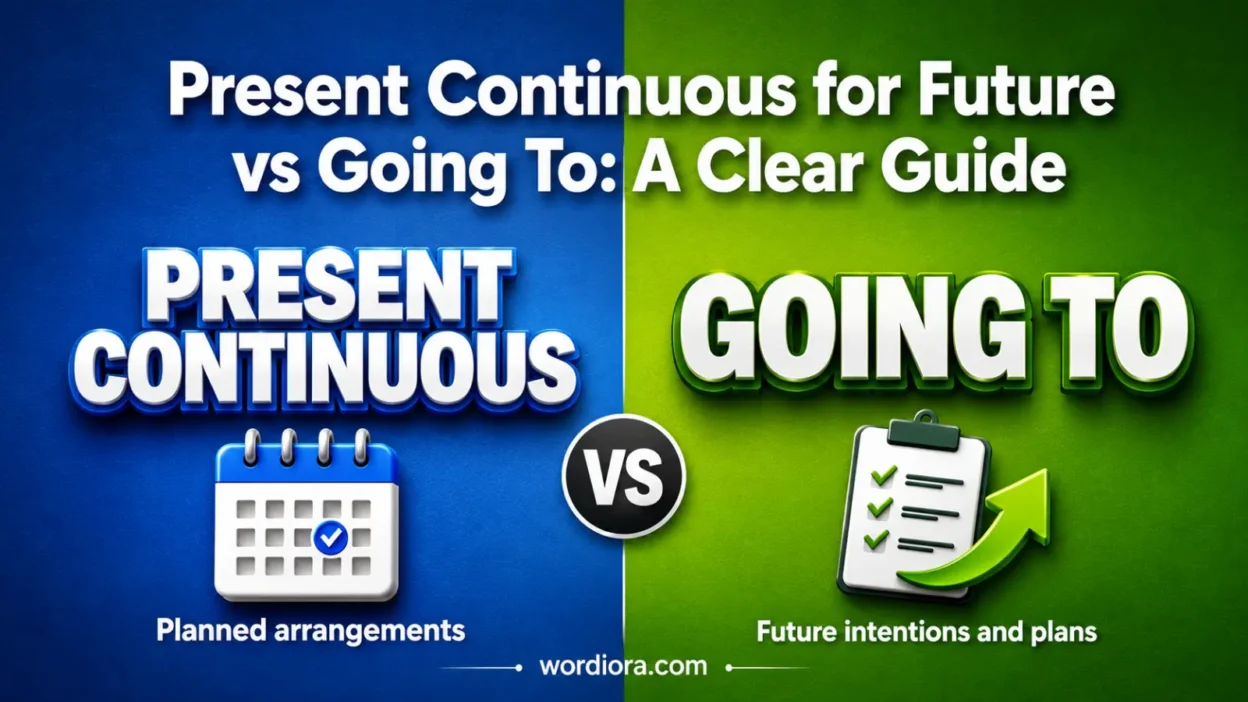
Both present continuous for future and going to can talk about future plans. The difference is not about which one is “more future.” It is about how fixed, arranged, or intended the future action feels.
Use present continuous for future when the plan sounds arranged. A time, place, ticket, meeting, or shared agreement is usually involved.
Use going to when you want to show an intention, a plan already in your mind, or a prediction based on what you can see now.
So, I’m meeting Ava at 6 sounds arranged. I’m going to call Ava later sounds like an intention.
Quick Answer
Use present continuous for future for plans that are already arranged.
Example: I’m flying to Denver on Friday.
This suggests the trip is set. Maybe the ticket is booked.
Use going to for intentions, future plans, and predictions.
Example: I’m going to start exercising next week.
This shows a plan or intention, but it may not be fully arranged yet.
In many everyday sentences, both can work.
Example:
I’m seeing my dentist tomorrow.
I’m going to see my dentist tomorrow.
The first sounds more like an appointment. The second still works, but it stresses the plan more than the arrangement.
Why People Confuse Them
People confuse these forms because both can describe future plans that were decided before speaking.
That overlap is real. English does not have only one future form. Speakers choose the form that best matches the situation.
The confusion grows because present continuous usually describes something happening now.
Example: I’m eating lunch.
But with a future time phrase, it can point to the future.
Example: I’m eating lunch with Mia tomorrow.
The word going also causes confusion because it can describe movement.
Example: I’m going to the store.
But in I’m going to call you, going to is a future form, not physical movement.
Key Differences At A Glance
| Context | Best Choice | Why |
|---|---|---|
| A fixed appointment | Present continuous for future | The time or plan is arranged |
| A personal intention | Going to | It shows what you plan to do |
| A prediction from evidence | Going to | It points to what seems likely now |
| A meeting with another person | Present continuous for future | It sounds confirmed with someone |
| A general future goal | Going to | It may not be arranged yet |
| A travel booking | Present continuous for future | It often suggests tickets or a schedule |
| A casual spoken plan | Going to | It sounds natural in everyday speech |
Compact comparison:
- Present continuous for future: arranged, scheduled, shared, fixed.
- Going to: intended, planned, expected, likely.
- Overlap: both can work for future plans.
- Main warning: do not use present continuous for future predictions.
Meaning and Usage Difference
Present continuous for future uses am/is/are + -ing verb with future meaning.
Examples:
I’m meeting Jordan after work.
She’s starting her new job Monday.
We’re leaving at 7 a.m.
These sentences sound like the details are already set.
Going to uses am/is/are going to + base verb.
Examples:
I’m going to meet Jordan after work.
She’s going to start her new job soon.
We’re going to leave early.
These sentences focus more on intention or expected action.
For predictions, going to is the better choice.
Correct: Look at those clouds. It’s going to rain.
Wrong: It’s raining tomorrow if you mean a prediction from clouds right now.
The present continuous can talk about future arrangements, not simple guesses about what may happen.
Tone, Context, and Formality
Both forms are common in American English. Neither is too formal or too casual by itself.
Present continuous for future often sounds more definite. It works well when the listener expects real details.
Example: I’m interviewing with the company on Thursday.
That sounds more fixed than:
I’m going to interview with the company soon.
Going to is very natural in speech and everyday writing. It is useful when the plan is real but not fully arranged.
Example: I’m going to clean the garage this weekend.
In relaxed speech, people often pronounce going to like gonna. That is fine in casual talk, but in standard writing, use going to unless you are writing dialogue or a very informal message.
Pronunciation does not change the grammar choice. Going to is the careful form. Gonna is the relaxed spoken form.
Which One Should You Use?
Ask one question: Is the future action already arranged?
Use present continuous for future when the answer is yes.
Examples:
I’m meeting my advisor at 2.
We’re having dinner with my parents tonight.
They’re flying to Chicago tomorrow morning.
Use going to when the plan is more about intention.
Examples:
I’m going to study after dinner.
We’re going to look for a new apartment.
They’re going to try a different route.
Use going to for evidence-based predictions.
Examples:
The glass is on the edge. It’s going to fall.
The sky is dark. It’s going to storm.
A simple rule works most of the time: arranged event = present continuous; intention or prediction = going to.
When One Choice Sounds Wrong
Present continuous for future sounds wrong when there is no future time or clear future context.
Unclear: I’m meeting Sam.
Future: I’m meeting Sam tomorrow.
Without tomorrow, tonight, next week, or another clear clue, the sentence may sound like it is happening now.
Present continuous for future also sounds wrong for many predictions.
Wrong: That ladder is falling soon.
Better: That ladder is going to fall.
The second sentence shows a prediction based on present evidence.
Going to can sound weaker when the event is clearly fixed.
Okay: I’m going to see the dentist at 3.
More natural for an appointment: I’m seeing the dentist at 3.
The first is not wrong. The second simply sounds more like a confirmed appointment.
Common Mistakes and Quick Fixes
Mistake 1: Using present continuous with no future clue.
Weak: I’m visiting my aunt.
Better: I’m visiting my aunt this weekend.
Mistake 2: Using present continuous for a prediction.
Wrong: Look out! You’re dropping that plate.
Better: Look out! You’re going to drop that plate.
Mistake 3: Treating going to as always less certain.
Not true. Going to can sound very certain when there is strong evidence.
Example: He’s going to win. He is ten points ahead.
Mistake 4: Thinking both forms always mean the same thing.
They often overlap, but not always.
I’m getting married next month sounds arranged.
I’m going to get married someday sounds like a future goal.
Everyday Examples
Present continuous for future:
I’m taking my car to the shop at 8.
The appointment is arranged.
We’re meeting the realtor on Saturday.
The meeting is set.
She’s flying to Austin tomorrow.
The travel plan sounds booked.
They’re having a team lunch Friday.
The event is planned with others.
Going to:
I’m going to call my brother after work.
That is my intention.
We’re going to repaint the kitchen.
That is our plan.
She’s going to apply for the job.
That is what she has decided.
It’s going to be a long day.
That is a prediction or expectation.
In daily speech, the best choice depends on what you want to stress: the fixed arrangement or the planned intention.
Dictionary-Style Word Details
Verb
Present continuous for future: This is not a single verb. It is a verb form: am/is/are + -ing verb used with future meaning.
Example: I’m meeting my tutor tomorrow.
Going to: In this comparison, going to is part of the future structure am/is/are going to + base verb.
Example: I’m going to meet my tutor tomorrow.
Noun
Present continuous for future: Not commonly used as a noun in standard US English. It is a grammar label for a future use of the present continuous form.
Going to: Not commonly used as a noun in this future meaning. It is a structure used before a base verb.
Synonyms
Exact synonyms do not fully fit because these are grammar forms, not ordinary vocabulary words.
Present continuous for future — closest plain alternatives: arranged future plan, fixed plan, scheduled plan.
Going to — closest plain alternatives: intend to, plan to, be about to, expect to.
Clear antonyms do not fit neatly because grammar forms do not have true opposites in the same way nouns and adjectives do.
Example Sentences
Present continuous for future:
I’m seeing the doctor at 9 tomorrow.
We’re driving to San Diego this weekend.
They’re meeting us outside the theater.
She’s starting classes next Monday.
Going to:
I’m going to see the doctor if this cough gets worse.
We’re going to drive instead of fly.
They’re going to meet us later.
She’s going to start classes next year.
Word History
Present continuous for future: The phrase is a modern grammar label. It describes a current English use of the present continuous form for future arrangements. A precise origin date is not needed for correct use.
Going to: The future structure comes from the verb go plus to, but in modern use it often no longer means physical movement. In I’m going to call, the focus is future intention, not travel.
Phrases Containing
Present continuous for future:
- present continuous for future arrangements
- present continuous with future meaning
- present continuous for future plans
- present continuous time expressions
Going to:
- be going to
- going to + base verb
- going to future
- gonna, in informal speech
- going to happen
- going to do
FAQs
Is present continuous for future the same as going to?
Not always. Both can talk about future plans, but present continuous for future usually sounds more arranged or scheduled. Going to often shows an intention, plan, or prediction.
When should I use present continuous for future?
Use present continuous for future when the plan is already arranged.
Example: I’m meeting my teacher at 3 p.m.
This sounds like the time and meeting are already fixed.
When should I use going to?
Use going to when you want to talk about an intention, plan, or prediction.
Example: I’m going to study tonight.
This shows what you plan to do.
Can both forms be correct in the same sentence?
Yes, sometimes both are correct.
Example:
I’m visiting my cousin this weekend.
I’m going to visit my cousin this weekend.
The first sounds more arranged. The second focuses more on the plan or intention.
Which is better: I’m meeting him tomorrow or I’m going to meet him tomorrow?
Both can be correct. I’m meeting him tomorrow sounds like the meeting is already arranged. I’m going to meet him tomorrow sounds like you plan to meet him.
Can I use present continuous for predictions?
Usually, no. Use going to for predictions based on what you can see now.
Correct: It’s going to rain.
Not natural: It’s raining tomorrow if you mean a prediction.
Does present continuous for future need a time word?
Most of the time, yes. A future time word helps avoid confusion.
Example: I’m leaving tomorrow.
Without tomorrow, the sentence may sound like the action is happening now.
Is gonna the same as going to?
Gonna is the casual spoken form of going to. It is common in conversation, but going to is better for school writing, work emails, and formal text.
Which form is more formal?
Both forms are normal in American English. Going to is common in speech and writing. Present continuous for future can sound a little more definite because it often points to a fixed arrangement.
What is the easiest way to choose between them?
Use this simple test: if the plan is arranged, use present continuous for future. If it is an intention or prediction, use going to.
Example:
Arranged: I’m seeing the doctor tomorrow.
Intention: I’m going to exercise more this month.
Conclusion
Use present continuous for future when the future action is arranged, scheduled, or fixed with another person, place, or time.
Use going to when you mean an intention, a plan, or a prediction based on present evidence.
The two forms can overlap, especially with personal plans. Still, the clearest difference is this: present continuous for future sounds arranged; going to sounds intended or expected.
When you are unsure, look for details. If the plan has a time, place, appointment, ticket, or agreement, present continuous usually sounds natural. If the plan is still mainly in your mind, or if you are predicting what will happen, going to is usually the better choice.